Wall Street’s SpaceX Mistake

A few weeks ago, I told you Wall Street was making a familiar mistake…
SpaceX (NASDAQ: SPCX) had fallen below its $135 IPO price, the excitement surrounding its historic public debut was evaporating, and the critics were getting louder.
The stock was too expensive. Expectations were unrealistic. Elon Musk was promising too much. The company was spending too aggressively…
And investors willing to pay a premium for its future were supposedly setting themselves up for disappointment.
But I was pretty sure I’d heard this story before…
And in fact, I had heard it before. I’d heard almost the exact same story about Palantir.
And that’s why I told Wealth Daily readers that Wall Street might be making the same mistake twice.
Less than a month later, we’ve got our first piece of evidence…
SpaceX bottomed at an intraday low of $104.83 on August 3.
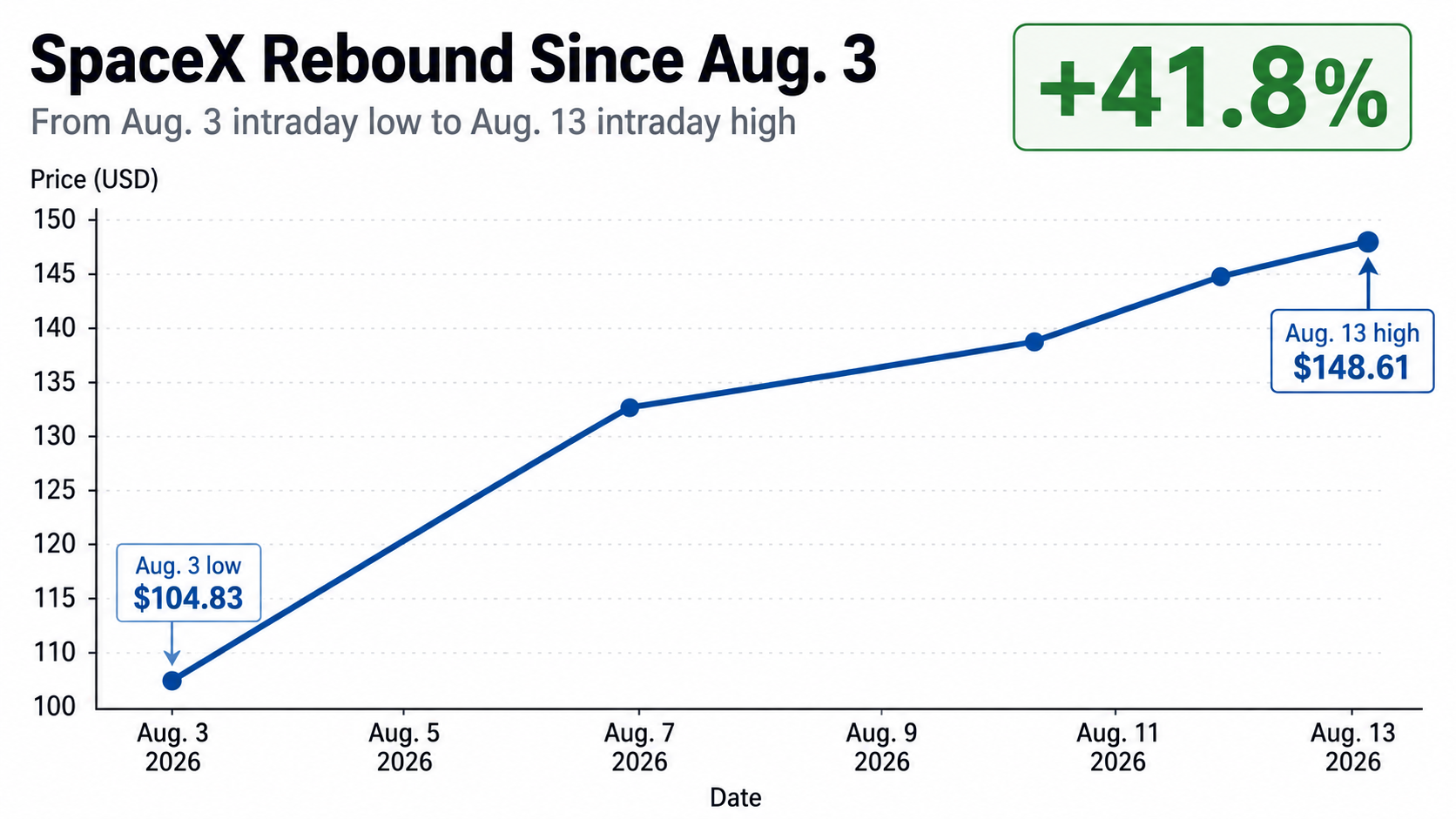
Since then, the stock has traded as high as $148.61, representing a rebound of roughly 42% in less than two weeks.
That doesn’t mean the stock will never fall again.
But it does mean investors who listened to the doom-and-gloom narrative at exactly the wrong moment missed one heck of a rally.
And I think there’s a much bigger lesson here…
Wall Street Keeps Looking Backward
The problem with companies like SpaceX and Palantir is that they don’t fit neatly into the spreadsheets Wall Street analysts use to value normal businesses.
Palantir had the same problem after it went public…
Investors looked at its existing government contracts, its valuation, its spending, and its relatively small commercial business and decided the numbers didn’t justify the price.
What those calculations had trouble capturing was what Palantir could become…
Its software eventually spread much further into commercial America.
Artificial intelligence dramatically expanded the usefulness of its platform.
Revenue accelerated. Margins improved. And a company that critics once considered ridiculously expensive became one of the defining winners of the AI boom.
And now SpaceX is following a surprisingly similar script…
Morningstar, for example, valued SpaceX at just $63 per share before its IPO. That’s less than half the $135 offer price!
Its analysts argued that even fairly optimistic assumptions had trouble justifying the valuation.
And to be clear, there are legitimate risks here…
SpaceX is spending enormous amounts of money.
Starship remains an expensive development project.
AI infrastructure requires staggering capital expenditures.
And the company’s valuation assumes a tremendous amount of future growth.
But that’s precisely the point…
You can’t value a company building several potentially enormous new businesses by pretending those businesses never get enormous.
Then SpaceX Started Delivering
SpaceX’s first public earnings report gave investors a glimpse of why we remained bullish despite Wall Street’s doom-and-gloom attitude…
Second-quarter revenue jumped 92% year over year, to roughly $7.8 billion.
Starlink subscribers doubled to 12 million.
The Connectivity business grew revenue 66% and operating income 79%.
SpaceX also disclosed $14.1 billion in contracted cloud-services sales and more than $6 billion in multi-year U.S. government contracts for Starshield.
That’s not a science experiment. That’s a rapidly scaling collection of businesses.
You see, SpaceX isn’t just launching (and catching) rockets anymore…
Yes, it operates the world’s most important commercial launch infrastructure.
But it also owns a massive satellite communications network.
And it’s expanding into direct-to-device connectivity.
It also has a growing national-security business.
And it’s pushing aggressively into AI infrastructure.
Meanwhile, Starship has the potential to dramatically lower the cost of moving equipment into orbit.
And that last piece is especially important…
Lower launch costs don’t merely make SpaceX more profitable. They expand the number of things that become economically possible in space.
More satellites, more communications infrastructure, more Earth observation, more manufacturing, more research, more data infrastructure, more defense applications, and, eventually, entirely new industries that would be prohibitively expensive under today’s launch economics.
That’s why I’ve said repeatedly that the civilian space economy could ultimately dwarf the military side of the business.
SpaceX isn’t simply competing for a bigger slice of today’s space economy. It’s helping make the pie bigger.
The Crowd Changed Its Mind Fast
Markets have a wonderful way of humbling people who confuse current conditions with permanent ones…
SpaceX shares peaked above $225 shortly after their June debut before plunging by more than half to that August 3 low.
At the bottom, pessimism was everywhere. But then the fundamental story started overpowering the narrative…
SpaceX delivered enormous revenue growth. Starlink kept expanding. Its huge insider share unlock arrived without the avalanche of selling investors had feared.
And the company continued announcing progress across communications, launches, government programs, and AI.
The shares subsequently pushed back through their $135 IPO price for the first time in nearly a month.
And suddenly a stock investors were being warned away from near $105 was trading above $145.
It’s funny how quickly Wall Street can change its tune, isn’t it?
But this isn’t really about taking a victory lap…
It’s about recognizing a pattern.
The biggest investment opportunities rarely look comfortable before everybody recognizes them.
By the time the revenue is obvious, the business model is proven, the risks have disappeared, and every analyst agrees about the future, much of the opportunity has already been priced into the stock.
Palantir taught many investors that lesson. And SpaceX may be teaching it again.
The Best Free Investment You’ll Ever Make
Join Wealth Daily today for FREE. We’ll keep you on top of all the hottest investment ideas before they
hit Wall Street. Become a member today, and get our latest free report: “The $10 Trillion AI Infrastructure Boom.”
It contains full details on why money managers are overpaid and provides you with
tools for growing your wealth.On your own terms. No fees, no commission.
SpaceX Isn’t Even My Favorite Space Investment
And here’s the part that should really get your attention…
As bullish as my team and I are on SpaceX, there are three other space companies we like even more.
Not because they’re bigger… They’re not.
Not because they’re safer… They aren’t.
But because they’re positioned in some of the fastest-growing corners of the emerging space economy while receiving only a fraction of SpaceX’s attention.
That’s exactly the kind of setup we’re always looking for.
SpaceX has already become one of the most valuable companies on Earth.
It can still generate tremendous returns if Musk and his team execute, but moving a company of that size substantially higher requires creating hundreds of billions — or even trillions — of dollars in additional value.
But smaller companies don’t face that mathematical hurdle…
A relatively small contract, technology breakthrough, production ramp, or surge in demand can completely transform their businesses.
That’s where things can get really interesting for investors…
Because our team has identified three lesser-known space stocks we believe could offer even greater upside than SpaceX as this new space economy develops.
We’ve put the complete story together in a special report explaining what each company does, why we think its particular corner of the space economy is about to explode, and why investors should have these three stocks on their radar (and in their portfolio) right now.
Click here to get the report and discover our three favorite space stocks today.
Because if Wall Street really is repeating its Palantir mistake with SpaceX, I don’t think SpaceX will be the last opportunity it misses.
In fact, I’m convinced the biggest surprises are still ahead.
To your wealth,

Jason Williams
 @TheReal_JayDubs
 Angel Research on Youtube
After graduating Cum Laude in finance and economics, Jason designed and analyzed complex projects for the U.S. Army. He made the jump to the private sector as an investment banking analyst at Morgan Stanley, where he eventually led his own team responsible for billions of dollars in daily trading. Jason left Wall Street to found his own investment office and now shares the strategies he used and the network he built with you. Jason is the founder of Main Street Ventures, a pre-IPO investment newsletter; the founder of Future Giants, a nano cap investing service; and authors The Wealth Advisory income stock newsletter. He is also the managing editor of Wealth Daily. To learn more about Jason, click here.
Want to hear more from Jason? Sign up to receive emails directly from him ranging from market commentaries to opportunities that he has his eye on.
The Best Free Investment You'll Ever Make
We never spam! View our Privacy Policy
After getting your report, you’ll begin receiving the Wealth Daily e-Letter, delivered to your inbox daily.
Angel Publishing Investor Club Discord - Chat Now
Jason Williams Premium
Introductory

Advanced


