Buy the Dip. China Is.

Beijing Is Preparing for the MoneyQuake. Are You?
There’s an old saying on Wall Street:
Watch what they do. Not what they say.
And right now, halfway around the world, China is doing something that every American investor should be paying attention to.
It’s buying gold. And lots of it.
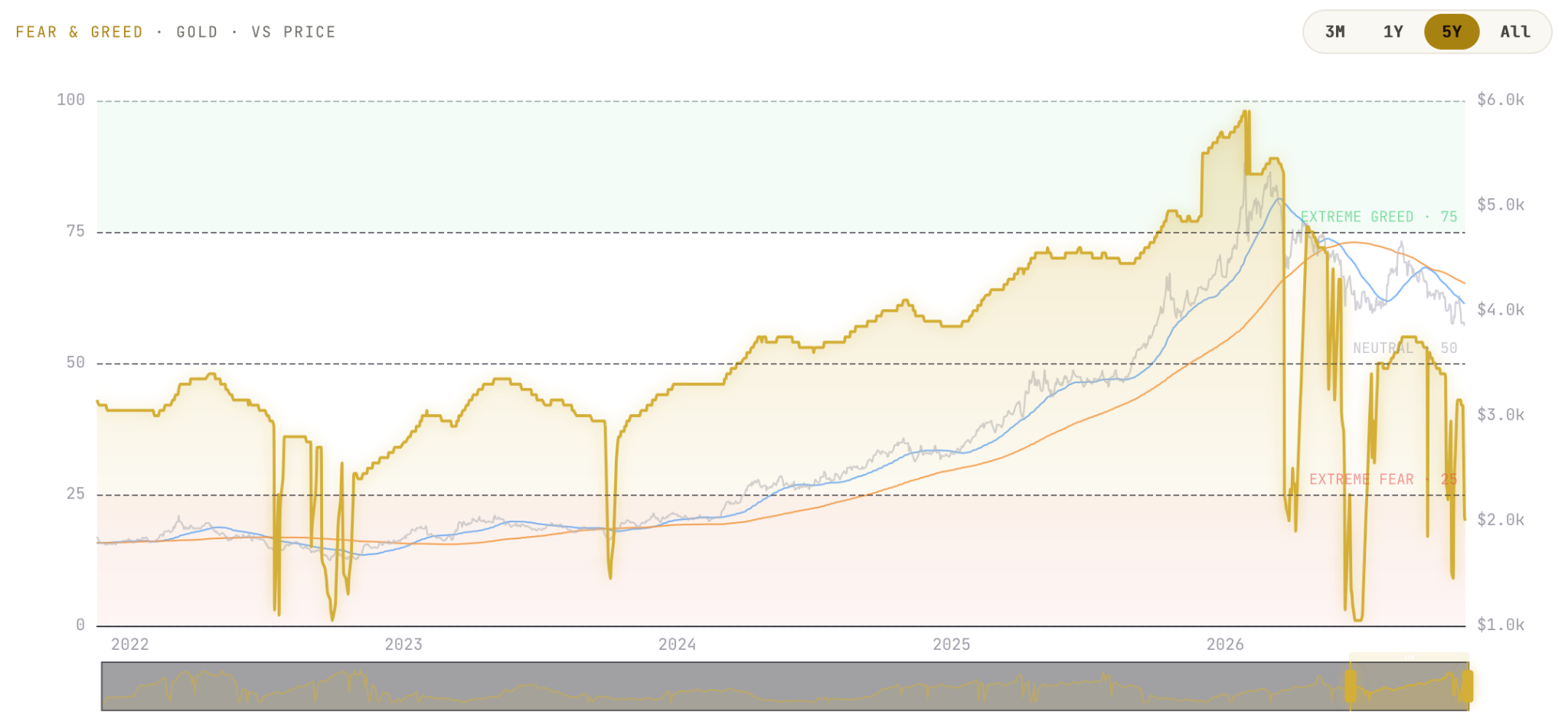
I’ve been telling you for years to follow the Gold Fear & Greed Index. Whenever gold reaches fear or extreme fear levels, it’s time to buy. Or at least to start looking to buy.
Not a few bars here and there. Not a few million dollars’ worth.
We’re talking about a systematic accumulation of one of the oldest and most trusted forms of money in human history.
And here’s the fascinating part.
China isn’t waiting for gold prices to go higher. It’s taking advantage of lower prices to accumulate more.
Sound familiar?
It should.
Because that’s precisely what I’ve been telling my readers to do during the recent market turmoil.
Buy the dip.
And apparently, Beijing agrees.
24 Months. No Signs of Stopping.
In October, China’s central bank added another 830,000 ounces of gold to its reserves.
That extended its buying streak to an astonishing 24 consecutive months.
Two full years.
China’s officially reported gold reserves now stand at approximately 2,435 metric tons.
And consider this.
During October, the reported dollar value of China’s gold holdings actually declined from approximately $323.5 billion to $306.4 billion as gold prices retreated.
Yet China added another 25.8 metric tons.
Think about what that means. While short-term traders were watching prices fall, Beijing was accumulating more physical gold.
China wasn’t necessarily trying to call the bottom. It was executing a longer-term strategy. And that’s a lesson investors would be wise to understand.
Because when you believe an asset has a much higher long-term value, a temporary price decline isn’t necessarily a reason to panic.
It’s an opportunity.
The Best Free Investment You’ll Ever Make
Join Gold World today for FREE. Get the latest insight on gold, silver, and precious metals delivered straight to your inbox. When you become a member today, you’ll get our latest free report: “The #1 Golden Token to Buy Now.” Don’t Delay!
After getting your report, you’ll begin receiving the Gold World e-Letter, delivered to your inbox daily.
Buy the dip. China is.
But here’s the trillion-dollar question.
Why?
Why is the world’s second-largest economy so determined to accumulate a metal that many Western economists spent decades dismissing as an outdated relic?
I believe the answer has everything to do with what I’ve been calling the MoneyQuake.
The Two Conjoined Twins
Longtime readers know that my MoneyQuake thesis revolves around two extraordinary economic transformations occurring simultaneously.
I call them the Conjoined Twins.
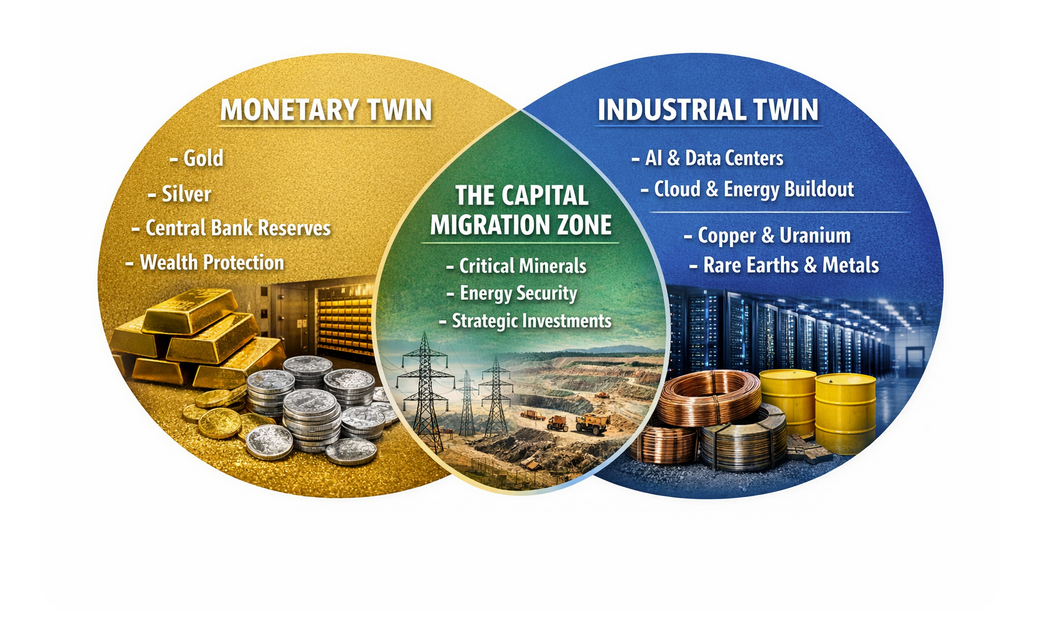
The first is the Monetary Twin.
It encompasses gold, silver, currency debasement, sovereign debt, the international monetary system, and the search for alternative stores of wealth.
The second is the Industrial Twin.
That’s the unprecedented global buildout of artificial intelligence, data centers, electrification, robotics, energy infrastructure, and the critical minerals required to power everything.
These two transformations are interconnected.
And China provides a remarkable real-world example of how they overlap.
On the monetary side, Beijing is accumulating gold. On the industrial side, China has developed enormous capabilities in the production, processing, and consumption of strategic metals, including silver.
Gold protects financial wealth. Silver helps power industrial wealth.
Two metals. Two transformations. One MoneyQuake.
And China appears determined to position itself for both.
China Knows Something About the Dollar
To understand China’s motivation, we need to revisit February 2022.
When Russia invaded Ukraine, Western governments responded with sweeping financial sanctions, including restrictions that immobilized a substantial portion of Russia’s central-bank reserves.
Imagine watching that unfold from Beijing.
Suddenly, an uncomfortable reality became impossible to ignore.
A country’s foreign currency reserves aren’t necessarily beyond the reach of another country’s financial system.
And if you’re China, with enormous exposure to dollar-denominated assets, that presents a strategic vulnerability.
Gold offers something different.
Physical bullion held within your own borders isn’t a promise from Washington.
Now, I’m not suggesting China is about to abandon the dollar tomorrow.
The dollar remains deeply embedded in global trade and finance. But Beijing doesn’t need to abandon it to reduce its dependence on it.
It can diversify gradually. And that’s exactly what its reported gold purchases suggest.
According to the World Gold Council, gold represented approximately 8.5% of China’s official reserves at the end of September 2026.
That leaves considerable room for additional diversification if Beijing chooses to increase that allocation.
In fact, some analysts have suggested China could eventually hold 5,000 metric tons of gold.
That’s not an official Chinese target.
But consider the mathematics.
At approximately 2,435 tons today, reaching 5,000 tons would require another 2,565 tons.
That’s roughly 82.5 million additional troy ounces.
At an illustrative gold price of $5,000 per ounce, we’re talking about more than $412 billion worth of gold.
And that’s just one country.
Now imagine other central banks pursuing similar diversification strategies. That’s the kind of structural demand that could reshape the gold market for years.
Silver: China’s Other Strategic Metal
But here’s where the story becomes even more interesting. China’s interest in precious metals doesn’t end with gold.
Silver occupies a particularly important position in the MoneyQuake because it straddles both Conjoined Twins.
It’s a precious metal with thousands of years of monetary history.
But unlike gold, silver is also consumed extensively by modern industry in solar panels, electronics, electric vehicles, electrical connections, and power infrastructure.
Technologies central to the industrial transformation I’ve been describing.
China’s BYD: The Silver-Hungry Giant
And if you want to understand just how important silver has become to China’s industrial ambitions, consider one company.
BYD.
China’s electric-vehicle powerhouse has become one of the largest automakers on the planet.
In 2025 alone, BYD sold approximately 4.5 million passenger vehicles, including more than 2.25 million fully electric vehicles.
Now, here’s where things get interesting.
According to industry estimates, a battery-electric vehicle can contain approximately 25 to 50 grams of silver, while plug-in hybrids may use roughly 20 to 40 grams.
Silver is essential to numerous electrical components, including power electronics, switches, electrical contacts, and battery-management systems.
Do the math.
Based on BYD’s 2025 vehicle sales and those estimated silver-content ranges, BYD alone could account for approximately 3.3 million to 6.6 million ounces of annual silver demand.
The midpoint?
Nearly 5 million ounces of silver.
Every year.
And remember, that’s just ONE Chinese automaker.
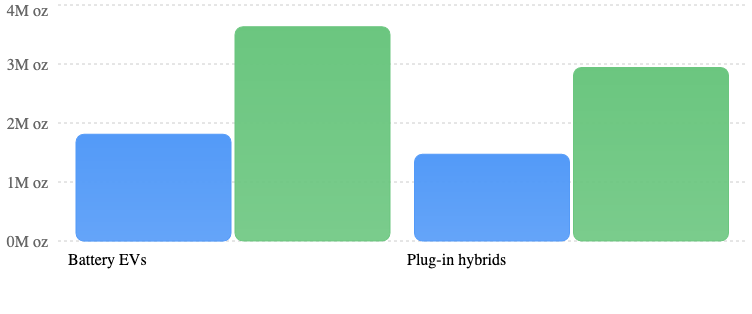
■ Low estimate
■ High estimate
*** Calculated using 25–50 g per battery EV and 20–40 g per plug-in hybrid. It doesn’t include the silver consumed by China’s other EV manufacturers. Or its massive solar-panel industry.
Now consider the bigger picture.
While China’s central bank is accumulating gold to diversify its monetary reserves, its industrial giants are consuming silver to manufacture the technologies of tomorrow.
One metal helps protect financial wealth.
The other helps build industrial wealth.
That’s the MoneyQuake’s two Conjoined Twins in action.
And it’s one more reason I believe investors should pay close attention when precious-metal prices retreat.
Because while Wall Street worries about the next dip, China’s long-term demand for these metals isn’t going away overnight.
Think about it: China dominates global solar manufacturing and plays an enormous role in silver refining and international trade.
And the global silver market is already facing structural supply pressure.
According to the Silver Institute’s November 2026 outlook, the market is headed toward its sixth consecutive annual supply deficit.
The projected deficit for 2026 is approximately 35 million ounces, with cumulative deficits from 2021 through 2026 estimated at 746 million ounces.
That’s an enormous imbalance.
Now, there’s an important distinction here.
Unlike gold, China’s official silver stockpiles aren’t transparently reported as central-bank monetary reserves. And China’s strong silver exports don’t support claims that Beijing has simply shut off international supplies.
But its industrial position gives it a powerful interest in securing access to silver.
And that makes silver especially fascinating.
Gold is increasingly important to monetary diversification.
Silver is important to both investment demand and the physical infrastructure of the next industrial age.
That’s why I’ve argued that the two Conjoined Twins could contribute to a historic repricing of precious metals.
The Biggest Mistake Investors Can Make
Now, let’s bring this back to the recent sell-off.
Because there’s something almost comical about the difference between how investors react to falling prices and how long-term accumulators behave.
When gold falls, speculators panic. When silver retreats, traders rush for the exits. Financial television starts asking whether the bull market is over.
Meanwhile, China keeps buying gold.
Twenty-four consecutive months. And counting.
Beijing’s buying doesn’t guarantee prices will rebound tomorrow. Nor does it mean every dip is automatically a bargain.
But it illustrates the difference between trading headlines and building a strategic position.
And it brings me back to a prediction I’ve made that some readers undoubtedly consider outrageous.
$48,571 gold.
That’s my long-term gold price target, based on the possibility of an extraordinary monetary repricing comparable in magnitude to the great gold bull market of the 1970s.
It’s a scenario, not a guarantee.
But if the MoneyQuake unfolds as I expect, today’s price volatility could eventually look like little more than a footnote.
China’s accumulation is one piece of evidence supporting the broader monetary transformation — not proof of my target.
Still, I find its behavior revealing.
The world’s second-largest economy is steadily accumulating an asset that cannot be printed, created through deficit spending, or manufactured by a central bank.
And it’s doing so while that asset experiences substantial price volatility.
So here’s my question.
If China believes gold deserves a larger place in its national reserves, shouldn’t investors at least consider what role precious metals deserve in their own portfolios?
Because while the financial media obsesses over the next Federal Reserve announcement, Beijing is playing a much longer game.
And when prices fall, China doesn’t appear to be running away from gold.
It’s buying more.
Buy the dip. China is.
And if my MoneyQuake thesis proves correct, the greatest mistake investors make may not be buying gold and silver too early.
It may be waiting until everyone else finally understands why they matter.
Get to the good, green grass first…
The Prophet of Profit,

Brian Hicks
 Check us out on YouTube!
Brian is a founding member and President of Angel Publishing. He writes about general investment strategies for Wealth Daily and Energy and Capital. Brian is the managing editor and investment director of R.I.C.H Report (Retired Independent Carefree Healthy), New World Assets and Extreme Opportunities. For more on Brian, take a look at his editor’s page.
The Best Free Investment You'll Ever Make
We never spam! View our Privacy Policy
After getting your report, you’ll begin receiving the Wealth Daily e-Letter, delivered to your inbox daily.
Angel Publishing Investor Club Discord - Chat Now
Brian Hicks Premium
Introductory

Advanced


