While Xi Smiled for the Cameras, China Was Buying Gold

Last week, Chinese President Xi Jinping walked through the doors of the White House.
There were handshakes. Military honors. A state dinner.
And AI-generated memes were all the rage for a couple of days.
President Trump even presented Xi with a custom-made statue of a bald eagle — the quintessential symbol of American power.
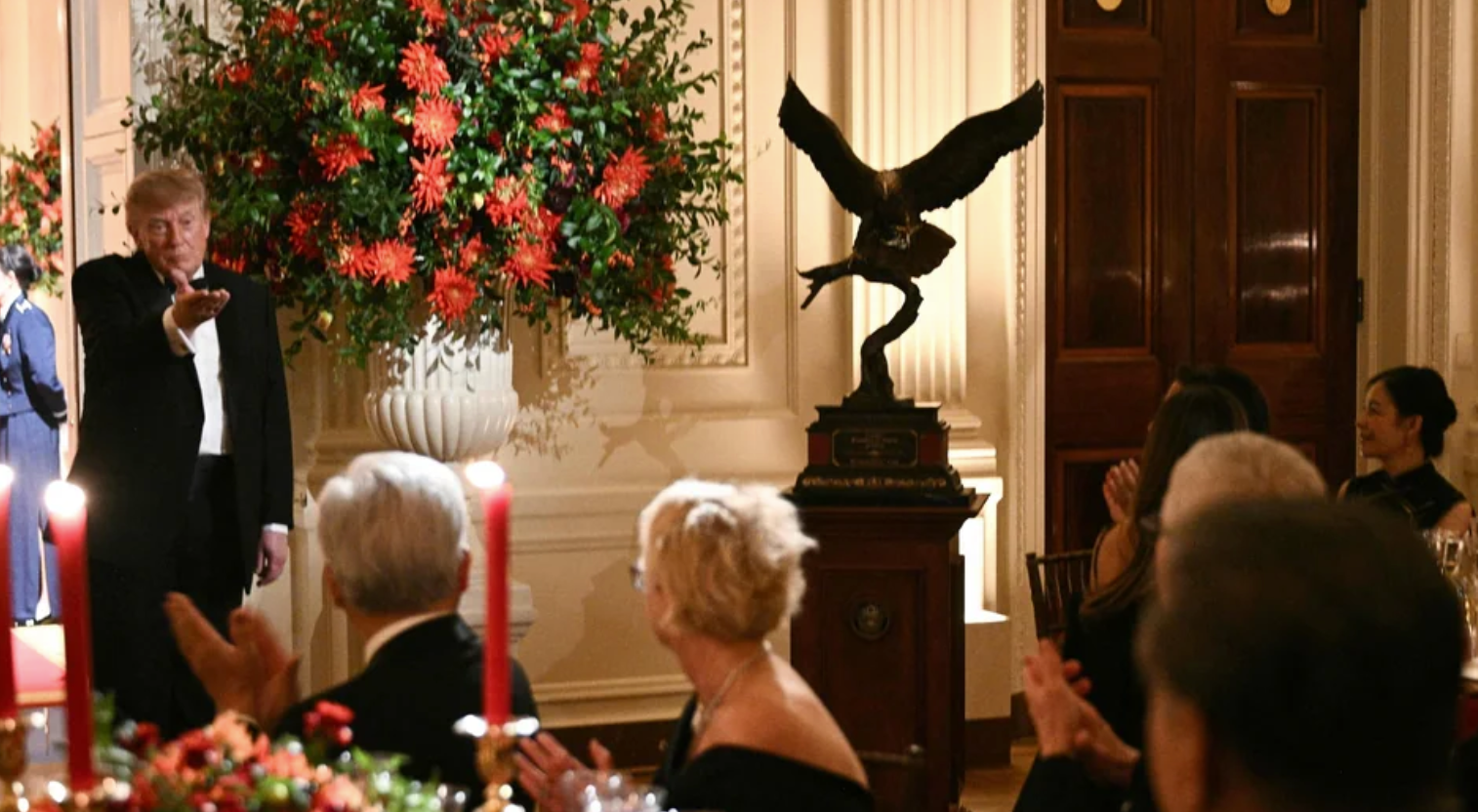
It was quite a scene.
Xi’s September 23–25 state visit was the first White House visit by a Chinese president in more than a decade. The two leaders discussed trade, agriculture, Taiwan, artificial intelligence, critical minerals, and the future relationship between the world’s two largest economies.
But while the cameras were focused on Washington…
I was watching something else.
Gold.
More specifically, I was watching what China has been doing with gold.
Because sometimes what a country does with its money tells you more than what its leaders say behind a podium.
And China has been buying gold at a staggering pace.
According to Chinese customs data reported this week, China imported roughly 1,100 metric tons of gold during the first eight months of 2026.
Think about that.
China has already imported more gold in eight months than it imported during all of 2025.
The dollar value?
Approximately $158.8 billion. And that may not be the end of it.
Heraeus estimates Chinese imports could approach 1,700 metric tons for the full year if the current pace continues, which would make 2026 China’s strongest gold-import year of the decade.
But here’s the number that really caught my attention.
The People’s Bank of China reported adding another 20.2 metric tons of gold to its official reserves in August.
That was its largest monthly addition since October 2023.
China’s official gold holdings have now increased for 22 consecutive months, reaching approximately 2,387 metric tons at the end of August. Gold now represents roughly 9% of China’s reported foreign-exchange reserves.
Twenty-two consecutive months.
That’s not a trade. That’s a strategy.
And yet…
Gold is falling.
Welcome to the MoneyQuake
As I write this, gold has suffered one of its sharpest setbacks in months.
Spot gold dropped as much as 4% Monday, briefly trading near $4,111 an ounce, its lowest level since early August.
Why?
Bond yields.
Gold, which doesn’t kick off a yield, is competing with U.S. Treasuries.
The yield on the 10-year U.S. Treasury has surged to its highest level since June 2007. Markets are increasingly pricing the possibility of another Federal Reserve rate hike, while the dollar has strengthened.
That’s kryptonite for gold in the short term.
Gold doesn’t pay interest. Treasuries do.
So when Treasury yields rise sharply, investors suddenly have an alternative. Money moves toward yield-bearing securities, leveraged gold positions get unwound, speculators sell, and algorithms pile onto the trade.
That’s essentially what we’re seeing now.
The Best Free Investment You’ll Ever Make
Join Gold World today for FREE. Get the latest insight on gold, silver, and precious metals delivered straight to your inbox. When you become a member today, you’ll get our latest free report: “The #1 Golden Token to Buy Now.” Don’t Delay!
After getting your report, you’ll begin receiving the Gold World e-Letter, delivered to your inbox daily.
Reuters reports that speculative net-long positions in gold have declined and gold ETFs experienced modest outflows last week as rising yields increased the opportunity cost of owning bullion.
Wall Street sees: Gold down. Bonds yielding more. Sell gold.
I see something very different.
I see the MoneyQuake.
Because MoneyQuake was never supposed to happen in a straight line.
This Is a Decade, Not a Trade
I’ve been pounding the table about this for a reason.
MoneyQuake isn’t my prediction for what happens next Tuesday.
It’s a decade-long monetary transformation.
We’re watching the architecture of the global financial system slowly change beneath our feet.
Governments are running enormous debts. Central banks are reconsidering the composition of their reserves. Gold has reemerged as a strategic monetary asset. Digital assets are challenging traditional definitions of money. Tokenization is changing how ownership itself works.
And simultaneously, artificial intelligence, data centers, power generation, critical minerals, and infrastructure are unleashing an enormous industrial capital cycle.
Those are my MoneyQuake Conjoined Twins.
One twin is monetary.
The other is industrial.
And they’re growing together.
Which brings me back to China.
I’m not arguing that China’s gold purchases prove Beijing has some secret plan to overthrow the dollar. The data doesn’t establish that.
What they do establish is that China continues diversifying its reserves by accumulating an asset that isn’t someone else’s debt.
That distinction matters.
A Treasury bond is an obligation of the United States government.
Gold is nobody’s liability.
And while traders are currently selling gold because Treasury yields are rising…
China keeps accumulating gold. And a lot of it.
That divergence is fascinating.
Don’t Confuse Price With Thesis
This is one of the hardest lessons investors ever learn.
A falling price does not necessarily mean a broken thesis.
Sometimes it means the market is giving you another opportunity to participate in a thesis that remains intact.
Tesla investors learned that lesson. Amazon investors learned it. Bitcoin investors certainly learned it.
And gold investors have learned it repeatedly throughout history.
Gold has already experienced an extraordinary run. It made a record high last January of THIS YEAR!
A correction after that kind of move isn’t shocking. In fact, volatility should be expected.
But ask yourself the question I always ask when one of my long-term investments gets hammered…
What changed?
Did China suddenly stop buying gold?
No.
Did the People’s Bank of China suddenly reverse its reserve-diversification strategy?
No. Its reported gold holdings increased for the 22nd consecutive month through August.
Did governments suddenly discover fiscal discipline?
Hardly.
Did America’s enormous government financing requirements disappear?
No.
Did the MoneyQuake end?
Not remotely.
Instead, the immediate catalyst is that interest rates and Treasury yields have moved higher, increasing the short-term opportunity cost of holding gold. That’s a legitimate headwind. And if rates remain higher for longer, gold could certainly fall further.
But that’s the difference between price risk and thesis risk.
I believe investors need to understand both.
Watch What They Do
That’s why Xi’s visit struck me as such an extraordinary backdrop for what’s happening.
On the surface, we saw diplomacy. Trump and Xi shaking hands. State dinners with American billionaires.
Bilateral meetings. Discussions about trade, agriculture, AI, Taiwan, and critical minerals.
Meanwhile, the financial data tell another story.
China imported roughly 1,100 metric tons of gold in eight months.
Its central bank reported buying another 20.2 metric tons in August alone. Its official gold accumulation streak reached 22 straight months.
And estimates suggest total Chinese imports could approach 1,700 metric tons this year.
That’s why I don’t panic when gold drops 3% or 4%.
I pay attention.
Because MoneyQuake investors aren’t trying to guess tomorrow morning’s gold price.
We’re trying to position ourselves for where the global monetary system may be going over the next decade.
There will be corrections. There will be frightening headlines.
There will be moments when rising interest rates make gold look temporarily obsolete.
And there will undoubtedly be times when people tell us the gold bull market is over.
Good.
Because secular bull markets don’t move in straight lines.
They shake people out.
They test conviction.
And occasionally, they give patient investors something increasingly rare…
A second chance to buy into a decade-long story at a cheaper price.
So while Wall Street watches the bond market…
And Washington watches Xi Jinping…
I’ll keep watching the gold.
Because money leaves footprints.
And right now, China’s footprints are golden.
Get to the good, green grass first…
The Prophet of Profit,

Brian Hicks
 Check us out on YouTube!
Brian is a founding member and President of Angel Publishing. He writes about general investment strategies for Wealth Daily and Energy and Capital. Brian is the managing editor and investment director of R.I.C.H Report (Retired Independent Carefree Healthy), New World Assets and Extreme Opportunities. For more on Brian, take a look at his editor’s page.
The Best Free Investment You'll Ever Make
We never spam! View our Privacy Policy
After getting your report, you’ll begin receiving the Wealth Daily e-Letter, delivered to your inbox daily.
Angel Publishing Investor Club Discord - Chat Now
Brian Hicks Premium
Introductory

Advanced


