The Industrial Twin Is Bigger Than You Think

In my last Wealth Daily, I told you that the White House may have quietly acknowledged something we’ve been discussing inside the MoneyQuake for months.
Not the Monetary Twin.
But the Industrial Twin.
President Trump declared a national emergency to secure America’s bulk power system, arguing that the explosive growth of artificial intelligence, advanced manufacturing, defense production, and critical infrastructure has made America’s electric grid more strategically important than ever. The administration also warned that dependence on foreign-made electrical equipment presents growing national security risks.
Most investors saw another executive order.
I saw another piece of a much larger puzzle.
Because if you think this story is about electricity, you’ve only scratched the surface.
The real story isn’t electricity. The real story is what electricity makes possible.
For decades, Wall Street has trained investors to think in neat little boxes. Technology belongs in one sector. Utilities belong in another. Mining has its own analysts. Energy is separate from manufacturing. Defense sits in its own category, while construction, engineering, and infrastructure rarely receive the same attention as the latest software company.
That framework worked reasonably well in yesterday’s economy.
It doesn’t work anymore.
Artificial intelligence has shattered those walls.
The average investor sees ChatGPT and thinks about software.
I see copper.
I see transmission lines stretching across the countryside.
I see natural gas turbines spinning 24 hours a day.
I see nuclear reactors returning to the national conversation.
And I see a wave of substations, transformers, water pipelines, cooling systems, heavy equipment, concrete, steel, and thousands of skilled workers building the physical foundation of a new industrial age.
That’s the difference.
One perspective sees an app. The other sees an ecosystem.
We’ve spent decades talking about the digital economy as though it floated somewhere above the physical world.
“The cloud” became our favorite metaphor.
But here’s the truth.
The cloud is simply someone else’s building.
Behind every AI model sits an enormous physical campus filled with tens of thousands of advanced processors. Those processors generate immense heat. That heat must be removed through sophisticated cooling systems. The electricity feeding those servers arrives through substations, transformers, and transmission lines that took years to design and build.
None of that infrastructure appears by magic.
Every mile of transmission line requires steel towers, aluminum conductors, insulators, and enormous quantities of copper.
A substation requires transformers that weigh hundreds of thousands of pounds.
The transformers depend on specialized steel, copper windings, insulation materials, precision manufacturing, and highly skilled labor.
And every new data center begins with bulldozers, concrete trucks, cranes, electricians, welders, engineers, and construction crews long before the first AI model is ever trained.
That’s why I’ve said repeatedly that artificial intelligence isn’t merely a software revolution.
It’s one of the largest industrial construction projects America has undertaken in generations.
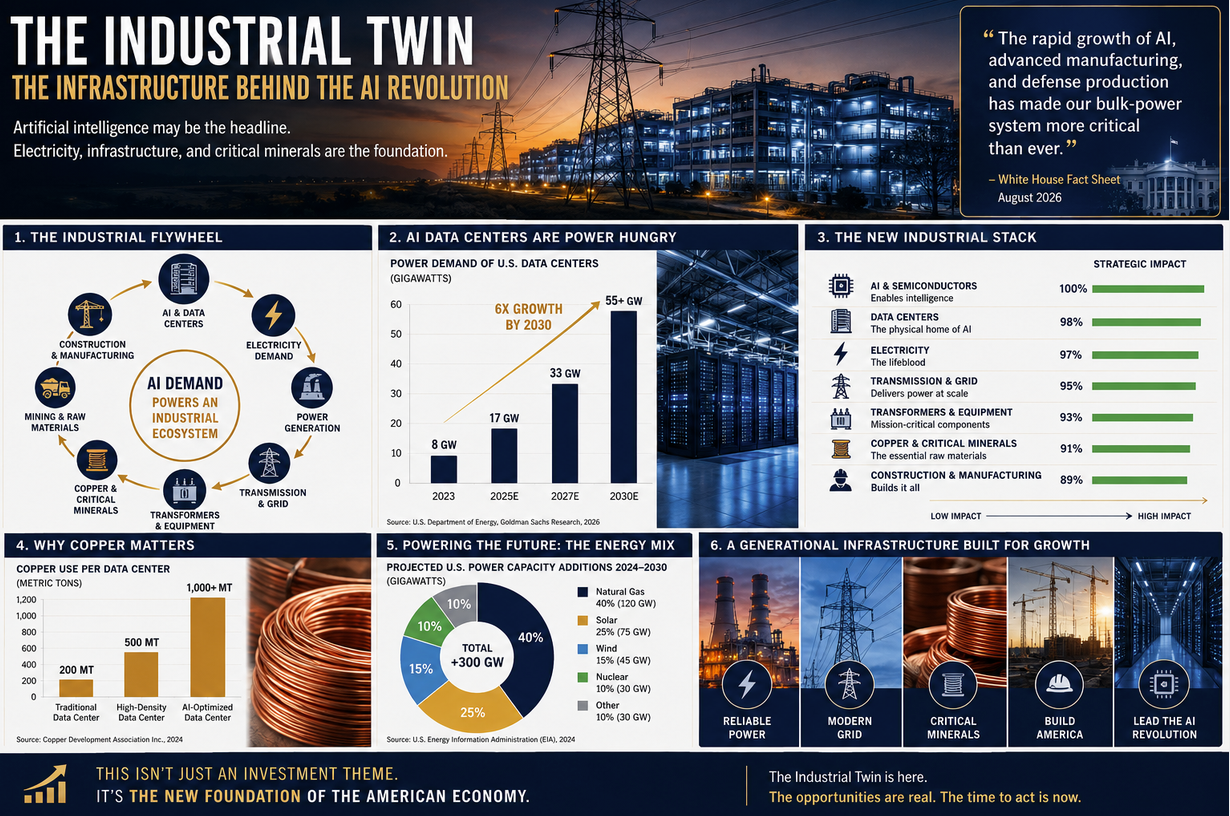
Now, think about what happens when that process repeats itself. Over and over again.
Every major technology company wants more computing capacity. Cloud providers are racing to expand. Semiconductor manufacturers are investing billions in domestic production. Defense contractors are integrating AI into everything from logistics to autonomous systems. Manufacturers are bringing advanced production back to American soil, where reliable electricity has become every bit as important as labor or capital.
Each project creates demand for another.
A new AI campus needs more electricity. More electricity requires additional generation.
More generation requires natural gas turbines, nuclear reactors, hydroelectric upgrades, or other dependable sources of baseload power.
Those facilities require new transmission lines.
The Best Free Investment You’ll Ever Make
Join Wealth Daily today for FREE. We’ll keep you on top of all the hottest investment ideas before they
hit Wall Street. Become a member today, and get our latest free report: “The $10 Trillion AI Infrastructure Boom.”
It contains full details on why money managers are overpaid and provides you with
tools for growing your wealth.On your own terms. No fees, no commission.
Transmission lines require copper. Copper requires mines. Mines require heavy equipment. Heavy equipment requires steel, engines, bearings, electronics, and skilled labor. Steel requires iron ore, metallurgical coal, recycled scrap, and industrial furnaces.
Wash. Rinse. Repeat.
You feel me?
Before long, what looked like one technology investment has become a nationwide industrial supply chain stretching from the mine to the manufacturing floor to the data center.
This isn’t a collection of unrelated industries.
It’s a flywheel.
Each turn creates momentum for the next.
This is precisely why I’ve argued that AI should be viewed less like the smartphone revolution and more like the Interstate Highway System.
When President Eisenhower proposed building 41,000 miles of interstate highways, critics saw roads.
The visionaries saw something else.
The interstate system transformed manufacturing, trucking, retail, tourism, suburban housing, logistics, and countless industries that barely existed when construction began.
The highways themselves weren’t the story.
They were the platform upon which an entirely new economy was built.
Today’s electrical grid is playing the same role.
Artificial intelligence may be the headline.
But electricity is the platform.
Without abundant, reliable, and secure electricity, the AI revolution slows dramatically.
Without transmission lines, the power can’t reach the data centers. Without transformers, the grid can’t expand. Without copper, none of it gets built.
And without water, many of these facilities cannot operate efficiently.
Suddenly, the “boring” industries become some of the most strategically important industries in America.
This also explains why so many recent policy initiatives seem disconnected at first glance.
FAST-41 permitting reforms
Critical mineral initiatives
Support for domestic mining
Defense supply chain investments
AI infrastructure policies
Grid modernization
And now the bulk-power emergency declaration.
Read separately, they appear to be individual policy decisions.
Read together, they begin to resemble a coordinated effort to strengthen the physical backbone of the American economy.
Whether every initiative succeeds is almost beside the point.
The direction is unmistakable.
Washington increasingly recognizes that economic leadership in the twenty-first century depends not only on writing better software, but on producing more electricity, securing more critical minerals, modernizing infrastructure, and rebuilding industrial capacity at home.
That’s exactly what we’ve been calling the Industrial Twin.
Next week, another headline will dominate the news.
Another earnings report. Another AI breakthrough. Another political controversy.
Most investors will move on.
I won’t.
Because beneath those daily headlines, a much larger transformation continues to gather momentum.
The Monetary Twin is changing the way the world thinks about money.
The Industrial Twin is rebuilding the physical foundation upon which that new monetary system — and the AI economy itself — will stand.
And if history teaches us anything, it’s that the investors who recognize great industrial transformations early rarely regret arriving before the crowd.
And that’s why we get to the good, green grass first…
The Prophet of Profit,

Brian Hicks
 Check us out on YouTube!
Brian is a founding member and President of Angel Publishing. He writes about general investment strategies for Wealth Daily and Energy and Capital. Brian is the managing editor and investment director of R.I.C.H Report (Retired Independent Carefree Healthy), New World Assets and Extreme Opportunities. For more on Brian, take a look at his editor’s page.
The Best Free Investment You'll Ever Make
We never spam! View our Privacy Policy
After getting your report, you’ll begin receiving the Wealth Daily e-Letter, delivered to your inbox daily.
Angel Publishing Investor Club Discord - Chat Now
Brian Hicks Premium
Introductory

Advanced


