My Next 10-Baggers in Gold Are Hiding in Plain Sight

Why the greatest fortunes of the MoneyQuake may be buried beneath North American soil.
In 1999, when the rest of the world was celebrating the dot-com revolution, a Canadian businessman named Rudi Fronk was thinking about something decidedly less fashionable.
Gold.
And at the time, almost nobody wanted it. They wanted the next hot shot dot-com idea.
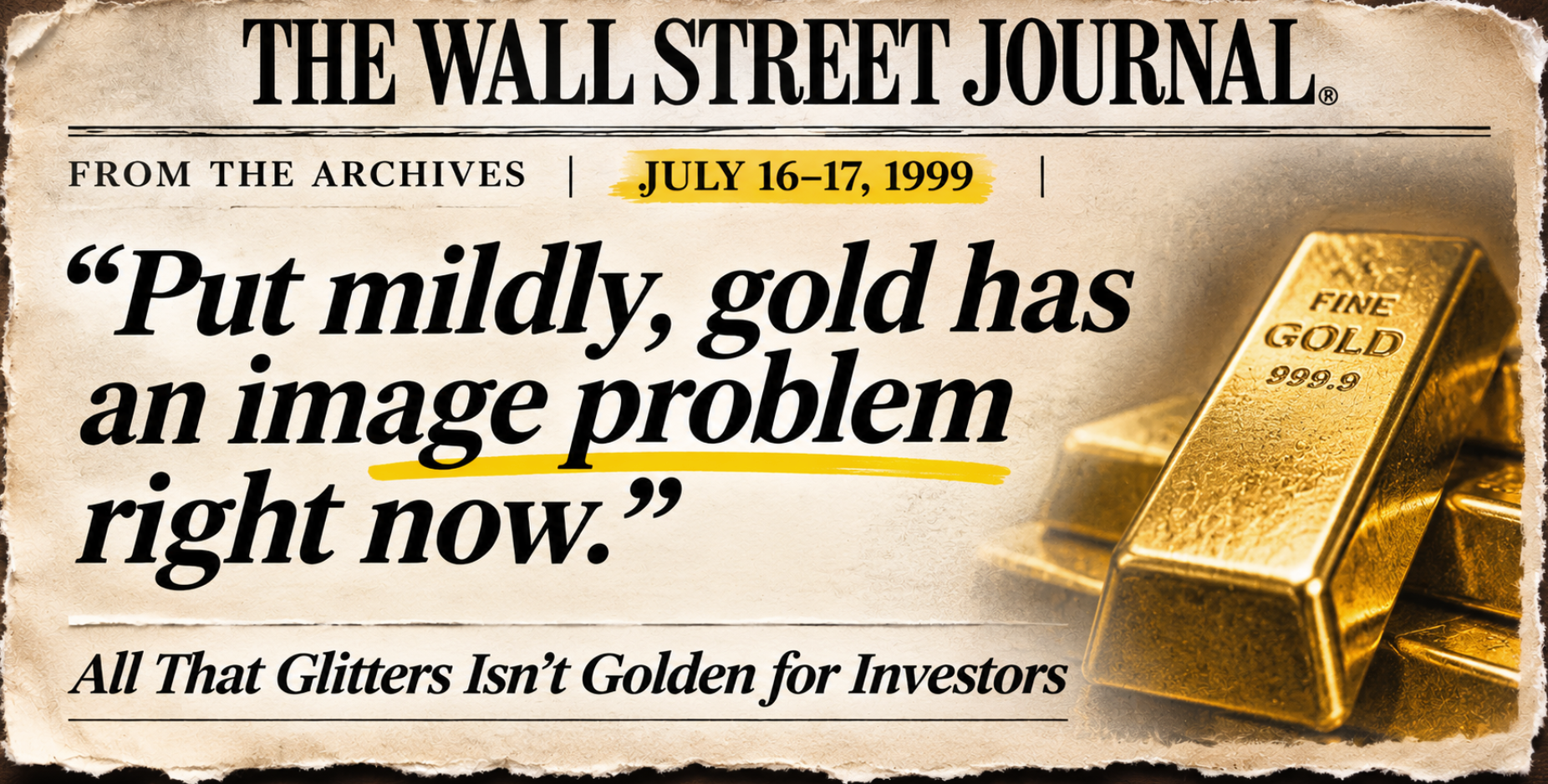
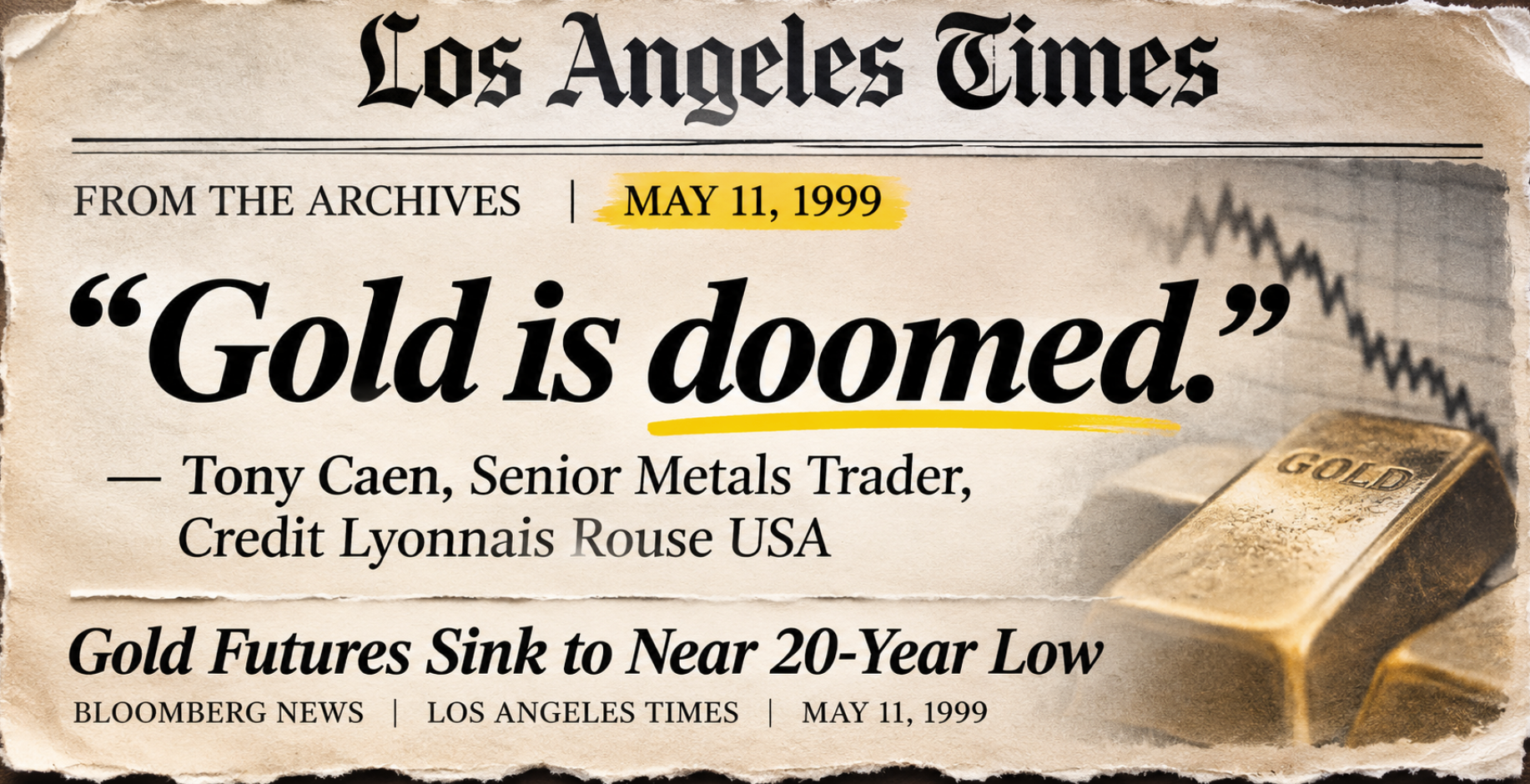
You see, in 1999, gold was trading near $250 an ounce. Central banks were actually selling their reserves.
Mining companies were struggling.
And Wall Street had essentially declared the yellow metal a relic of the past.
But Fronk saw something different.
He believed gold was approaching the beginning of a historic bull market.
And he had an idea.
Instead of spending billions of dollars building gold mines, why not acquire enormous gold deposits while nobody wanted them?
Buy the gold in the ground. Hold it. Expand the resources. And wait for the world to rediscover gold.
That was the founding philosophy behind Seabridge Gold (NYSE: SA).
And it would eventually make Seabridge the owner of one of the greatest undeveloped gold treasures on Earth.
But here’s where the story gets interesting.
For years, Seabridge accumulated an almost unimaginable amount of gold beneath the surface.
Yet its stock price often failed to reflect the extraordinary value of those deposits.
Then something changed.
And investors suddenly began looking at Seabridge in an entirely different light.
The result?
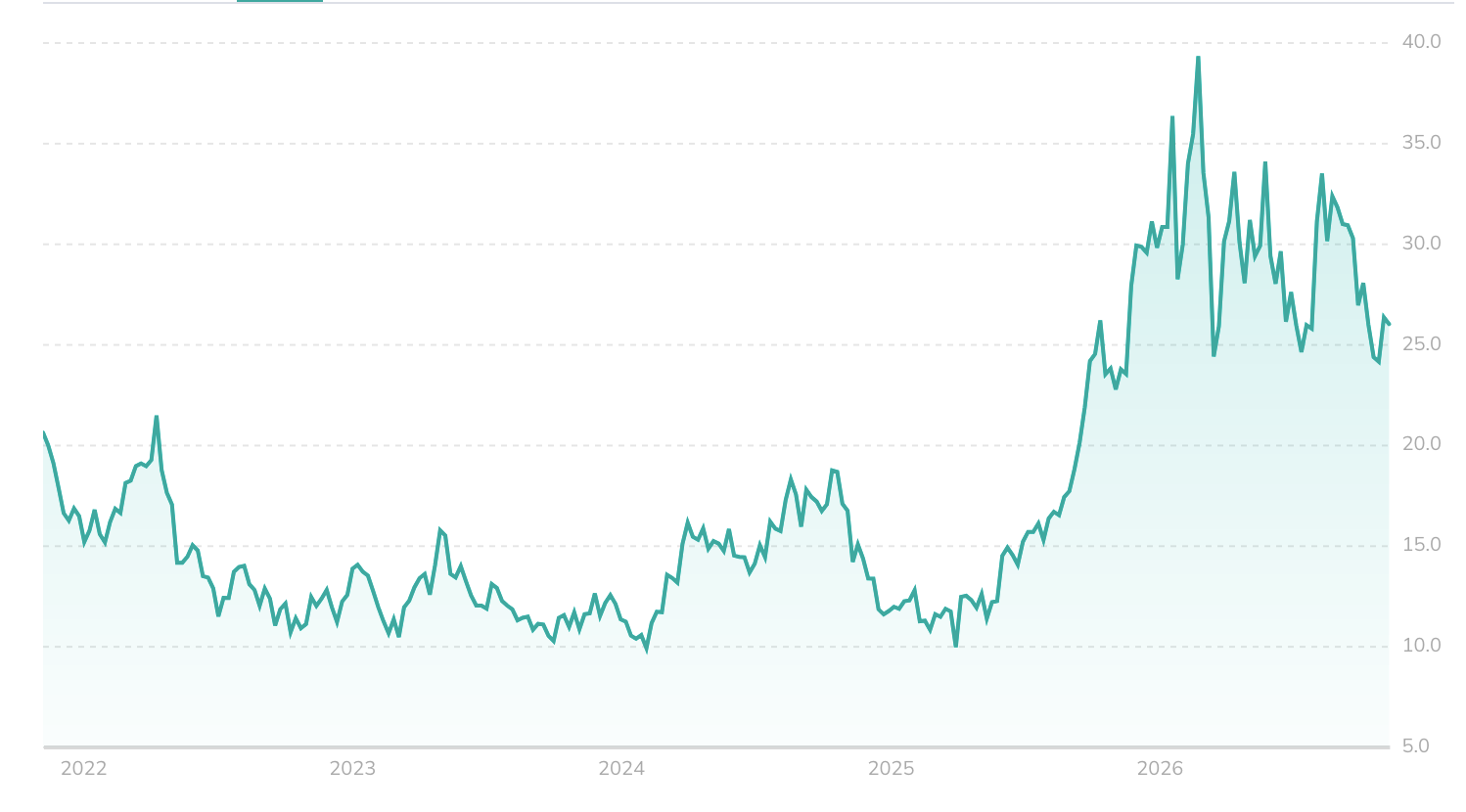
Seabridge Gold shares exploded approximately 159% in 2025 alone.
And I believe what happened to Seabridge offers a remarkable preview of what could happen to several other little-known gold companies over the next decade.
Companies that are sitting on gold deposits worth tens — even hundreds — of billions of dollars at today’s prices.
Companies whose stocks can still be purchased for a fraction of the price of a nice dinner.
And companies that could become some of the greatest beneficiaries of the MoneyQuake I’ve been predicting for years.
Let me explain.
The Greatest Gold Mine That Hasn’t Been Built
Travel to the remote mountains of northwestern British Columbia, near the Alaska border, and you’ll find one of the most extraordinary concentrations of precious metals ever discovered.
It’s called the Kerr-Sulphurets-Mitchell project.
Or simply KSM.
The property stretches across rugged mountains and valleys in a region famous for enormous mineral deposits.
And beneath those mountains lies an almost incomprehensible amount of wealth.
Seabridge’s KSM project contains approximately 88.7 million ounces of measured and indicated gold resources.
Another 71.5 million ounces are classified as inferred resources. Combined, that’s more than 160 million ounces of gold resources.
Let me put that into perspective.
At $4,100 an ounce, 160 million ounces of gold would have a gross, hypothetical metal value of approximately…
$656 BILLION.
And that’s just the gold.
KSM also contains enormous quantities of copper and silver.
Its measured and indicated resources include approximately 19.5 billion pounds of copper and hundreds of millions of ounces of silver.
Now, those figures aren’t profits. Much of the metal may never be economically recoverable, and developing a project of this magnitude would require billions of dollars in capital.
But the sheer scale is staggering.
KSM isn’t some speculative prospect where a geologist found a few promising rocks.
It’s one of the world’s largest undeveloped gold-copper projects.
And Seabridge spent decades building and expanding its ownership of this extraordinary resource.
There was just one problem.
Gold in the ground doesn’t generate cash flow.
And Wall Street eventually gets impatient.
The Best Free Investment You’ll Ever Make
Join Gold World today for FREE. Get the latest insight on gold, silver, and precious metals delivered straight to your inbox. When you become a member today, you’ll get our latest free report: “The #1 Golden Token to Buy Now.” Don’t Delay!
After getting your report, you’ll begin receiving the Gold World e-Letter, delivered to your inbox daily.
The $656 Billion Treasure That Wall Street Ignored
Think about Seabridge’s original business model. The company wasn’t interested in operating mines. It wanted to accumulate gold resources and increase the amount of gold attributable to each share.
In other words, management was attempting to create a financial instrument that would provide shareholders with extraordinary leverage to rising gold prices.
As gold became more valuable, the deposits would theoretically become more valuable. And as those deposits became more valuable, Seabridge shareholders would benefit.
It was an elegant strategy. But there was a catch.
Owning a gigantic gold deposit is one thing. Turning that deposit into an operating mine is something else entirely.
You need roads. Electricity. Water management systems. Processing facilities. Environmental approvals. Billions of dollars in financing.
And, perhaps most importantly, a mining partner with the expertise and financial resources to turn a geological discovery into a profitable operation.
For years, investors looked at KSM and saw an enormous treasure chest. But one without a key.
Then Seabridge began making a more determined effort to unlock it.
The company advanced permitting, engineering, infrastructure, and feasibility work. It began pursuing a major joint-venture partner.
And in April 2026, the government of British Columbia designated KSM a provincial priority project.
The message was becoming clear. Seabridge wasn’t abandoning its original philosophy of owning enormous gold resources.
It was moving those resources closer to the day when somebody could actually mine them. And Wall Street started paying attention.
When Gold in the Ground Suddenly Became Valuable Again
Here’s what happened to Seabridge’s stock.
At the beginning of 2025, shares were trading around $12. By the end of that year, they were approaching $30.
And by late February 2026, Seabridge had reached a record closing price of approximately $39.35. From the beginning of 2025 to that peak, investors had seen their shares more than triple.
Not bad for a company that wasn’t producing a single ounce of gold.
Of course, the stock has since corrected.
As of November 10, shares were trading near $26. But that doesn’t change the larger lesson.
The market began repricing Seabridge as the possibility of eventually developing KSM became more tangible.
And this is precisely the kind of repricing I’ve been discussing in my MoneyQuake research.
Because there’s a fundamental difference between the value of an asset and the value investors are currently willing to assign to it.
Sometimes that gap can persist for years.
Even decades.
But Seabridge isn’t the only company sitting on an enormous gold deposit.
Not even close.
Remember My $5,337 Gold Prediction I Made in Late 2025?
Before I reveal what I believe could be the next great opportunity in gold, I want to remind you of something.
On December 20, 2025, I published my annual MoneyQuake predictions in Wealth Daily.
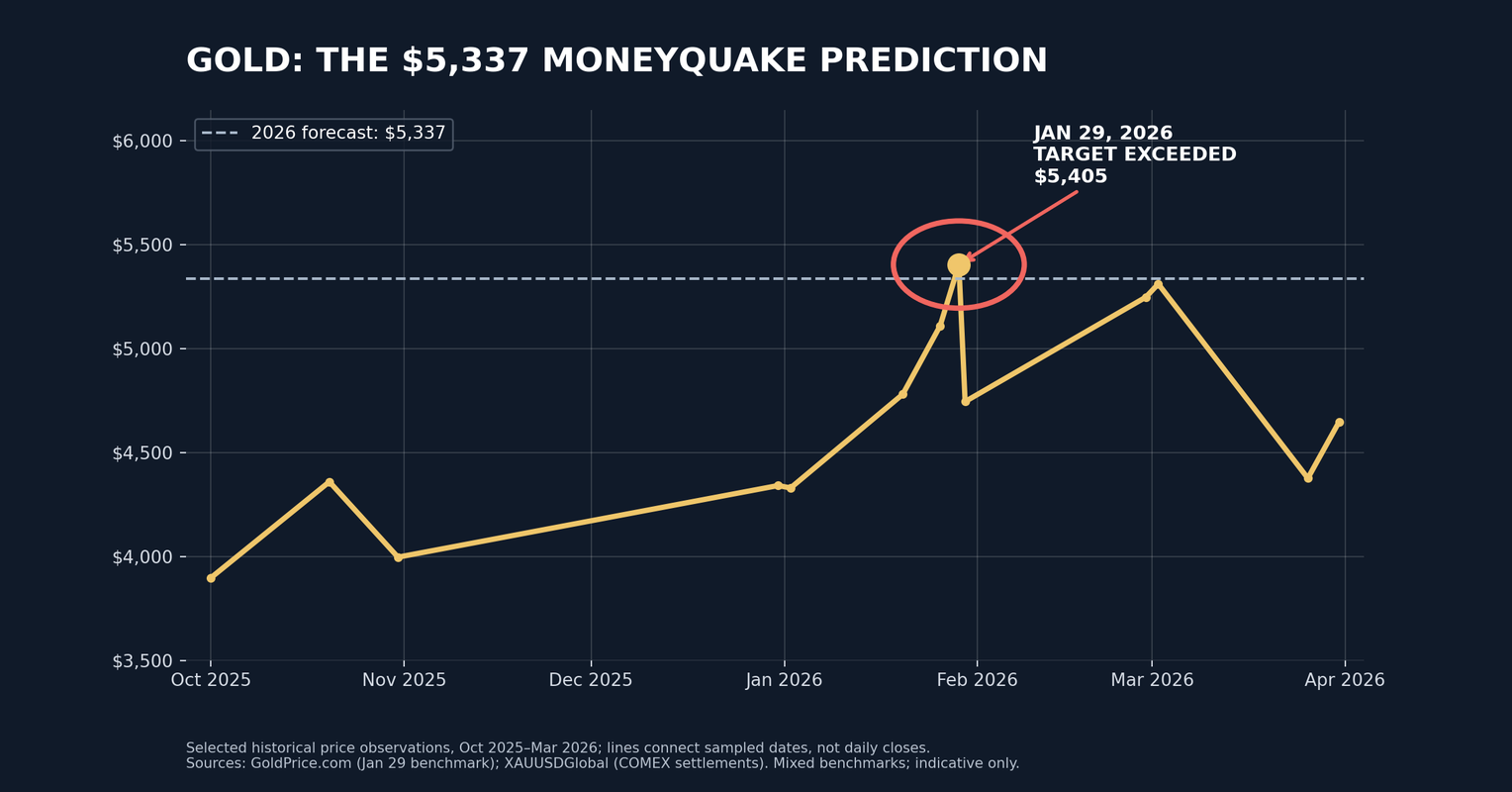
I predicted gold would reach $5,337 an ounce in 2026. I also predicted silver would reach $73.
Both targets were exceeded before January 2026 was over.
Gold reached my target on January 29, just 40 days after I published the prediction. And yes, gold has since experienced a significant correction.
But remember what I’ve been saying.
Gold’s bull market didn’t begin in January 2026. It began when gold broke through its multiyear resistance around $2,100 in March 2024.
That breakout was a historic technical development. And I believe it marked the beginning of a much larger monetary transformation.
Even after its correction, gold has nearly doubled from where it stood at the beginning of 2024.
And the structural forces driving this bull market remain intact.
Central banks continue diversifying their reserves. Government debt continues growing. The international monetary system continues fragmenting.
And investors are increasingly recognizing the importance of owning scarce, tangible assets.
That’s the monetary side of my MoneyQuake thesis.
And companies like Seabridge own gold.
But they also own enormous copper resources.
Which means they could benefit from both the monetary repricing of gold and the industrial repricing of critical resources.
That’s an extraordinarily powerful combination.
And it brings me to three other North American gold deposits that I believe deserve serious attention.
Three Buried Fortunes Wall Street Hasn’t Fully Discovered
Imagine discovering a property containing tens of millions of ounces of gold.
Now imagine owning that property while gold prices are approaching historic highs. You might assume investors would be falling over themselves to buy shares in the company that owns it.
But that’s not necessarily how the mining industry works. Some of the world’s largest undeveloped deposits remain stranded.
Not because the gold has disappeared.
But because of politics, environmental disputes, financing challenges, infrastructure costs, or the sheer difficulty of building a mine. And that’s where I believe the next great speculative opportunities could emerge.
Consider these three examples.
Buried Fortune No. 1: The Alaskan Giant
Somewhere in southwestern Alaska lies one of the most extraordinary undeveloped mineral deposits ever identified in North America.
The project contains an estimated 107 million ounces of gold resources, along with enormous quantities of copper and other valuable metals.
At $4,100 gold, the hypothetical gross value of that gold alone would exceed $438 billion.
But there’s a problem.
The project has spent years entangled in one of the most controversial environmental and regulatory battles in American mining history.
Opponents fear the consequences of developing a massive mine near a sensitive salmon-producing watershed.
Supporters argue that the project could become a major domestic source of gold, copper, and other strategically important minerals.
And the company behind the project? Its stock has traded for just a few dollars a share.
Now imagine what could happen if the regulatory obstacles were eventually resolved.
But that’s precisely why the stock trades where it does.
And it’s why the potential upside, if circumstances change dramatically, could be so extraordinary.
Buried Fortune No. 2: Alaska’s 40-Million-Ounce Treasure
The second opportunity is another Alaskan giant.
This deposit contains approximately 40 million ounces of gold.
At $4,100 gold, that’s roughly $164 billion in hypothetical gross metal value.
The project has been studied for decades.
Engineering work has outlined the possibility of producing more than one million ounces of gold annually during its early operating years.
Think about that.
A mine potentially producing more than a million ounces of gold every year.
At $4,100 an ounce, that would represent billions of dollars in annual gross gold sales at full projected production.
Of course, gross sales aren’t profits.
Operating expenses, capital costs, royalties, taxes, financing, and other obligations would consume a substantial portion.
And this project still faces significant development, permitting, infrastructure, and community-relations challenges.
But here’s the point.
Gold at $2,000 an ounce produces one set of project economics.
Gold at $4,000 produces another.
And gold at $6,000?
Or $10,000?
Suddenly, projects that once looked prohibitively expensive can become much more interesting.
That’s the leverage inherent in undeveloped gold deposits.
And it’s something I believe investors are only beginning to appreciate.
Buried Fortune No. 3: The Forgotten Northern Goldfield
The third opportunity is located in the Canadian North.
It isn’t as famous as the first two.
But it represents the same underlying investment concept.
A vast gold resource. A remote location. A long development timeline.
And a valuation that reflects the considerable uncertainty surrounding the project’s eventual development.
The company behind this type of deposit doesn’t need to become the next Barrick Gold overnight.
It needs to demonstrate that its gold can be extracted economically. It needs to secure the necessary permits and financing.
And it needs to convince investors that the resource beneath the ground can eventually become cash flow above it.
If those things happen during a historic gold bull market, the resulting change in valuation can be dramatic.
But if they don’t, the deposit can remain stranded indefinitely.
That’s the risk. And that’s the opportunity.
What Happens When Gold Reaches $10,000?
Now I want you to consider something.
My long-term price target for gold remains $48,571 an ounce.
I’ve explained the historical reasoning behind that number in my Gold Beyond Belief research.
It draws on the extraordinary monetary repricing that occurred during the 1970s and asks what a comparable transformation might look like in today’s heavily indebted global financial system.
I’m not suggesting gold will reach that level next year.
It’s a long-term bull-market scenario.
But even if gold never reaches $48,571, consider what happens to the economics of undeveloped deposits if gold reaches $6,000.
Or $8,000.
Or $10,000.
A deposit containing 40 million ounces of gold has a hypothetical gross in-ground metal value of $164 billion at $4,100 gold.
At $10,000 gold, that figure becomes $400 billion.
The deposit hasn’t changed. The number of ounces hasn’t changed. The mountain hasn’t moved.
Only the price the world is willing to pay for gold has changed.
Now, higher gold prices don’t automatically translate into equivalent gains in mining-company valuations. Development costs, dilution, recovery rates, permitting, and financing still matter enormously.
But higher sustained gold prices can dramatically improve project economics.
And they can create incentives to solve problems that previously seemed insurmountable.
That’s why I believe the next decade could produce extraordinary opportunities among companies controlling large undeveloped gold resources.
The Next 10 Years Could Make the Last Two Look Ordinary
Here’s what I find most fascinating about this entire story.
In 1999, Rudi Fronk recognized something most investors couldn’t see.
He recognized that gold was dramatically undervalued.
And instead of chasing whatever happened to be fashionable on Wall Street, he began accumulating ownership of one of the world’s scarcest and most enduring monetary assets.
For years, his strategy required patience.
Lots of it.
But as gold prices climbed and Seabridge moved its flagship project closer to potential development, investors began recognizing the value of what the company had assembled.
And its stock took off.
I believe we’re approaching a period when other stranded gold deposits could experience similar moments of recognition.
The winners? They could be spectacular.
Because we’re not talking about ordinary businesses trying to increase sales by 10% next year.
We’re talking about companies controlling some of the largest undeveloped concentrations of gold in North America.
Gold that has been sitting beneath the surface for millions of years. Gold that investors have often ignored for decades.
And gold that could become increasingly valuable as the world’s monetary system undergoes the transformation I’ve been calling the MoneyQuake.
Remember, my $5,337 gold prediction was reached in January 2026.
My long-term target remains $48,571.
And in our upcoming MoneyQuake Predictions Podcast for 2027, I’ll reveal why I believe gold could climb considerably higher than even J.P. Morgan’s $6,300 forecast for next year.
But here’s the prediction I want you to remember today.
Some of the greatest investments of the next 10 years may be hiding inside gold stocks that most investors wouldn’t even recognize by name.
Stocks trading for a few dollars. Some for less than a dollar!
Companies controlling enormous deposits. Assets that have remained stranded for decades. And opportunities that could be transformed by the next great leg of the gold bull market.
The MoneyQuake is already changing the value of money.
Soon, I believe, it could change the value of what’s buried beneath our feet.
And when that happens, the investors who recognized the opportunity early could be sitting on fortunes.
Get to the good, green grass first…
The Prophet of Profit,

Brian Hicks
 Check us out on YouTube!
Brian is a founding member and President of Angel Publishing. He writes about general investment strategies for Wealth Daily and Energy and Capital. Brian is the managing editor and investment director of R.I.C.H Report (Retired Independent Carefree Healthy), New World Assets and Extreme Opportunities. For more on Brian, take a look at his editor’s page.
The Best Free Investment You'll Ever Make
We never spam! View our Privacy Policy
After getting your report, you’ll begin receiving the Wealth Daily e-Letter, delivered to your inbox daily.
Angel Publishing Investor Club Discord - Chat Now
Brian Hicks Premium
Introductory

Advanced


