The Shale Revolution: The Critics Saw an Environmental Disaster. America Built Energy Dominance.

Initial Investment:
Hundreds of billions of dollars in drilling, pipelines, processing facilities, export terminals, and supporting infrastructure.
Estimated Return on Investment:
Immeasurable. Conservatively, tens of trillions of dollars in economic value, lower energy costs, increased national security, and industrial competitiveness.
The next great American investment that many hated — especially liberals — was the shale revolution. In the early 2000s, the conventional wisdom surrounding American energy was remarkably pessimistic.
The United States, we were told, was running out of oil. There’s a term for it. It was called Peak Oil.
I took it so seriously, that I wrote a book on the topic:
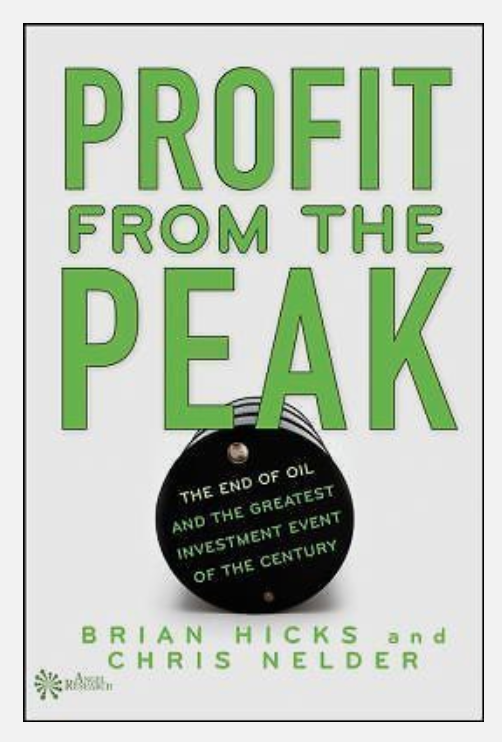
Domestic production had been in decline for decades. America’s dependence on foreign energy appeared destined to grow indefinitely. The country imported millions of barrels of oil every day, and policymakers worried openly about energy security.
The future seemed obvious.
America’s best energy days were behind it.
Then came shale, which the U.S. had an enormous amount of.
It may surprise you that fracking has been around for a very long time. In fact, it goes way back to the American Civil War.
The Bakken in North Dakota, the Marcellus in Pennsylvania, and the Barnett Shale in Texas are credited with giving birth to the current fracking revolution…
And protests. Hollywood actor Matt Damon has said the following regarding fracking in New York:
What Gov. Cuomo is doing is he has decreed this moratorium, and he wants the science to dictate what he does. That seems to be a pretty rational approach. Rushing into something seems insane, given what’s at stake, and given some of the complaints we’re starting to hear. Let’s wait and see.
But nothing could be further from the truth.
But it might surprise Matt that fracking dates back to around the time of the U.S. Civil War.
You see, in 1866 (160 years ago), U.S. Patent No. 59,936 was issued to Civil War veteran Col. Edward Roberts.
Roberts’ invention is known simply as “Exploding Torpedo.”
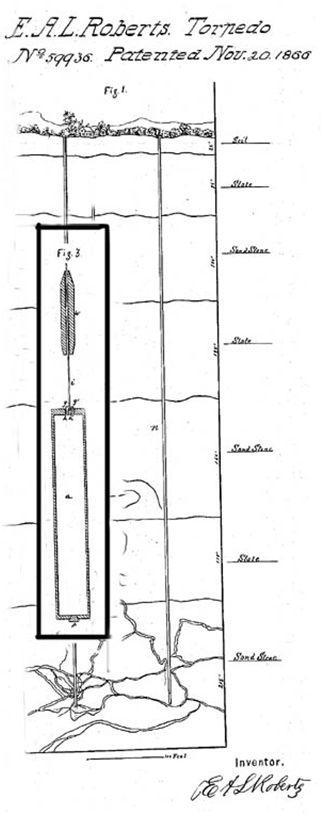
Its creation began when he witnessed Confederate exploding artillery rounds plunging into the narrow millrace (canal) that obstructed a battlefield in Fredericksburg, Virginia.
Roberts’ observation gave him an idea that would evolve into what he described as “superincumbent fluid tamping.”
Nobody knew it at the time, but Roberts’ “Exploding Torpedo” was the birth of the modern-day shale fracturing industry…
The Best Free Investment You’ll Ever Make
Join Wealth Daily today for FREE. We’ll keep you on top of all the hottest investment ideas before they
hit Wall Street. Become a member today, and get our latest free report: “The $10 Trillion AI Infrastructure Boom.”
It contains full details on why money managers are overpaid and provides you with
tools for growing your wealth.On your own terms. No fees, no commission.
The Titusville Morning Herald reported in 1866:
Our attention has been called to a series of experiments that have been made in the wells of various localities by Col. Roberts, with his newly patented torpedo. The results have in many cases been astonishing.
The torpedo, which is an iron case, containing an amount of powder varying from 15–20 pounds, is lowered into the well, down to the spot, as near as can be ascertained, where it is necessary to explode it.
It is then exploded by means of a cap on the torpedo, connected with the top of the shell by a wire.
Filling the borehole with water provided Roberts his “fluid tamping” to concentrate concussion and more efficiently fracture surrounding oil strata.
The technique was immediately successful. Production from some wells increased 1,200% within a week of being shot — and the Roberts Petroleum Torpedo Company experienced booming business as a result.
Roberts’ company flourished as it helped other oil companies frack their wells.
To avoid Roberts’ fees and royalties, some oil companies hired unlicensed operators to “torpedo” their wells, working by “moonlight,” where the term originates.
Roberts hired lawyers to protect his patent… and, according to the American Oil and Gas Historical Society, “is said to have been responsible for more civil litigation in defense of a patent than anyone in U.S. history.”
“Exploding shot” would be used in oil wells for decades to come.
But instead of an exploding torpedo, drillers used nitroglycerin detonations to increase a well’s production.
Nitroglycerin detonations would be used until 1989. But the next evolution of the Roberts torpedo came in 1947 in Grant County, Kansas, where natural gas wells underwent the very first hydraulic fracturing…
Then came an oil well two years later.
However, today, the combination of horizontal drilling and hydraulic fracturing unlocked oil and natural gas trapped in rock formations that had long been considered uneconomic. Engineers and entrepreneurs began proving that vast quantities of hydrocarbons could be extracted from places like the Bakken, Eagle Ford, Permian Basin, and Marcellus Shale.
The reaction from many critics was immediate.
Some argued the economics didn’t work. Others claimed production declines would be too steep. Environmental concerns became front-page news. Industry skeptics predicted that the shale boom would prove short-lived and end in financial disaster.
To many observers, shale looked like a risky experiment that was consuming enormous amounts of capital with little chance of long-term success.
History would prove otherwise.
Over the next two decades, the United States experienced one of the most remarkable energy transformations in modern history.
Domestic oil production surged. Natural gas production exploded.
And as a result, America became the world’s largest producer of both oil and natural gas.
Entire regions of the country experienced economic booms. Jobs were created. Manufacturing became more competitive thanks to lower energy prices. Chemical companies expanded. Liquefied natural gas exports turned the United States into a major energy supplier to the world.
The geopolitical implications were equally profound.
America’s dependence on foreign energy declined dramatically. European allies gained an alternative source of natural gas. Energy markets became more diversified. The United States acquired a level of energy security that few experts thought possible at the beginning of the century.
Trying to calculate the return on investment becomes almost impossible.
The economic value generated by the shale revolution runs into the trillions of dollars. Lower energy costs, higher industrial output, increased exports, and improved national security have created benefits that continue to compound.
You see, the shale revolution wasn’t one technology.
It was a system.
That’s an important distinction.
Horizontal drilling mattered. Hydraulic fracturing mattered.
But so did pipelines, sand, water infrastructure, drilling equipment, compressors, export facilities, refineries, and billions of dollars in supporting infrastructure.
The shale revolution succeeded because an entire ecosystem was built around it.
Every major investment cycle works this way.
Railroads required steel and locomotives. The internet required fiber and data centers. Artificial intelligence requires chips, power generation, cooling systems, transmission lines, and enormous computing infrastructure.
The similarities are impossible to ignore.
You see, many of the criticisms leveled against artificial intelligence today sound remarkably familiar to anyone who lived through the early years of the shale revolution.
The infrastructure is too expensive. The demand projections are too optimistic. The build-out is happening too quickly. The environmental costs are too high.
The whole thing is a bubble.
I’ve heard these arguments before.
In fact, I heard many of them during the early days of shale.
And history had other plans.
The most important lesson from shale is that transformational technologies often create investment opportunities far beyond the obvious winners.
Some investors made fortunes owning energy producers.
Others made fortunes in pipelines.
Still others profited from drilling services, sand suppliers, compressors, railroads, storage facilities, and export terminals.
The ecosystem became as important as the resource itself.
I believe the same thing is happening with artificial intelligence.
The obvious winners may be the companies building large language models and designing advanced semiconductors.
But beneath the surface, an enormous industrial ecosystem is being constructed.
Utilities are expanding generation capacity. Natural gas producers are seeing new demand. Nuclear power is experiencing a renaissance. Copper and silver are becoming increasingly important. Transformer manufacturers face years of order backlogs. Engineering and construction companies are busier than ever. Cooling technologies, water infrastructure, and electrical equipment suppliers all stand to benefit.
This is much bigger than software.
It’s an industrial build-out.
You see, that’s why I often describe artificial intelligence as the most physical digital technology ever created.
Every prompt, every inference, every model training run ultimately requires electricity, hardware, cooling, and infrastructure.
Artificial intelligence turns electrons into intelligence.
And just as shale turned previously uneconomic rock formations into one of the world’s greatest energy resources, AI is turning data centers into the factories of the intelligence economy.
Nobody standing in the Bakken 20 years ago could fully appreciate how profoundly shale would reshape energy markets.
Likewise, nobody standing in front of a hyperscale data center today can fully appreciate how profoundly artificial intelligence may reshape the global economy.
The critics of shale saw environmental risk and financial excess. The builders saw energy abundance. The critics saw expensive infrastructure.
Maybe most importantly, America gained energy dominance.
And today, the critics of artificial intelligence see enormous capital expenditures and power-hungry data centers.
I see the construction of a new industrial ecosystem — one that could shape the economy for decades to come.
History has a remarkable habit of rewarding those who understand that the biggest fortunes are often created not by a single technology, but by the vast network of infrastructure and supporting industries that grow up around it.
Get to the good, green grass first…
The Prophet of Profit,

Brian Hicks
 Check us out on YouTube!
Brian is a founding member and President of Angel Publishing. He writes about general investment strategies for Wealth Daily and Energy and Capital. Brian is the managing editor and investment director of R.I.C.H Report (Retired Independent Carefree Healthy), New World Assets and Extreme Opportunities. For more on Brian, take a look at his editor’s page.
The Best Free Investment You'll Ever Make
We never spam! View our Privacy Policy
After getting your report, you’ll begin receiving the Wealth Daily e-Letter, delivered to your inbox daily.
Angel Publishing Investor Club Discord - Chat Now
Brian Hicks Premium
Introductory

Advanced


