$0.03 for an Acre of Land

We continue our Wealth Daily series of looking at America’s greatest 11 investments that people hated.
For this third installment in the series, we go way back to 1803 when Thomas Jefferson was president.
In 1803, President Thomas Jefferson faced a problem.
He wanted control of New Orleans.
That was the key because Jefferson believed it to be vital to the national and economic security for the young Republic.
New Orleans controlled the mouth of the Mississippi River, and the Mississippi River was the economic spine of the young American republic. Farmers in the West needed it. Merchants needed it. The country’s future depended on it.
Jefferson sent negotiators to France hoping to buy New Orleans and perhaps a little land around it.
Instead, Napoleon offered all of Louisiana.
Not the state of Louisiana.
The Louisiana Territory.
And that’s the part of this story that matters most.
It was vast.
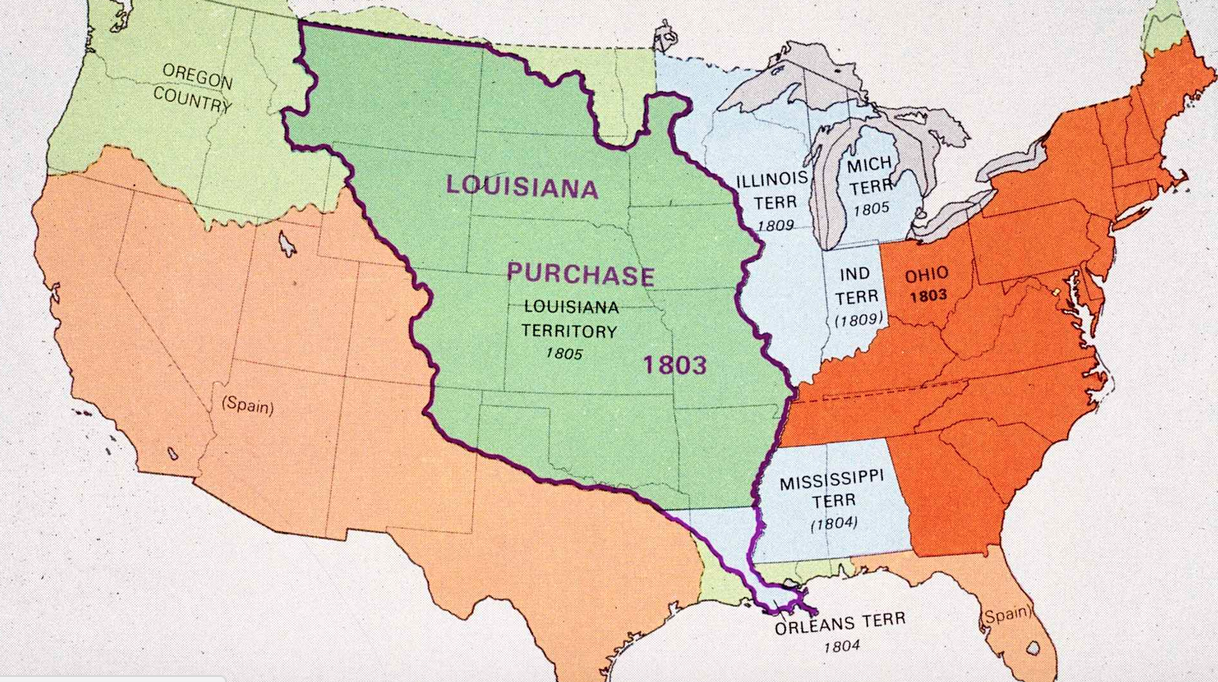
It stretched from the Mississippi River toward the Rocky Mountains. It included land that would eventually become part or all of more than a dozen states.
So on April 30, 1803, the United States made one of the most important investments in its history.
For $15 million, President Thomas Jefferson acquired the Louisiana Territory from France, instantly doubling the size of the young republic. The purchase added approximately 828,000 square miles — roughly 530 million acres — to the United States at a cost of about $0.03 an acre.
Three cents.
Today, you can’t buy a stick of gum for that.
At the time, however, many Americans thought Jefferson had made a terrible mistake.
The opposition came from several directions. Some Federalists argued that the Constitution did not explicitly authorize a president to acquire foreign territory and accused Jefferson of abandoning his own strict interpretation of federal power. Others believed the country had become too large to govern and worried that distant western lands would dilute the political influence of the original states. There were even those who questioned whether the territory had any real value at all. After all, much of it remained unexplored. Nobody knew what resources lay beneath the soil or what industries one day might emerge there.
The Best Free Investment You’ll Ever Make
Join Wealth Daily today for FREE. We’ll keep you on top of all the hottest investment ideas before they
hit Wall Street. Become a member today, and get our latest free report: “The $10 Trillion AI Infrastructure Boom.”
It contains full details on why money managers are overpaid and provides you with
tools for growing your wealth.On your own terms. No fees, no commission.
To many Americans, Jefferson had spent $15 million on a vast, undeveloped wilderness.
History would prove otherwise.
Over the next two centuries, the Louisiana Territory became the heart of the American economy. Some of the world’s most productive farmland emerged from these lands. Railroads crossed the plains. Rivers became commercial highways. Cities grew, factories multiplied, and, eventually, oil and natural gas production transformed large portions of the region into energy powerhouses. The territory became home to industries that would feed the world, fuel economic expansion, and help establish the United States as the richest nation in history.
Trying to calculate the return on investment is almost impossible.
The economic value generated from the Louisiana Purchase runs into the tens of trillions of dollars. Entire industries, states, transportation networks, and energy systems owe their existence to Jefferson’s decision to make a bet on a future that nobody could fully envision at the time.
The Louisiana Purchase was not valuable because the land was immediately productive. It was valuable because it created a platform upon which future prosperity could be built.
That’s an important distinction.
Jefferson wasn’t buying corn fields, oil wells, or factories. He was buying possibility. He was acquiring capacity for future growth, even though he had no idea exactly how that growth would unfold.
Every great investment works this way.
The full value rarely exists on day one. It emerges slowly as entrepreneurs, engineers, workers, and investors begin building on top of the foundation that has been created.
You see, that’s exactly what’s happening today with artificial intelligence.
The critics look at AI infrastructure and see giant buildings filled with servers that consume staggering amounts of electricity. They see transmission lines, cooling systems, water requirements, and enormous capital expenditures. To some, it all looks excessive, expensive, and perhaps even reckless.
But I think they’re making the same mistake Jefferson’s critics made in 1803.
They’re focusing on what exists today while missing what becomes possible tomorrow.
Artificial intelligence is not simply another software trend. It is a foundational technology that will likely touch every major industry on Earth. Medicine, manufacturing, logistics, finance, energy, defense, education, scientific research, and materials discovery will all be transformed in ways we cannot yet fully appreciate.
And none of that happens without infrastructure.
The data centers being built today are, in many respects, the Louisiana Territory of the digital age. They represent capacity. They represent possibility. They represent a foundation for industries and opportunities that haven’t yet been fully imagined.
Nobody in 1803 could have predicted modern agriculture, the interstate highway system, commercial aviation, or the shale revolution.
Likewise, nobody today can confidently predict every industry that artificial intelligence will create over the next 20 years.
That’s precisely why this moment is so important.
The critics of the Louisiana Purchase saw an expensive gamble on empty land.
Jefferson saw a continent.
The critics of artificial intelligence see warehouses full of computers.
I see the foundation of the next economy.
History has a habit of rewarding people who can recognize the difference.
And history has a habit of rewarding investors who get to the good, green first…
The Prophet of Profit,

Brian Hicks
 Check us out on YouTube!
Brian is a founding member and President of Angel Publishing. He writes about general investment strategies for Wealth Daily and Energy and Capital. Brian is the managing editor and investment director of R.I.C.H Report (Retired Independent Carefree Healthy), New World Assets and Extreme Opportunities. For more on Brian, take a look at his editor’s page.
P.S. The AI boom is shifting from software to hard infrastructure — trillions of dollars in power generation, grids, data centers, and raw materials. AI cannot scale without electricity and industrial capacity, yet many of the resource “choke point” assets beneath this build-out still trade like overlooked small caps. As the market catches on to this infrastructure phase, early positioning in these critical systems is an absolute must. Get all the details right here.
The Best Free Investment You'll Ever Make
We never spam! View our Privacy Policy
After getting your report, you’ll begin receiving the Wealth Daily e-Letter, delivered to your inbox daily.
Angel Publishing Investor Club Discord - Chat Now
Brian Hicks Premium
Introductory

Advanced


