The Next "Seward's Folly"

On the evening of March 30, 1867, a weary group of diplomats finally put down their pens.
After an all-night negotiating session in Washington, D.C., Secretary of State William H. Seward agreed to purchase Alaska from Russia for $7.2 million.
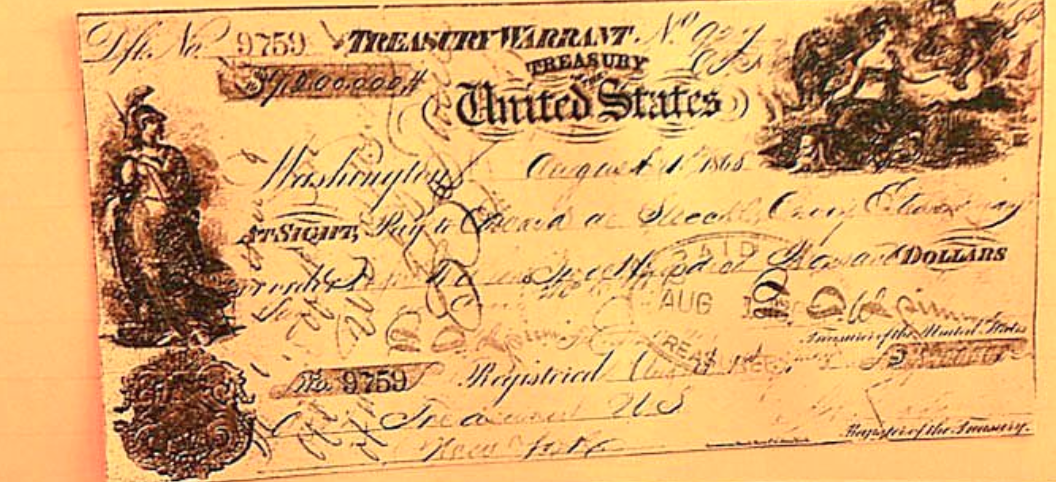
Adjusted for inflation, $7.2 million is about $162 million in 2026 dollars!
It was one of the largest land acquisitions in American history.
And one of the most ridiculed.
The deal added nearly 600,000 square miles to the United States — an area larger than Texas, California, and Montana combined.
The price?
Just $7.2 million.
That works out to about $12 per square mile.
Or roughly $0.02 per acre.
Two pennies.
Read that again: $0.02 for an Alaskan acre!
Today, you couldn’t buy a parking space in Manhattan for $7.2 million. You couldn’t buy an acre of barren desert for that. Heck, you couldn’t buy a cup of coffee with that.
But in 1867, many Americans thought Seward had lost his mind.
The newspapers were merciless.
Critics mocked the purchase as “Seward’s Folly.”
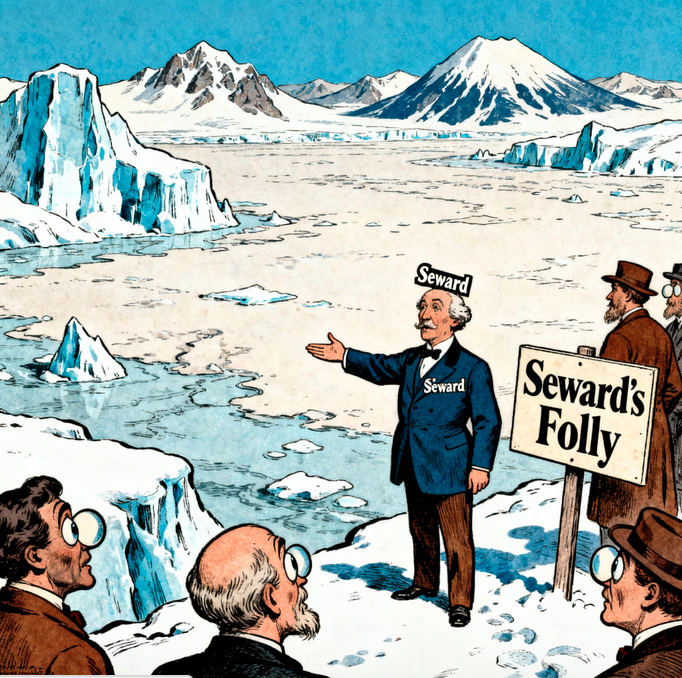
Others called it “Seward’s Icebox.”
Some referred to Alaska as “Andrew Johnson’s Polar Bear Garden.”
The New York World sneered that “Russia has sold us a sucked orange.”
The legendary newspaper editor Horace Greeley questioned why America should invest in a “territory of ice, snow, and rock.”
And yet another critic asked, “What do we want with a territory covered with glaciers, icebergs, bears, and walruses?”
Can you imagine?
Nearly 600,000 square miles.
Purchased for pennies.
And the overwhelming reaction wasn’t excitement. It was ridicule and pessimism.
The critics simply couldn’t see beyond the ice. They couldn’t see beyond the immediate costs.
And, perhaps most importantly, they couldn’t imagine a future that looked different from the present.
History has a funny way of repeating itself.
Because that’s exactly where we are today.
You see, every major leap forward in human civilization comes with a chorus of naysayers.
The railroad would bankrupt the nation. The automobile would destroy cities. Electricity was unnecessary. The internet was a fad.
And now?
Artificial intelligence is apparently going to consume all our electricity, destroy the environment, and turn America into one giant industrial construction site.
The Best Free Investment You’ll Ever Make
Join Wealth Daily today for FREE. We’ll keep you on top of all the hottest investment ideas before they
hit Wall Street. Become a member today, and get our latest free report: “The $10 Trillion AI Infrastructure Boom.”
It contains full details on why money managers are overpaid and provides you with
tools for growing your wealth.On your own terms. No fees, no commission.
If the complaints sound familiar, well they’re supposed to.
Every great investment in human progress initially looks expensive, unnecessary, or dangerous.
Until it doesn’t.
Today, there is enormous opposition to the construction of AI data centers.
Communities worry about power demand. Environmental groups worry about water usage. Activists complain about land use.
Some critics insist that America is overbuilding.
Others argue that AI itself is a bubble.
I’ve heard all of it.
And every time I do, I think about Alaska.
Because the people criticizing AI infrastructure today are making the same mistake that the critics of Alaska made in 1867.
They’re looking at the present and assuming it will look exactly the same 10 years from now.
It won’t.
When Seward bought Alaska, nobody knew there were vast deposits of gold beneath its soil.
Nobody knew it would become home to some of the richest fisheries in the world.
Nobody knew it would eventually produce billions upon billions of dollars in oil and natural gas.
Nobody knew Alaska would become one of America’s most strategically important military locations.
And nobody knew that it would provide critical minerals, timber, tourism, and immense geopolitical advantages.
They saw ice. That’s all they saw.
The return on investment from that $7.2 million purchase has been almost beyond comprehension.
Alaska’s economy today produces tens of billions of dollars annually.
In fact, Alaska is natural resource wealthy, it created its own version of a national sovereign wealth fund.
Called the Alaska Permanent Fund, it is currently worth about $91.2 billion as of May 31, 2026
The Prudhoe Bay oil fields alone have generated hundreds of billions of dollars in economic value.
The Trans-Alaska Pipeline has transported more than 18 billion barrels of oil.
The state’s proven mineral wealth includes gold, zinc, copper, silver, lead, rare earths, and enormous untapped deposits of critical minerals.
If America had sold Alaska today, it would likely command a valuation in the trillions of dollars.
Not billions.
Trillions.
Imagine turning a $7.2 million investment into trillions.
That’s not a good trade.
That’s one of the greatest investments in human history. And yet, when it happened, the newspapers laughed.
The lesson here isn’t really about Alaska.
It’s about vision.
Big opportunities almost always arrive disguised as controversy.
They arrive carrying criticism.
And they arrive accompanied by people who can only tell you why something won’t work.
You see, every great economic transformation requires infrastructure.
The Industrial Revolution required railroads. The automobile age required highways. The internet required fiber-optic cables and cell towers. The cloud computing revolution required massive data centers.
And artificial intelligence?
AI requires electricity.
A lot of it.
It requires transmission lines. It requires natural gas. It requires nuclear energy. It requires substations.
It requires copper, silver, steel, cement, uranium, transformers, and water infrastructure.
The build-out underway today may ultimately become one of the largest infrastructure projects in American history.
That’s why I continue to call it the second half of the MoneyQuake.
Monetary reformation is one side of the story.
The physical build-out is the other.
The AI economy is not simply software.
It’s concrete. It’s steel. It’s power plants. It’s mines. It’s pipelines. It’s construction. It’s jobs.
And yes, it is data centers. Lots of them.
Will there be growing pains?
Absolutely. There always are.
Did railroads disrupt communities?
Yes.
Did highways require enormous amounts of land? Of course.
Did electrification change the landscape of America? Without question.
But nobody today is arguing that we should have stopped building railroads. Nobody wishes we had never constructed the Interstate Highway System.
Nobody wants to unplug the electric grid.
The critics were forgotten. The progress remained.
Ten years from now, I suspect the same thing will happen with AI.
The headlines warning about data centers consuming too much electricity will be forgotten.
The fears about overbuilding will fade. The people predicting disaster will move on to the next disaster.
But the infrastructure being built today?
That will still be here.
Producing and generating wealth.
Powering industries that don’t even exist yet. Creating entirely new fortunes.
That’s why I pay close attention whenever I hear the phrase, “This is crazy.”
Because history teaches us something very important.
The greatest investments often sound crazy at the beginning.
Buying frozen wilderness from Russia sounded crazy. Building railroads across a continent sounded crazy. Launching internet companies with no profits sounded crazy. Building thousands of megawatts of new electricity generation and constructing enormous AI data centers sounds crazy today.
Maybe that’s precisely why the opportunity exists.
William Seward himself reportedly said of the Alaska Purchase later in life, “The purchase of Alaska. But it will take another generation to find out.”
He was right.
The world needed time to understand what he saw. Perhaps the same thing will be said about today’s AI infrastructure boom.
Perhaps one day our children and grandchildren will look back at this period and wonder why anyone ever opposed building the digital infrastructure that powered the next great economic expansion.
Perhaps they’ll laugh at the headlines. Maybe they’ll marvel at how obvious the opportunity seems in hindsight.
And perhaps they’ll discover, once again, one of history’s great truths:
The future belongs to the people who can see value long before everyone else does.
Get to the good, green grass first…
The Prophet of Profit,

Brian Hicks
 Check us out on YouTube!
Brian is a founding member and President of Angel Publishing. He writes about general investment strategies for Wealth Daily and Energy and Capital. Brian is the managing editor and investment director of R.I.C.H Report (Retired Independent Carefree Healthy), New World Assets and Extreme Opportunities. For more on Brian, take a look at his editor’s page.
The Best Free Investment You'll Ever Make
We never spam! View our Privacy Policy
After getting your report, you’ll begin receiving the Wealth Daily e-Letter, delivered to your inbox daily.
Angel Publishing Investor Club Discord - Chat Now
Brian Hicks Premium
Introductory

Advanced


