The Industrial Twin Has Arrived

Last week, the White House declared a national emergency. It got little media attention.
But it got mine!
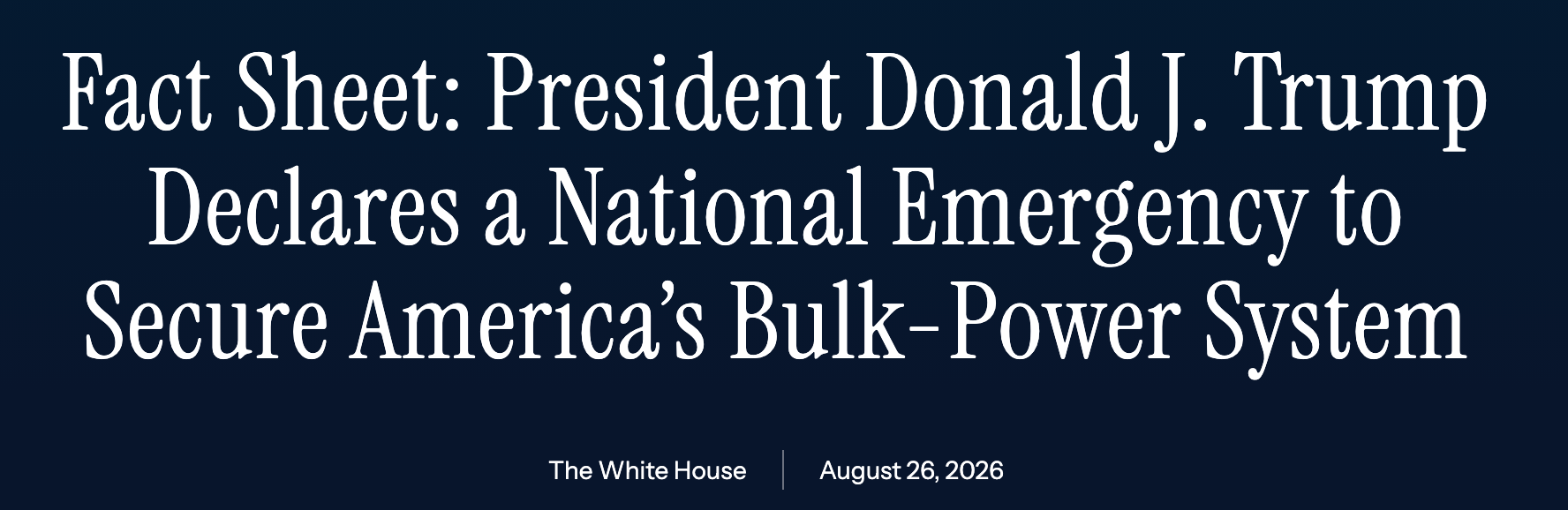
Buried beneath the daily noise of politics, earnings reports, and the endless churn of financial headlines was an announcement that most investors quickly dismissed as just another executive action. The White House declared a national emergency to secure America’s bulk power system, citing the rapidly growing electricity demands of artificial intelligence, advanced manufacturing, defense production, and critical infrastructure, while warning that dependence on foreign-made electrical equipment had become a national security risk.
At first glance, it sounds like an energy story.
It isn’t. It’s an economic story. An industrial story. And more importantly for you and me, it’s an investment story.
And even more importantly, it’s the clearest confirmation yet that one half of the MoneyQuake thesis is no longer a prediction. It’s becoming national policy.
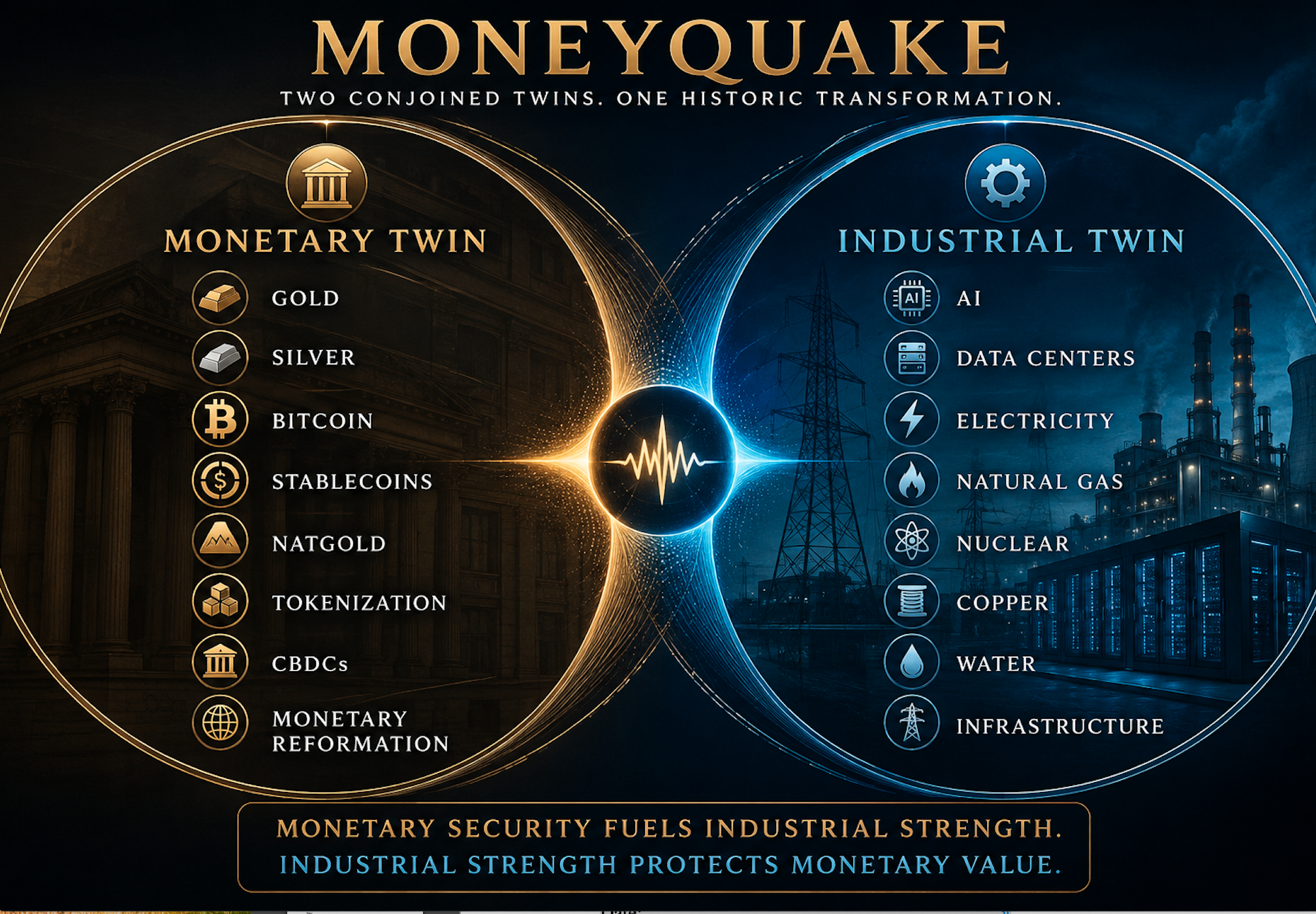
For nearly a year, I’ve argued that the world is being reshaped by two powerful forces moving simultaneously through the global economy. I’ve called them the Conjoined Twins of the MoneyQuake because neither can reach its full potential without the other.
The first twin is the one everyone sees.
It’s the Monetary Twin.
Gold climbing to record highs as central banks quietly rebuild their reserves. Silver finally awakening after years of neglect. Bitcoin transforming from an experiment into a strategic reserve asset. Stablecoins emerging as a new layer of the global financial system. Tokenization beginning to redefine ownership itself. NatGold challenging centuries-old assumptions by bringing one of humanity’s oldest stores of value into the digital economy.
That story is becoming increasingly obvious.
The second twin, however, has remained largely hidden in plain sight.
It doesn’t make as many headlines because it isn’t measured in ounces, coins, or tokens.
It’s measured in megawatts.
Steel. Copper. Concrete. Water.
Those resources will be used to build…
Transmission lines. Transformer factories. Natural gas turbines. Nuclear reactors. Construction cranes.
Millions upon millions of man-hours will be spent rebuilding the physical foundation of the modern economy.
The Best Free Investment You’ll Ever Make
Join Wealth Daily today for FREE. We’ll keep you on top of all the hottest investment ideas before they
hit Wall Street. Become a member today, and get our latest free report: “Why You Need to Fire Your Money
Manager.”
It contains full details on why money managers are overpaid and provides you with
tools for growing your wealth.On your own terms. No fees, no commission.
This is the Industrial Twin.
And last week’s announcement from Washington may prove to be one of the most important acknowledgments of its existence.
When most people hear the words “artificial intelligence,” they picture software.
They imagine chatbots, algorithms, or futuristic robots.
That’s understandable.
But it’s also incomplete.
Artificial intelligence doesn’t live in the cloud. The cloud is simply someone else’s building.
Behind every AI model is an enormous physical campus stretching across hundreds of acres. Inside are row after row of servers consuming staggering amounts of electricity, cooled by sophisticated water systems, connected through miles of fiber-optic cable, powered by transformers the size of small homes, and supported by substations capable of supplying enough electricity to power entire communities.
AI isn’t just software.
It’s one of the largest industrial construction projects of the 21st century.
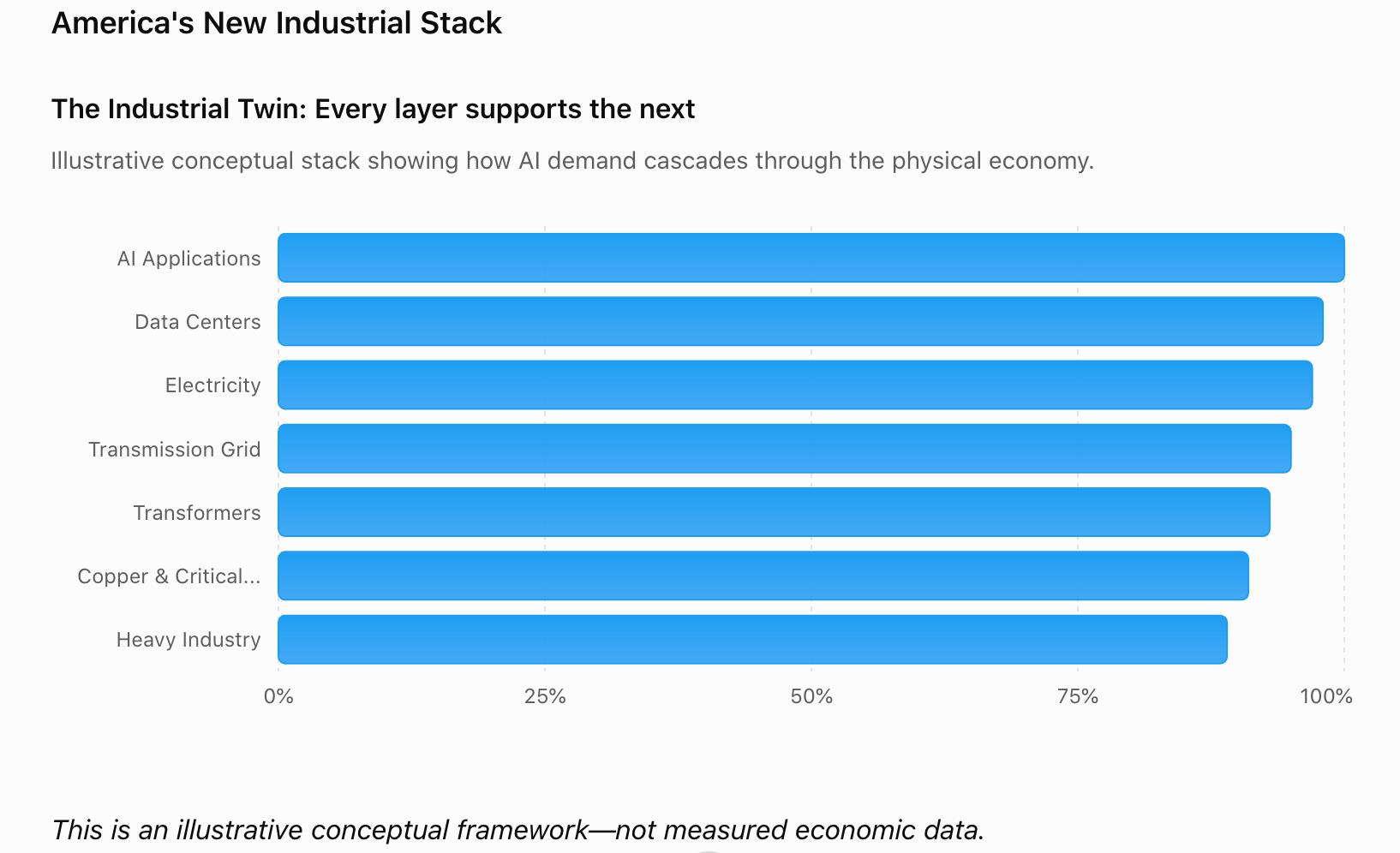
Every new data center creates demand for electricity.
More electricity requires additional generation.
Generation requires natural gas, nuclear power, hydroelectric facilities, or other reliable sources of baseload power.
That power must travel across new transmission lines.
Transmission lines require steel, aluminum, and enormous quantities of copper.
Copper must come from mines.
Mines require heavy equipment, diesel fuel, explosives, engineering firms, skilled labor, and financing.
Suddenly, what appeared to be a technology story becomes a story about mining, manufacturing, transportation, energy, construction, and infrastructure.
One investment leads to another. One project creates demand for 10 more.
That’s why I’ve never viewed AI as a single industry.
I’ve viewed it as an industrial flywheel.
Think about when President Eisenhower championed the Interstate Highway System. Many Americans saw just roads.
What they were really witnessing was the creation of the modern consumer economy.
The interstate system reshaped manufacturing, retail, tourism, logistics, housing, and countless industries that hadn’t even been imagined when the first sections of pavement were poured.
Likewise, when rural electrification swept across America, it wasn’t simply about turning on lights.
It revolutionized agriculture, manufacturing, health care, and productivity.
As a result, it raised living standards for millions of Americans.
Electricity became the invisible foundation beneath nearly every economic advance that followed.
Today, we’re living through another one of those moments.
Only this time, the infrastructure isn’t being built for automobiles.
It’s being built for intelligence. Artificial intelligence.
And just as the interstate highways became the circulatory system of 20th-century America, electricity is becoming the circulatory system of the 21st century.
That’s precisely what makes last week’s White House announcement so significant.
The administration wasn’t merely responding to concerns about transformers or imported electrical components. It was recognizing something much larger: America’s ability to lead in artificial intelligence, advanced manufacturing, and national defense increasingly depends on an abundant, secure, and resilient supply of electricity.
Think about how remarkable that is.
For decades, America optimized its economy around efficiency.
Manufacturing moved overseas. Supply chains stretched across continents. Critical components were sourced from wherever they could be produced at the lowest cost.
That strategy worked in a world where stability was largely taken for granted.
But today’s world looks very different.
Artificial intelligence has ignited an unprecedented race for computing power. Nations are competing to secure critical minerals, semiconductor manufacturing, energy resources, and industrial capacity. Supply chains once viewed purely through the lens of economics are now increasingly viewed through the lens of national security.
In that environment, electricity is no longer just another utility. It’s a strategic asset.
That realization changes everything.
Because once electricity becomes a strategic asset, every industry connected to producing it, transmitting it, protecting it, and expanding it becomes strategically important as well.
I’m talking about natural gas, nuclear power, and copper just to name a few.
Those will be used to build…
- Transmission equipment
- Transformer manufacturing
- Grid cybersecurity
- Water infrastructure
Viewed separately, they look like different sectors.
Viewed together, they form something much larger.
They form the Industrial Twin.
And I believe we’re only beginning to appreciate its true scale.
In my next Wealth Daily, I’ll explain how it will be done.
Get to the good, green grass first…
The Prophet of Profit,

Brian Hicks
 Check us out on YouTube!
Brian is a founding member and President of Angel Publishing. He writes about general investment strategies for Wealth Daily and Energy and Capital. Brian is the managing editor and investment director of R.I.C.H Report (Retired Independent Carefree Healthy), New World Assets and Extreme Opportunities. For more on Brian, take a look at his editor’s page.
The Best Free Investment You'll Ever Make
We never spam! View our Privacy Policy
After getting your report, you’ll begin receiving the Wealth Daily e-Letter, delivered to your inbox daily.
Angel Publishing Investor Club Discord - Chat Now
Brian Hicks Premium
Introductory

Advanced


