China’s Antimony Ban Is About to Return. America Isn't Ready.

In less than four weeks, China could once again cut off American access to one of the most strategically important metals on Earth.
And most Americans have probably never heard of it.
It’s called antimony.
This obscure, silvery metal is essential for manufacturing ammunition, explosives, military electronics, and numerous other products critical to American national security.
It’s also a material the United States once produced in enormous quantities.
But today, America depends almost entirely on foreign suppliers.
And China has already demonstrated what happens when those suppliers decide to stop selling.
On November 27, China’s temporary suspension of its antimony export ban is scheduled to expire.
Unless Beijing formally extends that suspension, the United States could face another major supply disruption.
And the consequences could extend far beyond the mining industry…
The Ban That Sent Prices Soaring
In September 2024, China implemented export controls on antimony, requiring suppliers to obtain government licenses before shipping the metal overseas.
Three months later, Beijing went further.
In December 2024, China effectively banned exports of certain antimony-related materials to the United States.
The restrictions also covered gallium and germanium, two other strategically important materials used in advanced electronics and defense technologies.
It didn’t take long for the market to react.
Antimony prices climbed from approximately $9.80 per pound in August 2024 to $18.10 by December; by June 2025, they had reached $27.50 per pound.
That’s an increase of about 180% in less than a year.
And American manufacturers suddenly found themselves scrambling for supplies of a material they couldn’t easily replace.
Some buyers even resorted to routing shipments through third countries to circumvent the disruption.
But it was clear that China had made its point…
Control the supply of a critical mineral, and you can exert enormous pressure on the industries that depend on it.
The Best Free Investment You’ll Ever Make
Join Gold World today for FREE. Get the latest insight on gold, silver, and precious metals delivered straight to your inbox. When you become a member today, you’ll get our latest free report: “The #1 Golden Token to Buy Now.” Don’t Delay!
After getting your report, you’ll begin receiving the Gold World e-Letter, delivered to your inbox daily.
A Temporary Reprieve with an Expiration Date
In November 2025, following negotiations between Washington and Beijing, China agreed to suspend its U.S.-specific export prohibition.
But there was a catch: The suspension was temporary, with an expiration date of November 27, 2026.
And even during the suspension, China maintained broader licensing requirements for antimony exports.
Restrictions on supplying American military end users also remained in place.
In other words, Beijing never fully surrendered its control over the supply chain; it simply loosened its grip.
Now, with the deadline approaching, that grip could tighten again.
Although broader U.S.-China trade arrangements have been extended, the specific November 27 deadline has not been clearly superseded by a published amendment.
That leaves American manufacturers facing another period of uncertainty.
And uncertainty is particularly dangerous when the material in question is essential to national defense.
America’s Dangerous Dependence
The numbers tell the story…
According to the USGS, the United States depended on net imports for approximately 91% of its antimony consumption in 2025.
Meanwhile, global mine production is overwhelmingly concentrated in three countries…
China produced approximately 40,000 metric tons last year. Russia produced another 32,000, and Tajikistan contributed approximately 22,000.
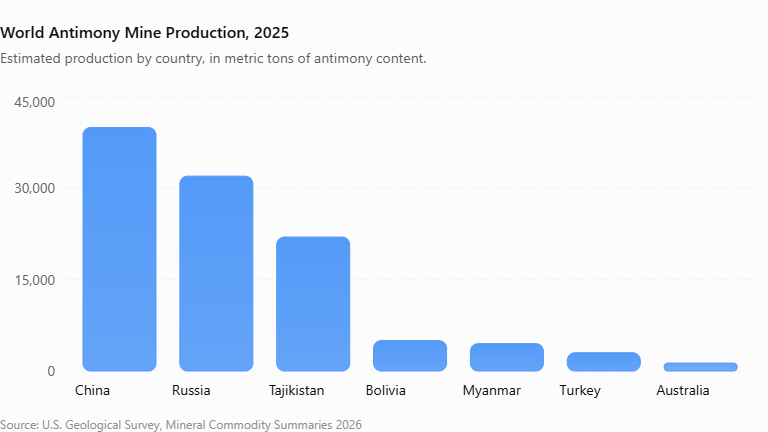
Together, those countries accounted for roughly 85% of global production.
Making matters worse, Tajikistan has substantial Chinese investment in its mining industry and historically shipped 100% of its antimony concentrates to China for processing.
That’s a very concentrated supply chain for a material essential to the Western military-industrial complex.
You see, antimony strengthens lead alloys used in ammunition, while antimony sulfide plays an important role in ammunition primers.
It’s also used in infrared equipment, night-vision systems, flame retardants, and industrial batteries.
Imagine trying to expand ammunition production during a major conflict when your adversaries control access to the essential raw materials.
That’s the vulnerability America faces.
The Solution Is Buried in Our Own Backyard
Ironically, we’ve confronted this problem before…
During World War II, Japanese advances in China threatened American access to antimony supplies.
Fortunately, domestic mining helped close the gap.
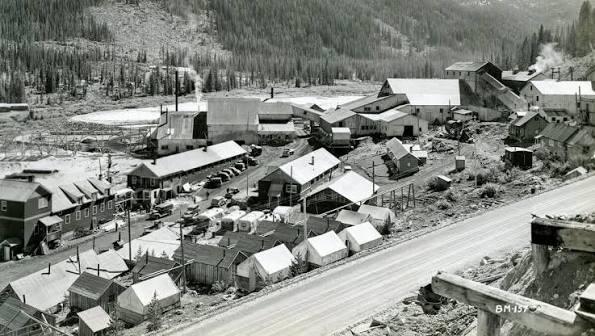
The Stibnite district in Idaho became one of America’s most important wartime sources of antimony and tungsten, supplying metals essential to Allied weapons production.
They’re also advancing domestic processing capabilities to reduce dependence on foreign refineries.
These efforts could help rebuild a strategic industry America allowed to deteriorate over decades.
But developing mines, constructing processing facilities, and establishing reliable supply chains takes years.
And China can change its export policies with the stroke of a pen.
That’s the problem and it’s a BIG one…
November 27 Is a Warning
Whether China reinstates its antimony ban this month, extends the suspension, or negotiates another compromise, the larger lesson remains unchanged.
America cannot afford to depend on rivals for the materials needed to defend itself.
And antimony is hardly the only mineral presenting this problem…
For investors, rebuilding domestic mineral supply chains represents a potentially enormous long-term opportunity.
For the United States and its allies, it’s becoming a strategic necessity.
Because the same metal that helped America win World War II is once again at the center of a global struggle for industrial and military dominance.
The question is whether we’ll rebuild the capacity to produce it before the next crisis forces our hand.
To your wealth,

Jason Williams
 @TheReal_JayDubs
 Angel Research on Youtube
After graduating Cum Laude in finance and economics, Jason designed and analyzed complex projects for the U.S. Army. He made the jump to the private sector as an investment banking analyst at Morgan Stanley, where he eventually led his own team responsible for billions of dollars in daily trading. Jason left Wall Street to found his own investment office and now shares the strategies he used and the network he built with you. Jason is the founder of Main Street Ventures, a pre-IPO investment newsletter; the founder of Future Giants, a nano cap investing service; and authors The Wealth Advisory income stock newsletter. He is also the managing editor of Wealth Daily. To learn more about Jason, click here.
Want to hear more from Jason? Sign up to receive emails directly from him ranging from market commentaries to opportunities that he has his eye on.
The Best Free Investment You'll Ever Make
We never spam! View our Privacy Policy
After getting your report, you’ll begin receiving the Wealth Daily e-Letter, delivered to your inbox daily.
Angel Publishing Investor Club Discord - Chat Now
Jason Williams Premium
Introductory

Advanced


