Wall Street Just Put the AI Revolution on Sale

Three weeks.
That’s all it took.
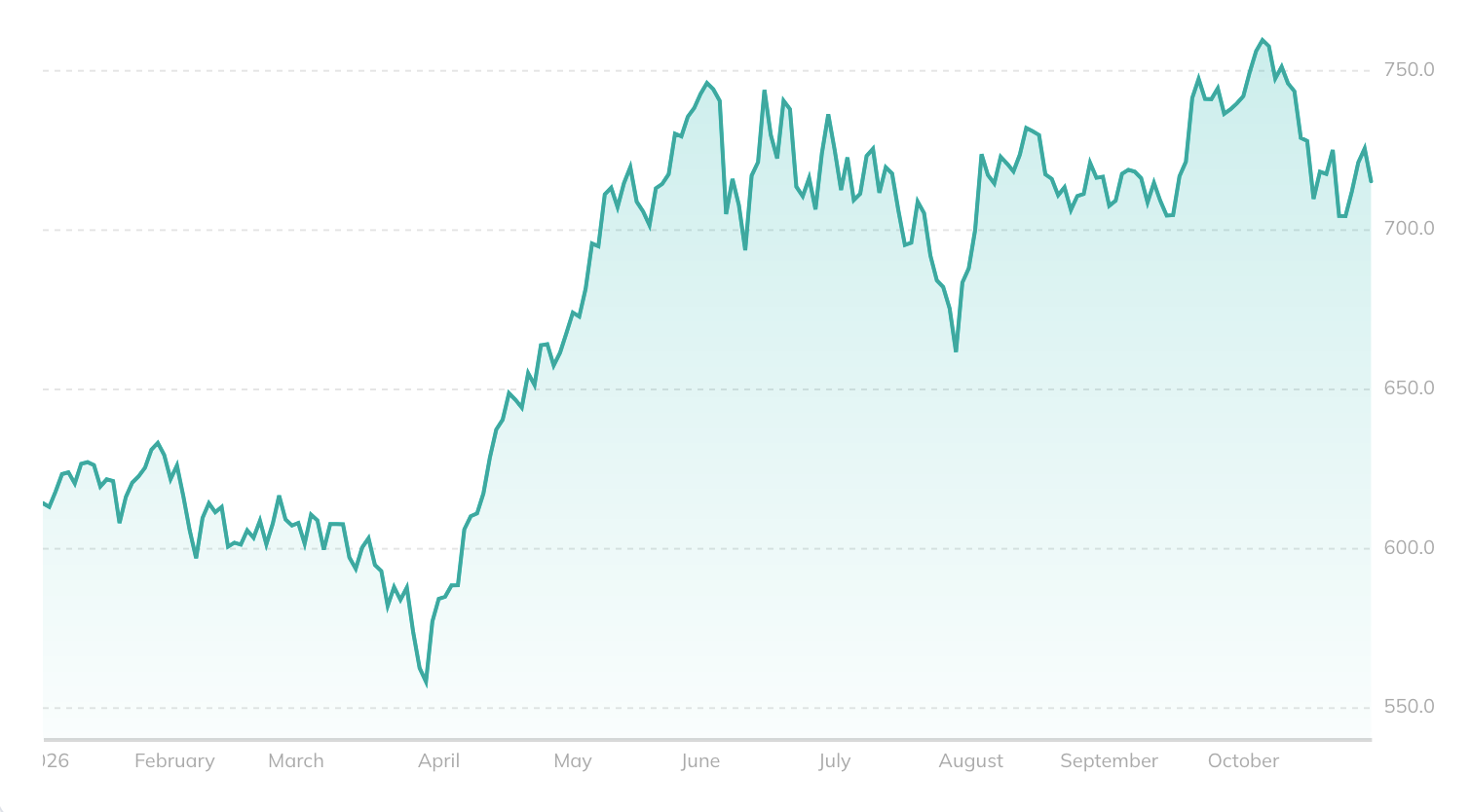
Three weeks ago, Wall Street was celebrating the artificial intelligence revolution. The Nasdaq 100 was trading in record territory.
Investors couldn’t get enough of the companies building the infrastructure for what could become the greatest technological transformation since the Industrial Revolution.
And this week?
They’re running for the exits.
Google is getting crushed.
Amazon is getting hammered.
Intel is getting demolished.
And hundreds of billions of dollars in stock market wealth are disappearing faster than you can say “artificial intelligence.”
The financial media is already dusting off its favorite headlines.
The AI bubble is bursting.
Big Tech spending is out of control.
The AI trade is over.
Really?
Because from where I’m sitting, this looks like something entirely different.
It looks like Wall Street just handed long-term investors one of the most compelling buying opportunities of the AI revolution.
And the irony is almost too delicious to believe.
The very thing that has investors panicking — the hundreds of billions of dollars being spent on artificial intelligence infrastructure — is the same force driving an extraordinary industrial investment boom across America.
We’re talking about power plants. Electrical grids. Natural gas turbines. Copper. Steel. Concrete. Semiconductors. Cooling systems. Data centers.
And an army of electricians, engineers, construction workers, and technicians needed to put it all together.
This isn’t some imaginary economy built on internet clicks and speculative promises.
This is an economy being rebuilt with steel, copper, concrete, silicon, and electricity.
And Wall Street is putting it on sale.
The Great AI Stock Market Massacre
Before we talk about the opportunity, let’s appreciate the extraordinary scale of this sell-off.
On Thursday, October 29, Alphabet, the parent company of Google, suffered a historic collapse.
Its shares plunged approximately 12%, erasing nearly $500 billion in market capitalization in a single trading session.
Half a trillion dollars.
Gone.
In one day.
The trigger? Disappointing growth in Google’s search advertising business, combined with investor anxiety over the company’s enormous AI infrastructure spending.
The Best Free Investment You’ll Ever Make
Join Wealth Daily today for FREE. We’ll keep you on top of all the hottest investment ideas before they
hit Wall Street. Become a member today, and get our latest free report: “The $10 Trillion AI Infrastructure Boom.”
It contains full details on why money managers are overpaid and provides you with
tools for growing your wealth.On your own terms. No fees, no commission.
And that was just the opening act.
By Friday morning, Amazon shares were down approximately 7% in premarket trading after investors digested another staggering round of AI capital expenditures.
Intel was down roughly 25%, battered by concerns about cash burn, manufacturing challenges, and weak PC demand.
Together, Amazon and Intel were on track to lose another $300 billion in market value if those early losses held.
Meanwhile, Nvidia, AMD, and Broadcom were all under pressure, and Nasdaq 100 futures were sinking more than 2%.
Let’s put that into perspective.
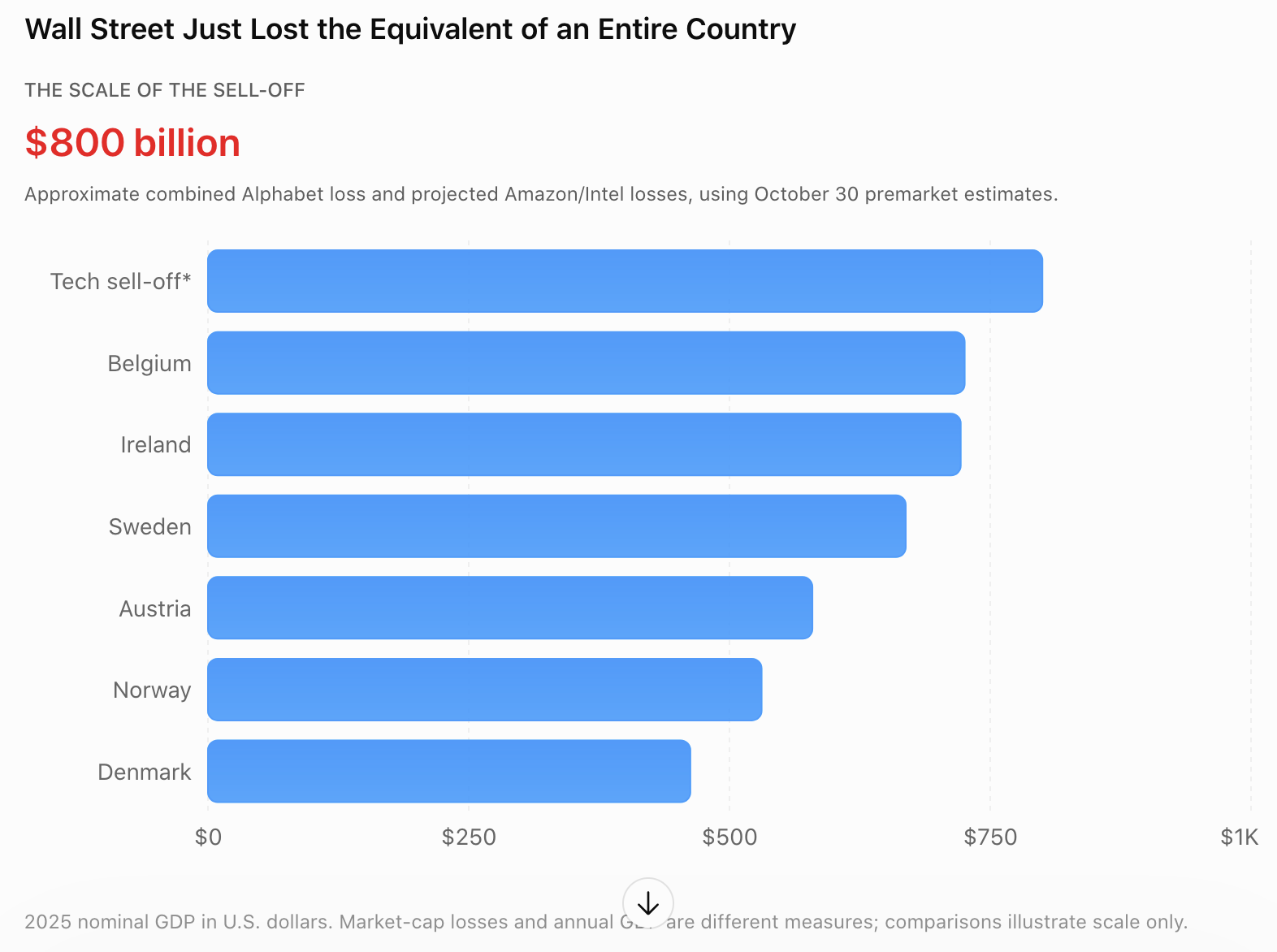
In just two trading sessions, Alphabet’s realized losses and the projected declines in Amazon and Intel amounted to approximately $800 billion.
That’s not the final tally of the entire technology sell-off. It’s a snapshot of just three companies, with Friday’s losses still provisional.
But even that snapshot is staggering.
Wall Street Just Lost the Equivalent of an Entire Country
$800 billion.
Approximate combined Alphabet loss and projected Amazon/Intel losses, using October 30 premarket estimates.
Consider what you’re looking at.
In approximately 48 hours, the stock market was threatening to erase more value from three American companies than the entire annual economic output of Belgium.
Or Sweden.
Or Ireland.
In fact, the $800 billion figure is larger than the annual GDP of Norway and Denmark combined.
And here’s another extraordinary comparison.
Alphabet’s roughly $500 billion one-day loss alone exceeded the annual economic output of Denmark.
Think about that.
A single American technology company lost more stock market value in one day than an entire developed European nation produces in a year.
Now, market capitalization isn’t GDP. One measures what investors are willing to pay for a company’s equity; the other measures a nation’s annual economic production.
But as a measure of financial magnitude?
It’s breathtaking.
And it reveals something important about the markets we’re investing in today.
The scale of the AI revolution has become so enormous that even its corrections are historically extraordinary.
Three Weeks Ago, Everyone Wanted In
Here’s what makes this sell-off so fascinating.
Just weeks ago, the QQQs — the Invesco ETF tracking the Nasdaq 100 — were trading in the neighborhood of record highs.
At the end of September, the fund stood at $739.77, barely 1% below its then-record closing price of $747.46.
Now the Nasdaq 100 is approximately 6% below its highs, according to reporting during this earnings season.
The market narrative has changed almost overnight.
Three weeks ago, the AI revolution was unstoppable.
Today, investors are worried that the companies building it are spending too much money.
But here’s my question.
What exactly has changed about the underlying need for AI infrastructure?
Has America suddenly discovered an unlimited supply of electricity? Have we solved the shortage of high-performance computing capacity? Have we built all the data centers we’ll ever need? Have copper, electrical transformers, gas turbines, and skilled construction workers suddenly become abundant?
Of course not.
The physical requirements of this revolution haven’t disappeared because some portfolio managers got nervous about quarterly cash flow.
And that’s the distinction between a stock market correction and a collapse in the underlying investment thesis.
They’re not the same thing.
The Economy Is Rocking — and AI Is Helping Drive It
Now here’s the part of this story that I find especially revealing.
While Wall Street is obsessing over quarterly earnings, the actual American economy is showing considerable strength.
Third-quarter GDP expanded at a 3.4% annualized rate, according to the latest economic reporting.
That’s not the profile of an economy rolling over.
It’s an economy demonstrating real momentum.
And the enormous AI capital expenditure cycle is one important part of the investment story.
Think about what happens when Amazon announces another multibillion-dollar data center project.
Before a single AI model generates revenue, somebody has to purchase the land.
That spending doesn’t stay inside Silicon Valley.
It flows into the industrial heartland.
Into utilities. Into engineering firms. Into construction companies. Into manufacturers that most technology investors couldn’t identify if their lives depended on it.
This is the industrial side of the MoneyQuake I’ve been writing about.
And it’s unfolding right in front of us.
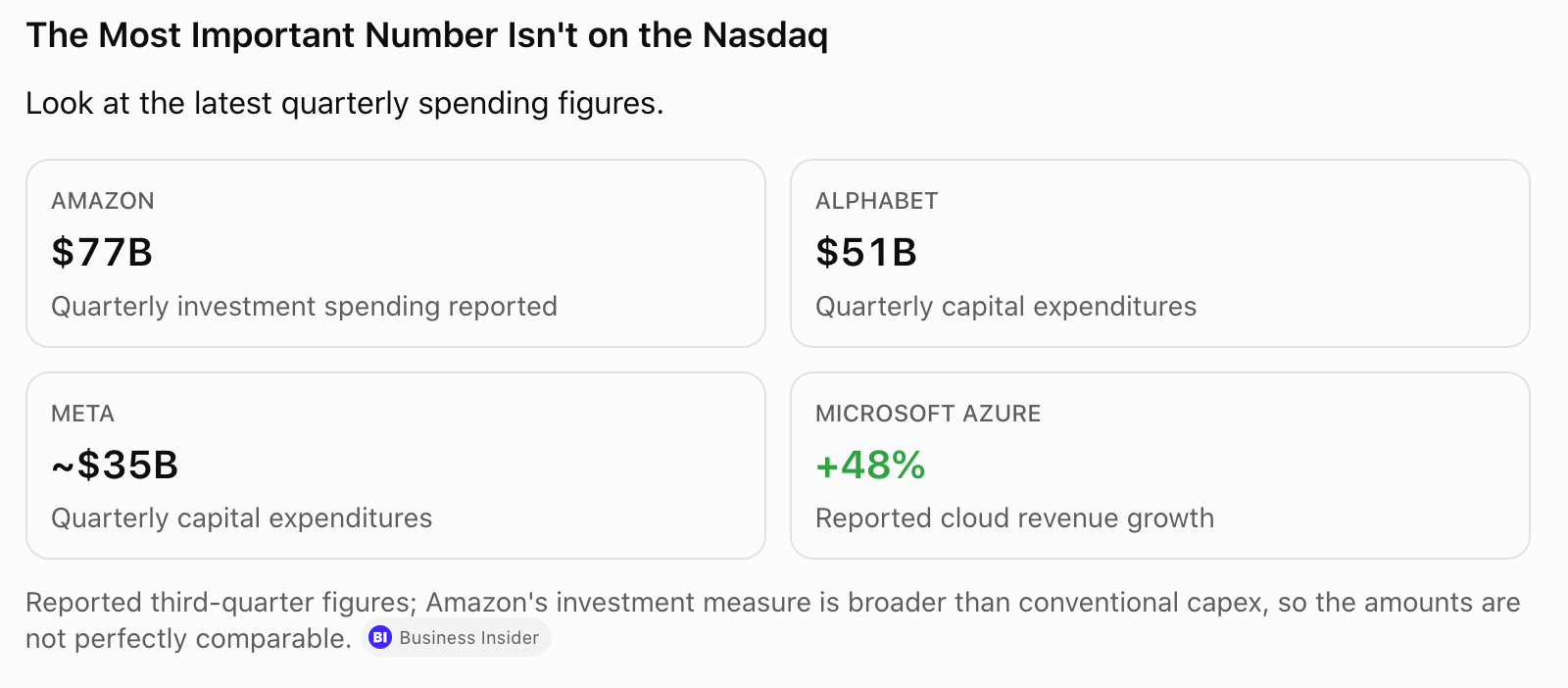
Amazon, Alphabet, and Meta alone reported approximately $163 billion in combined quarterly investment outlays using these reported measures.
And investors are upset?
Now, I understand the concern.
Spending money is not the same as making money.
Negative free cash flow is real. So is the possibility that companies overbuild infrastructure, misjudge demand, or fail to earn adequate returns on their investment.
But there’s another side to that equation.
One company’s capital expenditure is another company’s revenue.
And in this particular revolution, the recipients of that spending may be among the most attractive investment opportunities of all.
Which brings me to a company I’ve been following for years.
The Company That Doesn’t Care Who Wins the AI War
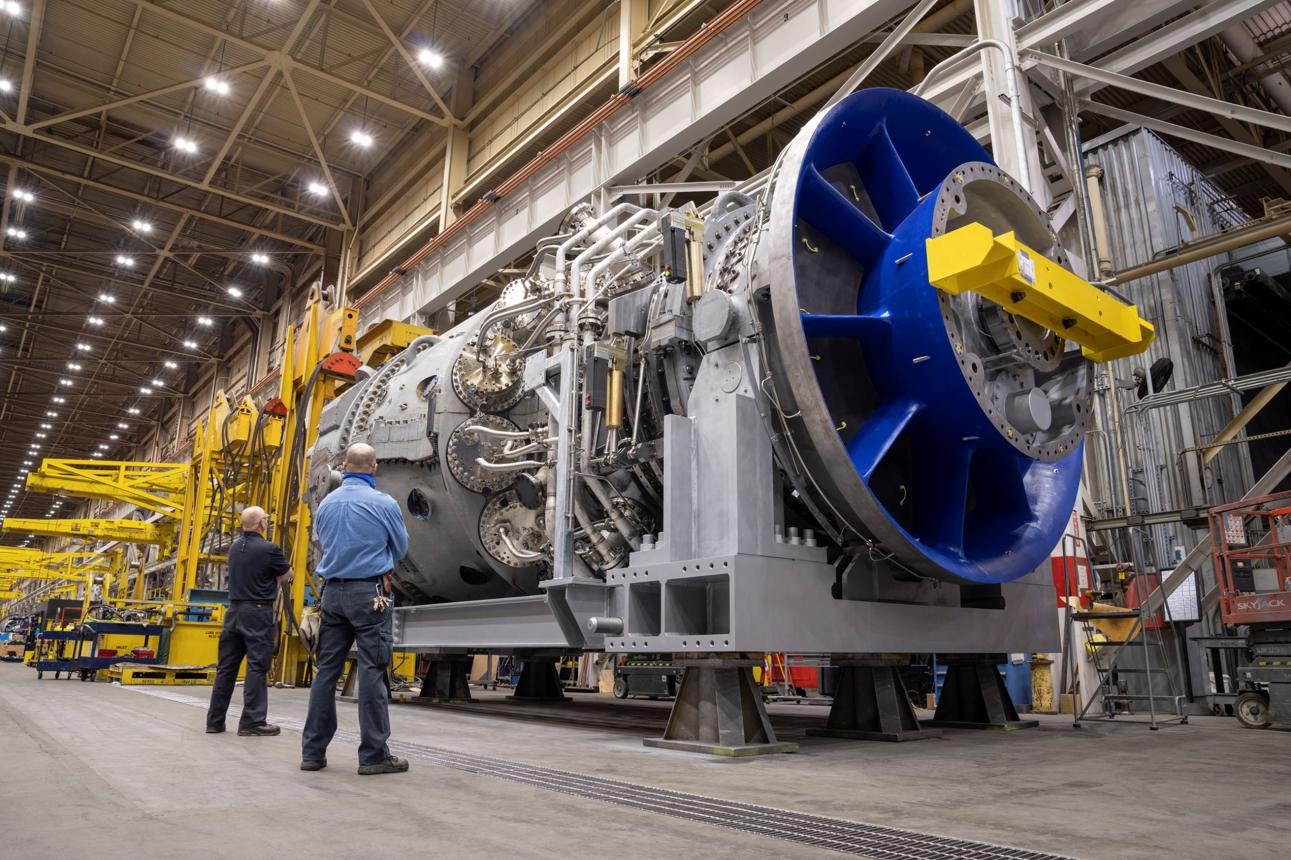
GE Vernova (NYSE: GEV).
A major supplier of power-generation and grid equipment needed to support expanding electricity demand, including demand from data centers.
GE Vernova represents exactly the kind of company that can benefit from the industrial side of the AI buildout.
Think about it.
Microsoft wants more computing capacity. Amazon wants more computing capacity.
Google wants more computing capacity. Meta wants more computing capacity.
And they all need electricity.
Enormous amounts of it.
It doesn’t matter which AI chatbot ultimately wins the battle for market share.
It doesn’t matter whether consumers prefer ChatGPT, Gemini, Claude, or whatever comes next.
The computers still have to run.
The data centers still have to be powered.
And the electrical infrastructure still has to be built.
That’s why I’ve been so focused on the companies supplying the physical foundations of this technological revolution.
The businesses providing turbines, transformers, transmission equipment, power systems, and critical materials may have more durable demand than many investors appreciate.
Of course, even an excellent business can be a poor investment if its stock price already assumes years of extraordinary growth.
But that’s precisely why corrections matter.
They can create opportunities to buy exposure to a long-term trend at more reasonable valuations.
Wall Street Is Confusing the Price of the Revolution With Its Value
I’ve been investing long enough to recognize a familiar pattern.
When an emerging technology starts changing the world, Wall Street initially underestimates it.
Then investors discover it. Then everybody wants to own it. Then expectations get ahead of reality.
And eventually, the market has a tantrum.
We saw variations of this during the internet revolution.
During the mobile computing revolution. During the cloud computing revolution.
And now we’re seeing it during the AI revolution.
The mistake is assuming that because investors overpaid for certain stocks, the technology itself must be a failure.
It isn’t.
But here’s an important distinction.
The internet absolutely changed the world.
That didn’t prevent countless internet stocks from collapsing in 2000.
Some never recovered.
Others went on to become among the most valuable businesses in history.
That’s why I don’t advocate blindly buying every AI stock that falls 20%.
I want the companies with real demand, strong balance sheets, defensible competitive positions, and the ability to convert this investment boom into durable earnings.
And I especially like the companies supplying essential infrastructure to multiple participants in the AI race.
Because in a gold rush, you don’t always need to know who will discover the richest vein.
Sometimes you want to own the company selling the picks, shovels, and heavy machinery.
The Greatest Buying Opportunities Rarely Feel Comfortable
Here’s something I’ve learned over decades of investing.
Nobody rings a bell at the bottom.
Nobody sends you an invitation announcing that the market has finally reached the perfect entry point.
Instead, the headlines get ugly.
Analysts start lowering their targets.
Financial television becomes a parade of pessimists.
And investors begin wondering whether the entire investment thesis was wrong.
That’s usually when the most interesting opportunities begin to emerge.
But it doesn’t mean every dip is the bottom.
Friday’s selling could intensify. Valuations could compress further. Higher financing costs, weaker AI monetization, and continued cash burn could turn this into a much longer correction.
That’s why patience, position sizing, and selectivity matter.
I would rather build positions in stages than pretend I can predict the exact day this correction ends.
But I also refuse to confuse falling share prices with the end of an industrial revolution.
Because here’s what I believe Wall Street is missing.
The AI infrastructure boom is no longer just a technology story. It’s an American industrial story.
It’s about rebuilding power generation.
Expanding the electrical grid.
Securing domestic supplies of critical minerals.
Manufacturing the equipment needed to support a new generation of computing.
And creating the physical infrastructure for an economy increasingly driven by artificial intelligence, automation, and robotics.
That’s the MoneyQuake.
And a few bad trading sessions won’t make it disappear.
My Favorite Three Words: Buy the Dip
Three weeks ago, investors were lining up to buy the AI revolution near record prices.
Today, they’re dumping many of the same companies because the revolution is costing more than they expected.
But that cost is also generating an extraordinary wave of demand throughout the American industrial economy.
And that demand isn’t going away tomorrow.
The market is asking whether Big Tech will earn enough on its enormous AI investments.
That’s a legitimate question.
But investors should be asking another question, too.
Who gets paid to build all this infrastructure, regardless of which AI company ultimately wins?
That’s where I see some of the most interesting opportunities of the coming decade.
Power generation.
Grid modernization.
Copper.
Critical minerals.
Industrial equipment.
And the companies supplying the essential building blocks of the new economy.
So while Wall Street obsesses over billions of dollars in quarterly cash burn, I’ll be watching the trillions of dollars of physical investment that could reshape America’s economy.
Because I believe we’re witnessing something far bigger than a speculative technology boom.
We’re watching the early stages of a generational industrial transformation.
And if Wall Street wants to put that transformation on sale?
I’m interested.
Not because every beaten-down AI stock deserves to be bought. Not because the market can’t fall further.
But because the best long-term investments are often made when short-term fear overwhelms long-term thinking.
Remember:
Three weeks ago, Wall Street loved the AI revolution at record prices.
Today, it’s terrified of that same revolution at a discount.
The revolution hasn’t stopped. The spending hasn’t stopped. The construction hasn’t stopped.
And the need for power, computing capacity, and critical materials certainly hasn’t stopped.
Only the market’s enthusiasm has changed.
And that, dear reader, is why this sell-off has my attention.
The AI revolution is still being built.
Wall Street just lowered the admission price.
Get to the good, green grass first…
The Prophet of Profit,

Brian Hicks
 Check us out on YouTube!
Brian is a founding member and President of Angel Publishing. He writes about general investment strategies for Wealth Daily and Energy and Capital. Brian is the managing editor and investment director of R.I.C.H Report (Retired Independent Carefree Healthy) New World Assets and Extreme Opportunities. For more on Brian, take a look at his editor’s page.
The Best Free Investment You'll Ever Make
We never spam! View our Privacy Policy
After getting your report, you’ll begin receiving the Wealth Daily e-Letter, delivered to your inbox daily.
Angel Publishing Investor Club Discord - Chat Now
Brian Hicks Premium
Introductory

Advanced


