Chapter 7: The Age of Scarcity

Imagine you’ve just been hired to build a $10 billion artificial intelligence data center somewhere in America.
Congratulations. You’ve secured the financing. You’ve purchased hundreds of acres of land. Your engineers have completed the designs, and your customer has already committed billions of dollars to purchase the most advanced computing equipment on Earth.
You’ve got everything you need to build one of the most sophisticated technological facilities in human history.
Or so you think.
Then the phone calls begin.
Your electrical contractor tells you the giant transformers required to connect your facility to the power grid may not arrive on schedule. Your equipment supplier informs you that the gas turbines you’ve ordered are competing for manufacturing capacity with dozens of other projects. Your construction manager says qualified electricians are becoming increasingly difficult to recruit.
Meanwhile, your concrete subcontractor is struggling to schedule enough trucks and crews to complete a major foundation pour. The mechanical contractor needs more pipefitters and welders. Your cooling equipment supplier is warning about delivery schedules, and the local utility is still trying to determine when it can provide the electricity you’ve requested.
Suddenly, your $10 billion project has a problem that another billion dollars cannot necessarily solve.
You can’t buy something that doesn’t exist.
And you can’t install something if there aren’t enough qualified people available to install it.
Welcome to the next phase of the artificial intelligence revolution.
Welcome to the Age of Scarcity.
The Great Collision
Over the past six chapters, we’ve traveled through 80 years of computing history, beginning with ENIAC in 1946 and ending with today’s enormous AI factories. Along the way, we’ve watched computers evolve from 30-ton machines occupying entire rooms into sophisticated networks of processors housed inside industrial complexes requiring extraordinary quantities of electricity.
In our last chapter, we explored what I call the Great AI Power Race. We examined how artificial intelligence is transforming the electricity industry and creating new demand for natural gas turbines, nuclear reactors, transmission lines, transformers and electrical equipment.
But the power race is only one part of a much larger story.
Because once you begin building power plants, semiconductor factories, electrical transmission networks and enormous data centers simultaneously, you discover something that doesn’t get nearly enough attention on Wall Street.
All these projects compete for many of the same resources.
They need copper. They need steel. They need aluminum. They need concrete, aggregate and cement. They need electrical equipment, industrial machinery, cooling systems, and water infrastructure.
And perhaps most importantly, they need people who know how to put everything together.
That’s where the MoneyQuake becomes particularly interesting. Artificial intelligence isn’t simply creating demand for more computing power. It’s colliding with an industrial economy that has physical limits, long development cycles, and a workforce that cannot expand overnight.
For decades, Wall Street rewarded companies capable of scaling their businesses without making equally large investments in physical infrastructure. Software companies became enormously valuable precisely because they could distribute their products to millions of customers at relatively low incremental cost.
But artificial intelligence is forcing a remarkable reversal.
The most sophisticated digital technology humanity has ever created is becoming dependent upon some of the oldest industries on Earth.
Mining. Steelmaking. Cement manufacturing. Construction. Electrical contracting. Plumbing. Welding. Power generation.
Silicon Valley has discovered that it cannot build the future without blue-collar America.
You Can’t Download a Copper Mine
Let’s start with copper.
If I asked you to name the most important material in the AI revolution, you’d probably say silicon. After all, silicon is the foundation of the semiconductor industry, and the chips manufactured from it have become the engines of modern computing.
But silicon doesn’t deliver electricity.
Copper does.
Copper is essential to electrical wiring, motors, transformers, generators, busbars, power distribution systems, and countless other components of the modern electrical economy.
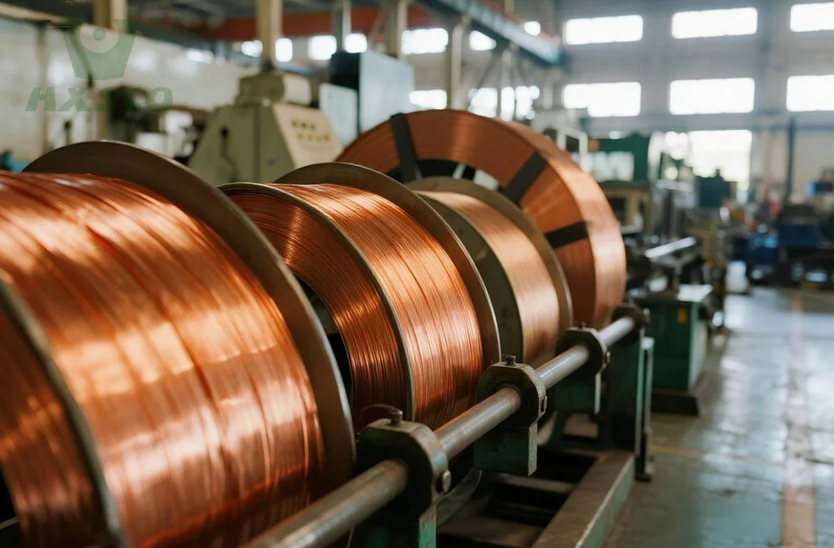
A major data center requires enormous amounts of electrical infrastructure, but the demand extends far beyond the building itself. Additional electricity generation may require new turbines and generators. Transmission upgrades require conductors and substations. New industrial facilities need wiring and electrical equipment. Cooling systems require pumps and motors.
Copper participates throughout this chain.
And here’s the problem.
A technology company can announce a $20 billion AI investment in an afternoon. Developing a new copper mine can take well over a decade when exploration, permitting, financing, construction, and commissioning are considered.
Even when a company discovers a large deposit, it must determine whether the resource can be economically extracted. Then it must secure financing, obtain permits, build roads, construct processing facilities, and establish the infrastructure necessary to bring the metal to market.
The International Energy Agency has warned that copper supply faces significant long-term challenges. Although direct AI data center demand represents only a relatively small portion of the global copper market, the broader electrification of transportation, power generation, and industrial infrastructure creates additional pressure.
That distinction is important. Artificial intelligence alone doesn’t have to consume most of the world’s copper to create bottlenecks. It merely has to add another source of demand to an already competitive market.
And copper isn’t the only material facing that problem.
The Concrete Reality of Artificial Intelligence
When investors imagine a data center, they picture endless rows of sophisticated servers, blinking lights, and fiber-optic cables.
They rarely picture a cement plant.
But before a single GPU is installed, someone has to construct the building.
And that begins with the ground beneath it.
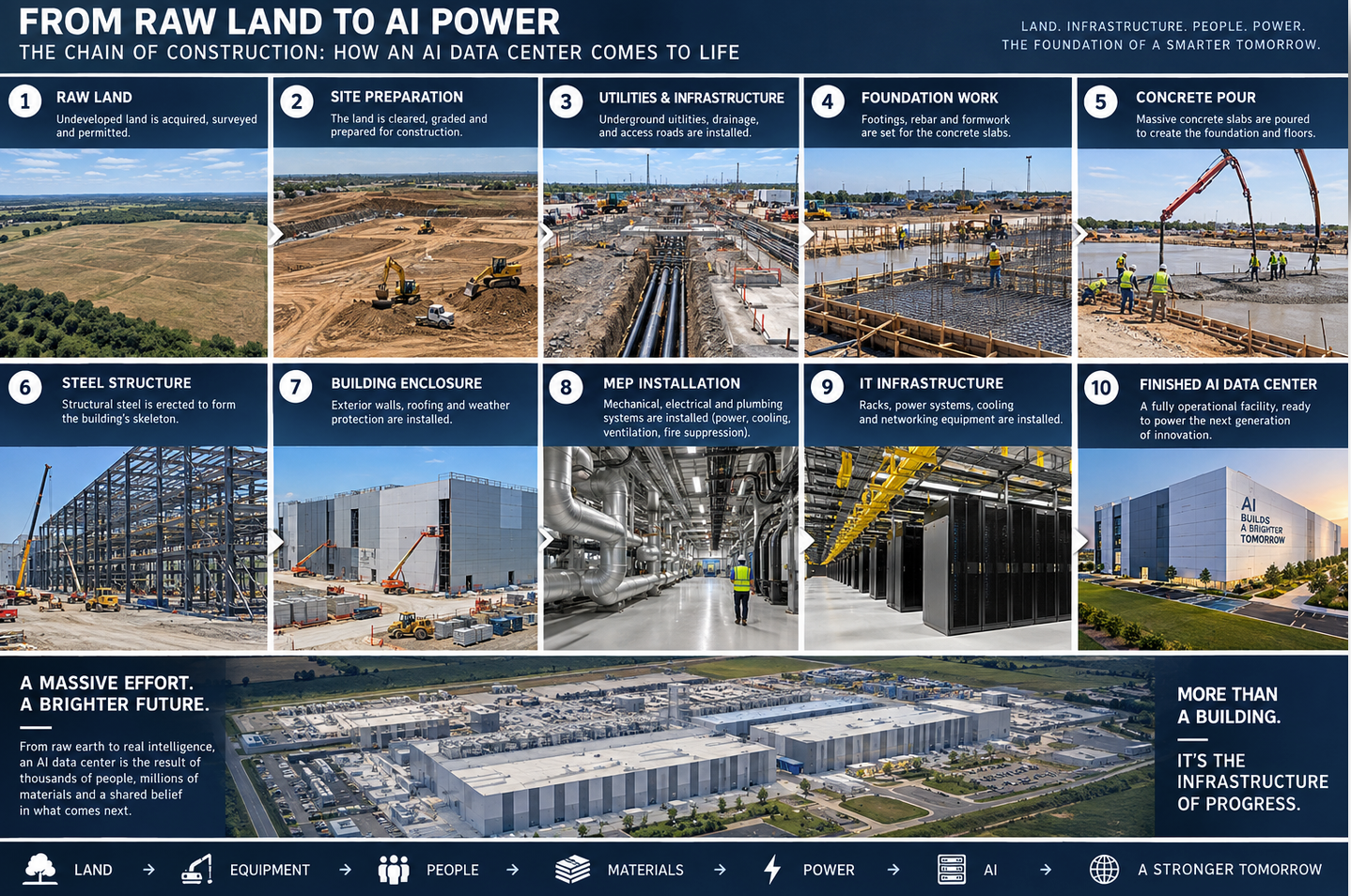
Enormous data centers require extensive site preparation, foundations, reinforced concrete slabs, roads, drainage systems, equipment pads, and structures capable of supporting heavy electrical and mechanical equipment.
Then consider what happens outside the data center.
New power plants need concrete foundations. Electrical substations require concrete structures and equipment pads. Transmission towers need foundations. Semiconductor factories require specialized industrial buildings. Water treatment facilities, pumping stations, and cooling infrastructure require still more construction.
Suddenly, one of the most futuristic investment themes in history begins creating demand for one of humanity’s oldest building materials.
Concrete.
And concrete is particularly interesting because it’s not a single commodity sitting in a warehouse waiting to be shipped anywhere in the world.
It’s a manufactured mixture of cement, aggregates, water, and other ingredients. Ready-mixed concrete has to be produced, transported, and placed within a limited period. That makes local batching capacity, available trucks, drivers, construction crews and delivery schedules extremely important.
You can have enormous quantities of limestone and aggregate available nationally while still experiencing shortages of concrete delivery capacity in a particular construction market.
This is the distinction between resource abundance and usable supply.
The United States isn’t necessarily running out of the ingredients needed to manufacture concrete. But when several enormous projects are constructed in the same region simultaneously, local production and delivery capacity can become constrained.
And the problem doesn’t end with concrete.
Those foundations often require reinforcing steel. Structural frames require steel beams and fabricated components. Electrical systems require cable trays, conduit, and specialized equipment. Cooling systems require pipes, pumps, valves, and mechanical installations.
The AI factory may be filled with advanced semiconductors, but the factory itself is still built from materials that have been essential to industrial civilization for generations.
The Best Free Investment You’ll Ever Make
Join Wealth Daily today for FREE. We’ll keep you on top of all the hottest investment ideas before they
hit Wall Street. Become a member today, and get our latest free report: “The $10 Trillion AI Infrastructure Boom.”
It contains full details on why money managers are overpaid and provides you with
tools for growing your wealth.On your own terms. No fees, no commission.
The Steel, Aluminum, and Equipment Bottleneck
Now consider the enormous industrial supply chain supporting all this construction.
Steel is required for structural frameworks, equipment supports, industrial buildings, reinforcing bars, machinery, and electrical infrastructure. Aluminum is important for electrical conductors, cooling equipment, and other industrial applications.
But the most difficult bottlenecks may involve products that aren’t traded on commodity exchanges.
Large transformers, for example, require specialized manufacturing capabilities, electrical steel, copper or aluminum windings, insulation systems, engineering expertise, and extensive testing.
Industrial gas turbines require precision components, advanced metallurgy, specialized factories, and highly trained workers.
High-voltage switchgear requires manufacturing capacity and sophisticated electrical engineering.
These aren’t products that can be manufactured instantly simply because their prices rise.
Factories have production schedules. Suppliers have existing customers. Specialized components have lead times. Skilled workers must be trained.
That means the bottleneck may shift from the underlying commodity to the finished equipment.
A utility might have enough money to purchase a transformer and access to all the copper it needs, yet still face a long wait because the transformer manufacturer has no available production slots.
And this is why I believe the Age of Scarcity is about much more than rising commodity prices.
It’s about the increasing value of industrial capacity itself.
The factory that can manufacture the transformer may become more strategically important than the copper sitting inside it.
The company that can deliver a gas turbine may become more valuable to a project than the fuel that will eventually power it.
And the contractor who can complete an installation on schedule may become indispensable.
Which brings us to a shortage that might surprise investors even more.
The Million-Dollar Electrician Problem
Imagine spending billions of dollars constructing a state-of-the-art AI campus, only to discover that your construction schedule is being delayed because you cannot find enough qualified electricians.
It sounds ridiculous.
But that’s the kind of challenge now confronting parts of America’s construction industry.
In September 2026, the Associated General Contractors of America released a workforce survey showing that 87% of responding construction firms had openings for hourly craft workers. Among firms with craft openings, 88% said those positions were as difficult or more difficult to fill than a year earlier.
The data center boom was making the problem worse.
Among contractors performing data center work, 58% reported increased competition for skilled workers, while 49% reported increased wage pressure. The survey also found that 42% of respondents had experienced project delays because of shortages of their own workers or subcontractors.
Think about what that means.
America is preparing to invest extraordinary sums in artificial intelligence infrastructure, yet one of the most important constraints may be the availability of people who can physically construct it.
Electricians are particularly important because a modern data center is an enormously sophisticated electrical installation. These facilities require high-voltage connections, transformers, switchgear, backup generation, power distribution systems, controls and miles of cabling.
But the shortage extends well beyond electricians.
Data centers also require plumbers, pipefitters, welders, HVAC technicians, ironworkers, concrete workers, equipment operators, engineers, construction managers, and commissioning specialists.
Cooling systems need pipes and pumps. Mechanical systems need installation and maintenance. Electrical equipment requires testing. Backup generators require technicians. Water systems need specialized contractors.
The U.S. Bureau of Labor Statistics projects employment of electricians will grow approximately 9% from 2025–2035, with about 72,700 openings annually on average, including positions created by retirements and workers changing occupations.
Those are not all new jobs created by AI, of course. Electricians serve residential, commercial, industrial and utility markets. But data center construction is adding another source of demand for an occupation that already requires substantial training.
And you cannot turn someone into a qualified industrial electrician with a weekend software course.
Training takes time. Apprenticeships take years. Specialized industrial experience takes even longer.
For decades, American parents were told that the path to prosperity ran almost exclusively through a four-year college degree and a professional office career.
Now some of the most strategically important workers in the AI economy may be the people wearing hard hats and carrying toolboxes.
There’s an irony in that worth appreciating.
Artificial intelligence may transform millions of white-collar tasks while simultaneously increasing the value of skilled blue-collar labor.
The Hidden Scarcity of Human Capital
There’s another dimension to the labor problem that investors should understand.
Skilled construction workers aren’t interchangeable.
A new report released last month by the Alliance for America’s Skilled Trades finds the U.S. will need to fill an estimated 1.7 million skilled trades openings each year through 2035, while training programs produce just 55 workers for every 100 needed.
By 2034, Arizona will need 29,000 electricians, Texas will need 86,000 auto mechanics, and North Carolina will need 19,000 carpenters.
The report sheds light on what is known as the essential economy, which includes construction, utilities, agriculture, transportation, oil and gas, and equipment manufacturing. It accounts for $12 trillion of the gross domestic product, 95 million jobs, and 3 million businesses.
You see, an electrician who installs residential lighting isn’t necessarily qualified to commission sophisticated high-voltage equipment at a hyperscale data center. A plumber working on residential water systems may need additional training before installing complex industrial cooling infrastructure.
The same is true of welders, pipefitters, controls technicians, and mechanical contractors.
Large industrial projects require workers with specialized certifications, experience, and safety training.
And when several major projects begin competing for those workers simultaneously, the consequences can ripple throughout a regional economy.
Wages rise. Contractors recruit workers from other states. Housing becomes more expensive near construction sites. Subcontractors struggle to staff multiple projects. Schedules slip.
A particularly revealing example is Meta’s Hyperion data center development in Louisiana. The project has brought thousands of construction jobs into a relatively rural region, creating opportunities for local businesses while also demonstrating the enormous workforce required to construct modern AI infrastructure.
This is where the Age of Scarcity becomes a local economic story.
A project worth tens of billions of dollars can transform demand for workers, housing, restaurants, transportation, and services in communities that were never previously considered major technology centers.
But it can also create problems.
A sudden influx of construction workers can strain housing markets and public services. Competing projects may struggle to find contractors. Local businesses may face higher labor costs.
The economic benefits can be substantial, but they aren’t automatic or evenly distributed.
And once again, the underlying lesson is that physical capacity cannot expand instantly simply because investors have supplied more money.
Even Water Has Become a Strategic Resource
Now consider another resource that most investors rarely associate with artificial intelligence.
Water.
Data centers generate heat, and that heat has to go somewhere. Depending upon the facility’s design, location, and cooling technology, water may be used in cooling towers, evaporative systems or other thermal-management processes.
Not every data center consumes large quantities of water. Some use air cooling or closed-loop systems designed to minimize water consumption. Newer liquid-cooling technologies can also change how water is circulated and heat is removed.
Nevertheless, water availability can become an important factor in where large computing campuses are located and how they are designed.
And the challenge extends beyond the data center itself.
Power generation may require cooling water. Semiconductor manufacturing uses large quantities of highly purified water. Industrial facilities require treatment, pumping, and distribution infrastructure.
In regions already experiencing water stress, new industrial demand can create difficult questions about competing uses.
A community may welcome the jobs and investment associated with a data center while also worrying about electricity prices, groundwater supplies, wastewater infrastructure, and long-term environmental effects.
Those concerns can affect permitting, project design, and, ultimately, whether a development moves forward.
That’s why the next generation of AI infrastructure will increasingly require solutions involving water recycling, efficient cooling, wastewater treatment, and advanced thermal-management technology.
And that’s another area where the MoneyQuake extends beyond conventional technology companies.
The New Economics of Scarcity
For most investors, scarcity means one simple thing.
Higher prices.
If copper becomes scarce, copper prices rise. If oil becomes scarce, oil prices rise. If natural gas becomes scarce, natural gas prices rise.
But the AI infrastructure boom reveals a more complicated reality.
Sometimes the shortage isn’t the resource.
It’s the ability to convert that resource into something useful.
You might have copper available, but not enough transformer manufacturing capacity. You might have natural gas available, but not enough turbines or pipeline capacity. You might have limestone available, but insufficient concrete delivery capacity near a construction site.
You might have every building material necessary to construct a data center, but not enough qualified electricians and mechanical contractors to finish it.
In those circumstances, the scarcity premium may appear in manufacturing margins, construction costs, labor wages, delivery schedules or the value of existing infrastructure rather than in the price of the raw commodity alone.
That is a critical distinction.
The most valuable asset in a shortage isn’t always the resource. Sometimes it’s the ability to deliver the resource where and when it’s needed.
And that creates a much broader investment opportunity than simply buying commodity producers.
It creates opportunities across mining, refining, manufacturing, transportation, industrial equipment, infrastructure development, engineering, and construction.
Of course, scarcity doesn’t guarantee profits. Higher costs can squeeze contractors, expensive materials can delay projects, and excessive investment can eventually create overcapacity.
But companies that control genuinely difficult-to-replicate assets, possess specialized manufacturing capabilities or can reliably deliver critical equipment may enjoy strategic advantages when demand grows faster than supply.
The MoneyQuake Comes Full Circle
This is where the two great forces behind our MoneyQuake thesis begin colliding in earnest.
On one side, we have monetary expansion, government borrowing, central bank reserve diversification, and growing interest in tangible stores of value.
On the other, we have artificial intelligence, electrification, data centers, industrial reshoring, national security, and the rebuilding of critical infrastructure.
Both forces can increase interest in physical assets, although they affect individual markets differently.
And the industrial side is especially fascinating because the world’s largest technology companies are preparing to deploy enormous quantities of capital into an economy where physical production capacity remains constrained.
The technology companies may have access to hundreds of billions of dollars.
But the mining industry cannot instantly double copper production.
The electrical equipment industry cannot instantly double transformer manufacturing capacity.
The construction industry cannot instantly produce tens of thousands of additional qualified electricians.
And communities cannot instantly expand water systems, roads, substations, and housing to accommodate enormous new industrial projects.
That mismatch between available capital and available physical capacity is one of the defining characteristics of the Age of Scarcity.
It’s also why I believe investors should be looking beyond the obvious technology beneficiaries.
The companies supplying power equipment, critical minerals, industrial materials, and essential infrastructure may participate in the same long-term transformation as the semiconductor giants.
The opportunities won’t be identical, and neither will the risks. But they belong to the same economic story.
The Next Great Fortune May Be Wearing a Hard Hat
I want to leave you with one final thought.
In 1946, ENIAC represented the cutting edge of human computing technology. It weighed approximately 30 tons, occupied an enormous room and required specialized electrical and cooling infrastructure.
Eighty years later, we’re building AI factories that consume electricity on the scale of major industrial facilities and require vast networks of physical infrastructure.

But here’s the remarkable part.
After eight decades of technological progress, after billions of transistors, after the invention of the internet, the cloud, the smartphone, and artificial intelligence, we still haven’t escaped some of the most fundamental limitations of the physical world.
We still have to dig materials out of the ground. We still have to manufacture steel and concrete. We still have to build factories. We still have to install electrical wiring. We still have to lay pipes.
We still need welders, electricians, plumbers, engineers, and construction workers.
And we still need enormous amounts of electricity.
The most advanced computers in human history remain dependent upon resources and skills that cannot be replicated with a line of software code.
That’s why I believe the Age of Scarcity could become one of the most important investment themes of the next decade.
The world isn’t necessarily running out of everything. In many cases, resources exist in abundance. But the capacity to extract, process, manufacture, transport, and install those resources is finite.
And when demand accelerates faster than that capacity can expand, bottlenecks emerge.
The digital world can scale at the speed of software. The physical world still has to be built one mine, one factory, one transformer, one foundation, and one skilled worker at a time.
That’s the MoneyQuake.
And in the next chapter, we’re going to explore an equally important question.
If the Age of Scarcity is making physical infrastructure increasingly valuable, which companies actually control the bottlenecks — and how do investors distinguish the genuine winners from the companies simply riding the hype?
Get to the good, green grass first…
The Prophet of Profit,

Brian Hicks
 Check us out on YouTube!
Brian is a founding member and President of Angel Publishing. He writes about general investment strategies for Wealth Daily and Energy and Capital. Brian is the managing editor and investment director of R.I.C.H Report (Retired Independent Carefree Healthy), New World Assets and Extreme Opportunities. For more on Brian, take a look at his editor’s page.
The Best Free Investment You'll Ever Make
We never spam! View our Privacy Policy
After getting your report, you’ll begin receiving the Wealth Daily e-Letter, delivered to your inbox daily.
Angel Publishing Investor Club Discord - Chat Now
Brian Hicks Premium
Introductory

Advanced


