How You Can Tell This Bubble Isn’t Popping

You can hardly open a financial newspaper anymore without seeing another warning about artificial intelligence…
Valuations are too high. The market is too concentrated. Capital spending is out of control. Everybody owns the same stocks. AI is a bubble about to burst.
Everybody knows the AI bubble is about to pop, which should make you wonder whether it’s anywhere even close to popping at all.
Maybe. But probably not.
That’s not to say AI isn’t a bubble. In fact, I think there’s more than just a good chance we look back on this period and call it one.
But there’s a huge difference between identifying a bubble and predicting when it will burst.
And if practically everyone agrees we’re in one? That might actually be an argument that it still has room to run…
Being Early Is the Same as Being Wrong
We’ve seen this plenty of times before.
On December 5, 1996, Federal Reserve Chairman Alan Greenspan famously warned about “irrational exuberance” in financial markets.
He wasn’t crazy. There was absolutely a technology bubble forming.
But the problem was his timing.
The Nasdaq Composite was around 1,300 when Greenspan delivered that warning.
By March 2000, it had climbed above 5,000…
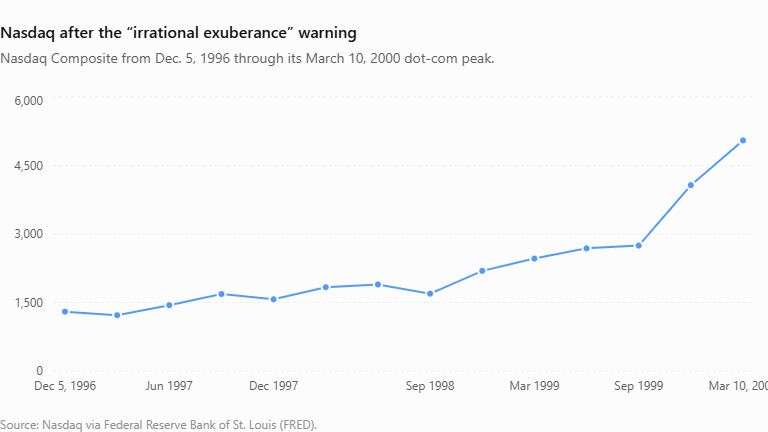
As we all know, eventually, the bears were proven spectacularly right…
But anyone who sold everything because Greenspan spotted the bubble in 1996 missed one of the greatest runs the stock market has ever produced.
And that’s worth remembering today because the important question isn’t whether AI has become speculative.
The important question is whether we’ve reached the point where that speculation can no longer support itself.
And I’m not convinced we have.
The Best Free Investment You’ll Ever Make
Join Wealth Daily today for FREE. We’ll keep you on top of all the hottest investment ideas before they
hit Wall Street. Become a member today, and get our latest free report: “The $10 Trillion AI Infrastructure Boom.”
It contains full details on why money managers are overpaid and provides you with
tools for growing your wealth.On your own terms. No fees, no commission.
Everybody Is Looking at the Same Warning Signs
There are plenty of reasons to be nervous…
The stock market has become extraordinarily concentrated. A handful of giant technology companies account for an enormous portion of the major indexes.
Money is pouring into anything associated with artificial intelligence. And the capital spending numbers have become almost absurd.
Moody’s estimates that six major U.S. hyperscalers — Microsoft, Amazon, Meta, Alphabet, Oracle, and CoreWeave — could spend roughly $700 billion this year alone.
That’s nearly six times what those companies were spending in 2022.
Microsoft, Alphabet, Amazon, Meta, and Oracle are already spending so aggressively that analysts expect their combined capital expenditures could exceed their free cash flow by 2027.
That is unquestionably bubble-like behavior. But huge spending alone doesn’t tell us where we are in the bubble.
For that, I think we need to ask a simpler question…
Are they building something nobody wants?
Because right now the answer appears to be no.
That’s the Difference
Think about the great infrastructure bubbles of the past…
Hundreds of companies would pile into the same opportunity. They’d raise money. They’d build competing infrastructure. Then somebody else would build another version right next to it.
Eventually, everyone discovered there were far more railroads, telecom networks, factories, houses, or whatever else was being financed than customers willing to pay for them.
And that’s when things got ugly every single time.
But AI looks different so far.
There aren’t hundreds of hyperscalers racing to build identical nationwide computing networks.
There are essentially six U.S. companies operating at the scale required to drive most of this build-out.
And instead of desperately searching for customers to fill all the capacity they’ve created, they’re still struggling to create enough capacity to satisfy demand.
That distinction matters a lot…
Because bubbles generally don’t burst simply because investors have spent an enormous amount of money.
They burst when everyone realizes that money was spent building something for which there isn’t enough demand.
And we haven’t reached that point with AI. Not yet.
They Still Can’t Build It Fast Enough
Look around the AI supply chain and you see shortages, not gluts.
Electricity demand is climbing so quickly that the U.S. Energy Information Administration expects American power consumption to set new records in both 2026 and 2027.
Memory remains tight, too…
Micron recently reported surging long-term customer commitments while warning that supply remains constrained as hyperscalers continue expanding AI capacity.
We’re seeing the same thing with transformers, turbines, cooling equipment, networking hardware, land near available power, and plenty of other pieces of the data-center supply chain.
That doesn’t look like the aftermath of an overbuilding boom; if anything, it looks like an industry that is still trying to catch up.
And that’s a very different stage of the cycle.
That Doesn’t Mean the Bears Are Wrong
Now, none of this means today’s spending will ultimately prove rational…
These companies can absolutely overbuild. They can borrow too much.
They can spend hundreds of billions of dollars fighting for market share only to discover that AI services eventually become commodities.
Margins could collapse or customers could decide they don’t need nearly as much compute as everyone expects.
And the hyperscalers could eventually find themselves sitting on enormous data centers that don’t generate adequate returns.
That’s a scenario I’m worried about and you should be too.
But notice what needs to happen first…
Supply has to catch demand. Then supply has to pass demand. Then enough excess capacity has to accumulate that prices and returns begin falling.
That’s when the economics really start breaking. And right now we’re still dealing with shortages.
Here’s What I’m Watching
I’m less interested in whether somebody can draw a historical chart showing that market concentration has reached some scary level.
Those charts are interesting, but they’re also exactly the sort of thing everyone is already staring at.
I’m watching the actual AI economy…
When data center capacity starts sitting empty, I’ll worry.
When cloud companies begin cutting AI prices because they have too much compute and not enough customers, I’ll worry.
When chip inventories start piling up, I’ll worry.
When hyperscalers start canceling data center projects instead of fighting utilities to secure enough electricity for them, I’ll worry.
When AI capital expenditures start falling because the companies spending the money can’t earn an acceptable return on what they’ve already built, I’ll really worry.
Those events would tell us something fundamental has changed…
But a chart showing that everybody loves Nvidia tells us something very different…
The Bubble Can Be Real and Still Get Much Bigger
That’s ultimately where I land on the AI bubble…
Yes, there’s speculation. Yes, there’s leverage. Yes, valuations are stretched.
Yes, an enormous portion of the market’s gains depends on a relatively small group of companies continuing to spend staggering amounts of money.
And yes, eventually investors will probably discover that some of today’s assumptions were ridiculous.
But that’s what happens in every great investment boom, and none of those things tells us the boom ends tomorrow.
Remember, history is filled with people who correctly identified bubbles years before they peaked.
Greenspan saw the dot-com bubble forming in 1996, but the market rewarded investors with another 288% before proving him right.
Today, practically everyone seems to know AI is a bubble, but what I don’t see yet is the thing that usually kills an infrastructure boom…
Too much supply chasing too little demand.
For now, we still have the opposite problem…
There isn’t enough power. There aren’t enough chips. There isn’t enough data center capacity.
And there are only a handful of companies with the resources to build all of it at the scale required.
Maybe they’ll eventually build too much. In fact, I’d bet they do.
But until we start seeing evidence that they have?
I’m not ready to place my wager, and I don’t think you should either.
To your wealth,

Jason Williams
 @TheReal_JayDubs
 Angel Research on Youtube
After graduating Cum Laude in finance and economics, Jason designed and analyzed complex projects for the U.S. Army. He made the jump to the private sector as an investment banking analyst at Morgan Stanley, where he eventually led his own team responsible for billions of dollars in daily trading. Jason left Wall Street to found his own investment office and now shares the strategies he used and the network he built with you. Jason is the founder of Main Street Ventures, a pre-IPO investment newsletter; the founder of Future Giants, a nano cap investing service; and authors The Wealth Advisory income stock newsletter. He is also the managing editor of Wealth Daily. To learn more about Jason, click here.
Want to hear more from Jason? Sign up to receive emails directly from him ranging from market commentaries to opportunities that he has his eye on.
The Best Free Investment You'll Ever Make
We never spam! View our Privacy Policy
After getting your report, you’ll begin receiving the Wealth Daily e-Letter, delivered to your inbox daily.
Angel Publishing Investor Club Discord - Chat Now
Jason Williams Premium
Introductory

Advanced


