Chapter 5: When the Data Center Became a Power Plant Problem

There is a building about 30 miles north of Seattle so enormous that it almost doesn’t seem possible.
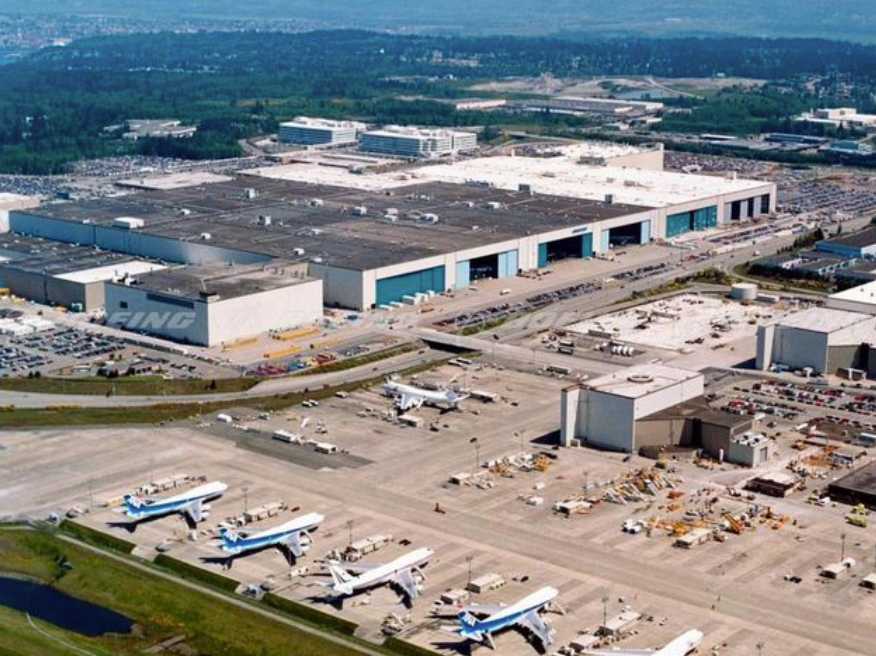
It’s the Boeing factory in Everett, Washington, and if you ever get the opportunity to stand inside it, your brain will likely have trouble processing what your eyes are seeing.
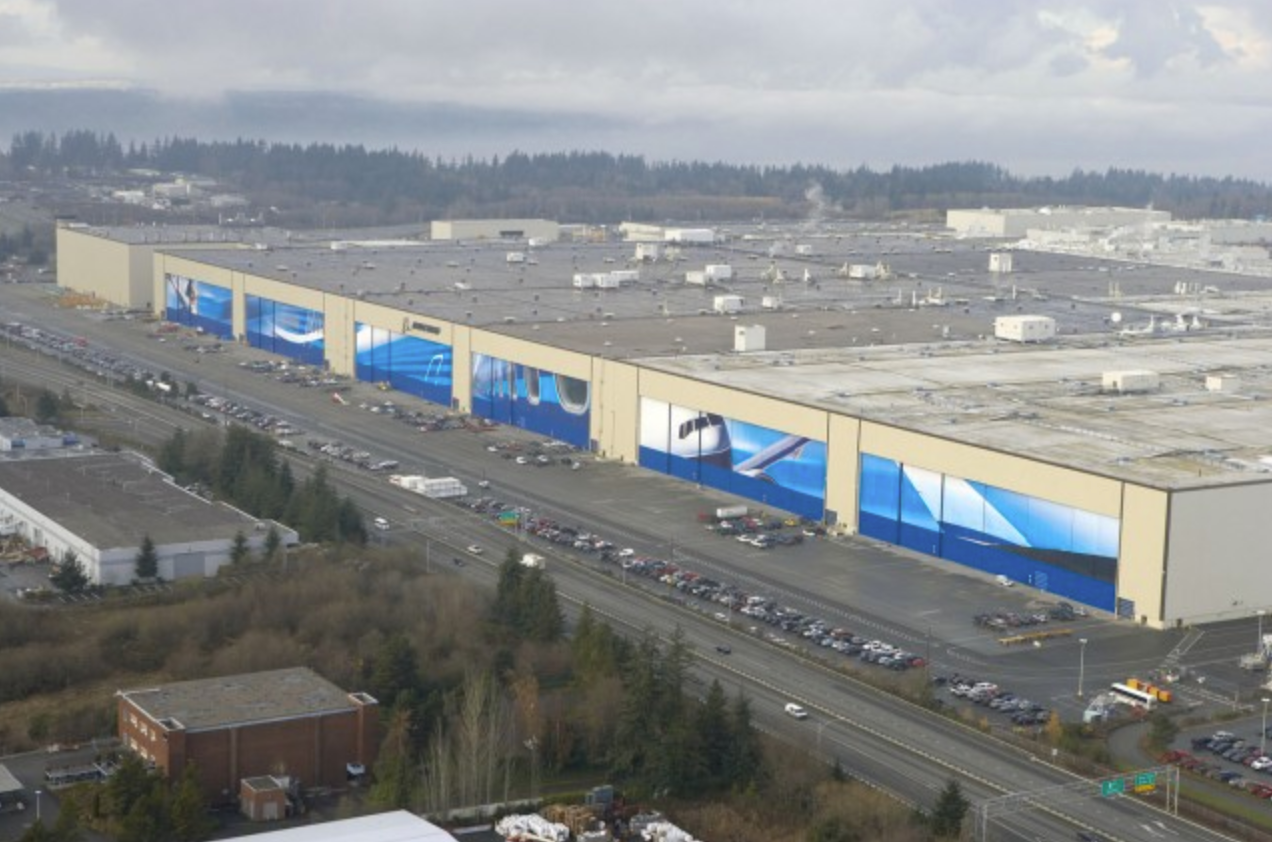
The main assembly building covers approximately 98 acres and encloses roughly 472 million cubic feet of space. Boeing originally built the factory during the 1960s because the company had decided to manufacture something unprecedented: the Boeing 747.
There was just one problem. Boeing didn’t have a building big enough to build it.
So before Boeing could revolutionize commercial aviation, it first had to revolutionize the factory. The result became the world’s largest building by volume, a structure so enormous that one of the enduring stories surrounding Everett is that at one point, moisture could accumulate near the ceiling and create clouds inside the building.
Think about that for a second. A building so big, it creates its own weather!
The story has become part of Everett lore, although accounts differ over whether literal indoor clouds routinely formed before ventilation improvements.
Whether you believe the cloud story or not isn’t the point.
The place is enormous.
Boeing says the Everett factory contains approximately 13.3 million cubic meters of interior space. It exists because the 747 demanded an industrial infrastructure unlike anything Boeing had previously needed.
The place is almost impossible to comprehend. So let me give you some perspective. Michigan Stadium — “The Big House” — is America’s largest football stadium, capable of seating more than 107,000 screaming fans. Its historic stadium footprint spans roughly 15.5 acres. Boeing’s Everett assembly building covers 98.3 acres under one roof. By that measure, you could lay out the footprint of more than six Michigan Stadiums across the Boeing factory floor. And all of it sits inside a single building containing 472 million cubic feet of space.
There’s an even better comparison for this, though: Boeing itself has said Disneyland could fit inside the Everett main assembly building.
And now, more than half a century later, we may be preparing to make it look small.
Because something extraordinary is happening in Texas.
The Best Free Investment You’ll Ever Make
Join Wealth Daily today for FREE. We’ll keep you on top of all the hottest investment ideas before they
hit Wall Street. Become a member today, and get our latest free report: “The $10 Trillion AI Infrastructure Boom.”
It contains full details on why money managers are overpaid and provides you with
tools for growing your wealth.On your own terms. No fees, no commission.
From Mega-Factory to Tera-Factory
SpaceX and Tesla are planning something called Terafab in Grimes County, Texas, and the proposed numbers almost sound made up. SpaceX has described plans for a vertically integrated semiconductor manufacturing complex eventually containing more than 100 million square feet of manufacturing space, bringing logic chips, memory and advanced packaging together to supply enormous future demand for computing.
For perspective, Boeing’s Everett factory covers approximately 4.3 million square feet. A 100-million-square-foot Terafab would therefore have more than 20 times the floor area of Boeing’s Everett building. The Daily Mirror calculated that the proposed complex could cover the equivalent of roughly 1,700 American football fields.
Compare that to Boeing’s factory’s 98.3 acres that can accommodate about 75 American-football playing fields or 911 NBA basketball courts.
Then consider the potential capital involved. Reports surrounding the project have described tens of billions of dollars of initial investment and the possibility of total investment eventually exceeding $100 billion if later phases are constructed.
Think about what that means.
A factory complex of almost unimaginable size may be built for the purpose of manufacturing one of the defining commodities of the 21st century: Compute.
The chips coming from factories like this would ultimately feed artificial intelligence systems, robots, autonomous vehicles, satellites, data centers, and technologies that don’t even exist yet.
That’s why I wanted to begin this chapter here. Boeing Everett and Terafab tell essentially the same story separated by roughly 60 years.
When a transformational technology becomes important enough, eventually, the existing infrastructure simply isn’t big enough anymore. Boeing needed a radically larger factory because the 747 demanded it.
Artificial intelligence is beginning to create the same phenomenon across the entire computing industry.
Only this time, the bottleneck isn’t merely the size of the building.
It’s the amount of electricity available outside it.
And I’ve been saying this for months now. We are not only witnessing an AI data center and innovation boom… we are also witnessing the beginning of an electricity capacity build-out boom.
We Have Crossed Another Line
For most of the history we’ve covered throughout this series, the central challenge was computation itself. Engineers needed to figure out how to build faster computers, store more information, connect more machines, move data faster, and pack increasing amounts of computing power into increasingly efficient spaces.
Artificial intelligence is pushing us across a completely different threshold. The limiting factor is increasingly not just how many processors we can manufacture or how many servers we can squeeze inside a building. It’s whether we can provide those machines with enough electricity to operate continuously.
That changes the entire economic equation.
Traditional data centers could consume electricity measured in tens of megawatts. Large hyperscale campuses pushed requirements into the hundreds of megawatts. Now the AI industry is increasingly discussing campuses whose power requirements are measured in gigawatts.
One gigawatt equals 1,000 megawatts.
Once individual computing campuses begin requiring electricity at that scale, we’re no longer talking only about technology infrastructure. We’re talking about energy infrastructure. Generation capacity has to exist somewhere. Electricity has to travel across transmission systems. Substations have to step it down. Transformers have to distribute it. Backup systems have to protect it. Cooling systems have to remove the enormous amount of heat produced when all those electrons flow through millions of processors.
That is why I believe we’ve reached another major turning point in the 80-year history of the data center.
The computer room became the data center. The data center became the cloud. The cloud became the hyperscale campus.
Now the hyperscale campus is becoming something entirely different…
A power plant problem.
Meet Prometheus
Meta provides us with a perfect example of where this is heading. The company has described its Prometheus AI cluster as a project being constructed at roughly 1 gigawatt of scale, spread across multiple data center buildings and the infrastructure necessary to support them.
Then there’s Hyperion, Meta’s enormous Louisiana project, which is designed to eventually scale to as much as 5 gigawatts of computing capacity.
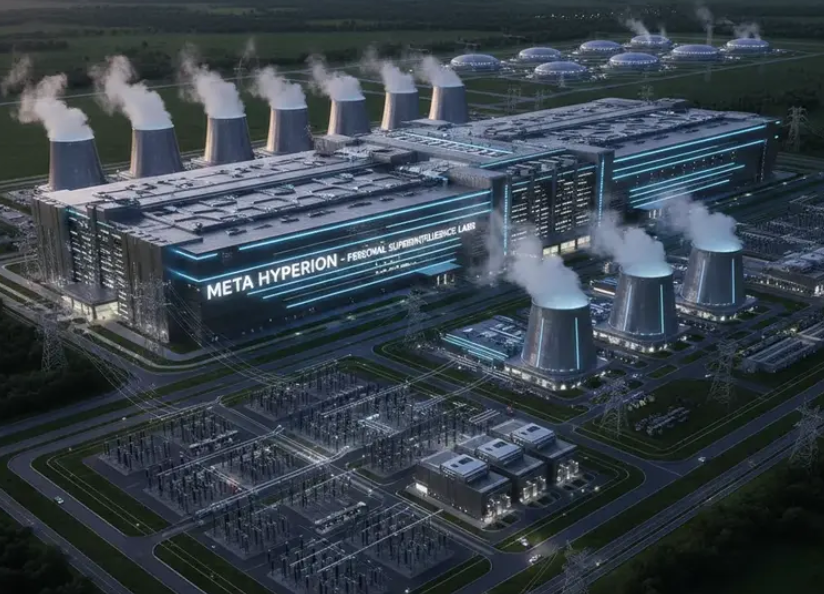
Five gigawatts.
At that scale, a data center developer cannot simply call the local electric utility and ask for another connection. The energy system itself becomes part of the project. Power generation, transmission, substations, transformers, switchgear, backup generation, batteries, natural gas infrastructure, cooling systems, and water all begin entering the equation.
This is the moment when the boundary between the technology industry and the energy industry begins disappearing.
For decades, we thought about computing companies and power companies as belonging to entirely different worlds. Microsoft wrote software. Utilities generated electricity. Semiconductor companies manufactured chips. Natural gas companies produced fuel. Mining companies dug metals out of the ground.
Artificial intelligence is beginning to connect all of them.
And that is the MoneyQuake.
AI Has Rediscovered Heavy Industry
For decades, Silicon Valley’s greatest products seemed almost weightless. Software, search engines, social networks, apps, digital advertising, and cloud computing could reach billions of people without the consumer ever seeing the enormous physical infrastructure operating behind them.
Artificial intelligence is beginning to destroy that illusion.
The software may still be digital, but the machines running it most certainly aren’t.
AI requires GPUs and other specialized processors. Those processors require semiconductor fabs. Semiconductor fabs require enormous factories. AI servers require data centers. Data centers require transformers. Transformers require copper and electrical steel. Cooling systems require pumps, chillers, pipes, and industrial equipment. Transmission systems require aluminum, copper, towers, and substations. Electricity requires turbines, reactors, solar farms, wind farms, natural gas infrastructure, batteries, and increasingly sophisticated grid equipment.
Suddenly Silicon Valley has rediscovered something America understood during every previous industrial revolution…
You can’t build the future without building things.
That’s why the Terafab story matters far beyond Elon Musk, SpaceX, or Tesla. It is a physical manifestation of the MoneyQuake. The supposedly digital AI revolution is reaching backward through the economy and pulling enormous quantities of capital, materials, electricity, and labor toward it.
The deeper artificial intelligence penetrates the economy, the more physical infrastructure we may need to support it.
The Numbers Are Starting to Become Absurd
The International Energy Agency estimates that global data center electricity consumption could reach roughly 945 terawatt-hours by 2030, more than double current consumption under its base-case projection. That would put the electricity consumed by the world’s data centers at slightly more than the amount of electricity Japan consumes today.
But the American numbers are even more interesting for our purposes.
The IEA estimates that data centers could account for nearly half of the growth in U.S. electricity demand through 2030. It also projects that by the end of the decade, America’s data centers could consume more electricity than the country currently uses to manufacture aluminum, steel, cement, chemicals, and other energy-intensive goods combined.
Think about the significance of that.
For decades, American electricity demand grew relatively slowly. Utilities could forecast population growth, housing construction, industrial development, and household consumption, and then plan generation and transmission infrastructure accordingly.
Artificial intelligence is beginning to break that model because enormous new loads can appear incredibly quickly. A technology company can announce a giant AI campus requiring hundreds of megawatts — or potentially gigawatts — of electricity in a location where the existing grid was never designed to supply anything remotely approaching that amount of power.
And here’s where things get really interesting for investors.
A data center can potentially be constructed in a few years. Major electrical infrastructure often cannot.
That mismatch may become one of the defining economic bottlenecks of the AI revolution.
And wherever there’s a bottleneck inside a historic capital spending boom, there’s usually an investment opportunity sitting beside it.
The New AI Supply Chain
This is why I keep telling MoneyQuake readers not to think about artificial intelligence as simply another technology trend. If you look only at Nvidia and the semiconductor companies, you’re looking at the engine and ignoring the rest of the airplane.
The real AI supply chain is enormous. It includes semiconductors, networking equipment, natural gas turbines, nuclear power, uranium, transformers, copper, aluminum, electrical steel, transmission equipment, cooling technology, water infrastructure, construction machinery, engineering firms, land, fiber-optic cable, backup generation, and energy storage.
Increasingly, it also includes power generation itself.
The winners of the AI revolution therefore won’t necessarily all look like technology companies. Some of them may look remarkably old-fashioned: companies manufacturing electrical equipment, companies building gas turbines, companies mining copper, companies producing uranium, companies transporting natural gas, companies constructing transmission infrastructure, and companies solving increasingly difficult cooling and water problems.
This is the paradox sitting at the center of the MoneyQuake.
The most advanced digital technology humanity has ever created is triggering one of the largest physical infrastructure build-outs we’ve ever attempted.
And once you understand that, artificial intelligence begins looking much less like another software cycle and much more like an industrial revolution.
The Grid Wasn’t Built for This
America’s electrical grid was never designed with today’s AI campuses in mind. Much of the system was constructed during an era when electricity demand grew in relatively predictable ways. Utilities could look at population growth, factories, commercial development, and household consumption and estimate where new power would eventually be required.
AI introduces something radically different.
Imagine a giant industrial customer suddenly arriving and requesting 500 megawatts of electricity. Then imagine another requesting one gigawatt. Then another. Then another. Now imagine several of those projects clustering in the same region because they all want access to fiber, land, skilled workers, and reliable electricity.
The consequences ripple through the entire electrical system.
Utilities need more generation. Transmission operators need additional capacity. Substations have to expand. Transformers have to be manufactured. Natural gas pipelines may need additional capacity. Backup power has to be installed. Cooling systems need electricity and potentially water. Permitting becomes increasingly important.
And here’s the problem…
You can’t manufacture a giant transformer overnight.
You can’t build a transmission line overnight.
You can’t construct a nuclear reactor overnight.
You can’t necessarily order dozens of gas turbines and expect immediate delivery.
The physical economy simply moves more slowly than software.
That may turn out to be one of the defining economic tensions of the AI age. Artificial intelligence can improve exponentially. Software can be updated almost instantaneously. New models can appear within months.
But power plants, transmission lines, pipelines, and factories still have to be engineered, financed, permitted, and physically constructed.
Silicon moves at exponential speed. Infrastructure doesn’t.
The gap between those two speeds may ultimately attract trillions of dollars of capital.
The Great Reindustrialization
Which brings us all the way back to Boeing.
In the 1960s, Boeing decided to build an airplane so enormous that its existing factories couldn’t contain it. So the company built a new factory, and that factory became the largest building by volume on Earth.
Now, roughly 60 years later, artificial intelligence is forcing companies to confront the same fundamental problem across multiple industries simultaneously.
Our existing semiconductor manufacturing capacity may not be enough. Our existing data centers may not be enough. Our existing power generation may not be enough in the places where it’s needed. Our existing transmission infrastructure may not be enough. Our supply of transformers may not be enough. In some locations, our existing natural gas, cooling, and water infrastructure may not be enough.
So what are we doing?
We’re doing exactly what America has historically done when confronted with a technological revolution.
We’re building.
We’re building semiconductor fabs and gigawatt-scale AI campuses. We’re building substations and transmission lines. We’re planning new power plants, pipelines, nuclear reactors, and cooling systems. We’re expanding factories that manufacture transformers, turbines, and electrical equipment. We’re searching for more copper, uranium, and critical minerals.
This isn’t simply another technology investment cycle.
It’s beginning to look like reindustrialization.
That’s why the projected $31 trillion global data center build-out we’ve been discussing throughout this series is so important. That capital isn’t simply going toward racks of computers. It flows outward through an enormous industrial ecosystem of energy, materials, equipment, construction, and infrastructure.
And I believe that’s one of the biggest investment stories of the next decade.
From 30 Tons to Gigawatts
Think about the extraordinary journey we’ve taken over these five chapters.
ENIAC weighed approximately 30 tons, yet its electricity requirements were tiny compared with what we’re contemplating today. Then came the corporate mainframe computer room. Then the server room. Then the Internet data center. Then the cloud. Then hyperscale computing.
And now we’re entering the age of the gigawatt AI factory.
We’ve gone from measuring computers by how many tons they weighed to measuring computing campuses by how many power plants they may effectively require.
That is the evolution investors need to understand.
The AI revolution is no longer confined to the semiconductor industry. It has escaped into the electrical grid, commodity markets, natural gas industry, nuclear power industry, water infrastructure, construction industry, and heavy manufacturing.
It has escaped Silicon Valley.
And it is beginning to spread across America’s physical economy.
That’s why I don’t view what we’re witnessing as merely another technology boom.
The digital revolution has become an industrial revolution.
And that brings us to the next great question.
If companies are preparing to spend trillions of dollars building AI infrastructure, and the machines inside those buildings require extraordinary quantities of electricity…
Where is all that power going to come from?
Natural gas?
Nuclear?
Solar?
Wind?
Battery storage?
All of them?
And what happens when dozens of gigantic AI campuses begin competing for the same electricity at the same time?
Because after 80 years of making computers faster, smaller, and more powerful, we’ve reached an extraordinary point in the history of computing.
The biggest constraint on the computer of the future may no longer be the computer.
It may be the power plant behind it.
Get to the good, green grass first…
The Prophet of Profit,

Brian Hicks
 Check us out on YouTube!
Brian is a founding member and President of Angel Publishing. He writes about general investment strategies for Wealth Daily and Energy and Capital. Brian is the managing editor and investment director of R.I.C.H Report (Retired Independent Carefree Healthy), New World Assets and Extreme Opportunities. For more on Brian, take a look at his editor’s page.
The Best Free Investment You'll Ever Make
We never spam! View our Privacy Policy
After getting your report, you’ll begin receiving the Wealth Daily e-Letter, delivered to your inbox daily.
Angel Publishing Investor Club Discord - Chat Now
Brian Hicks Premium
Introductory

Advanced


