America Just Voted to Send Data Centers into Space

Americans love artificial intelligence. But they just made it very clear they don’t want the buildings that run it anywhere near their homes.
And by saying no to data centers on the ground, they handed the best argument yet to the folks who want to put data centers in orbit.
Serious money is already chasing that idea. And this past weekend, SpaceX proved the hardest piece of it can work.
Voters Pulled the Plug
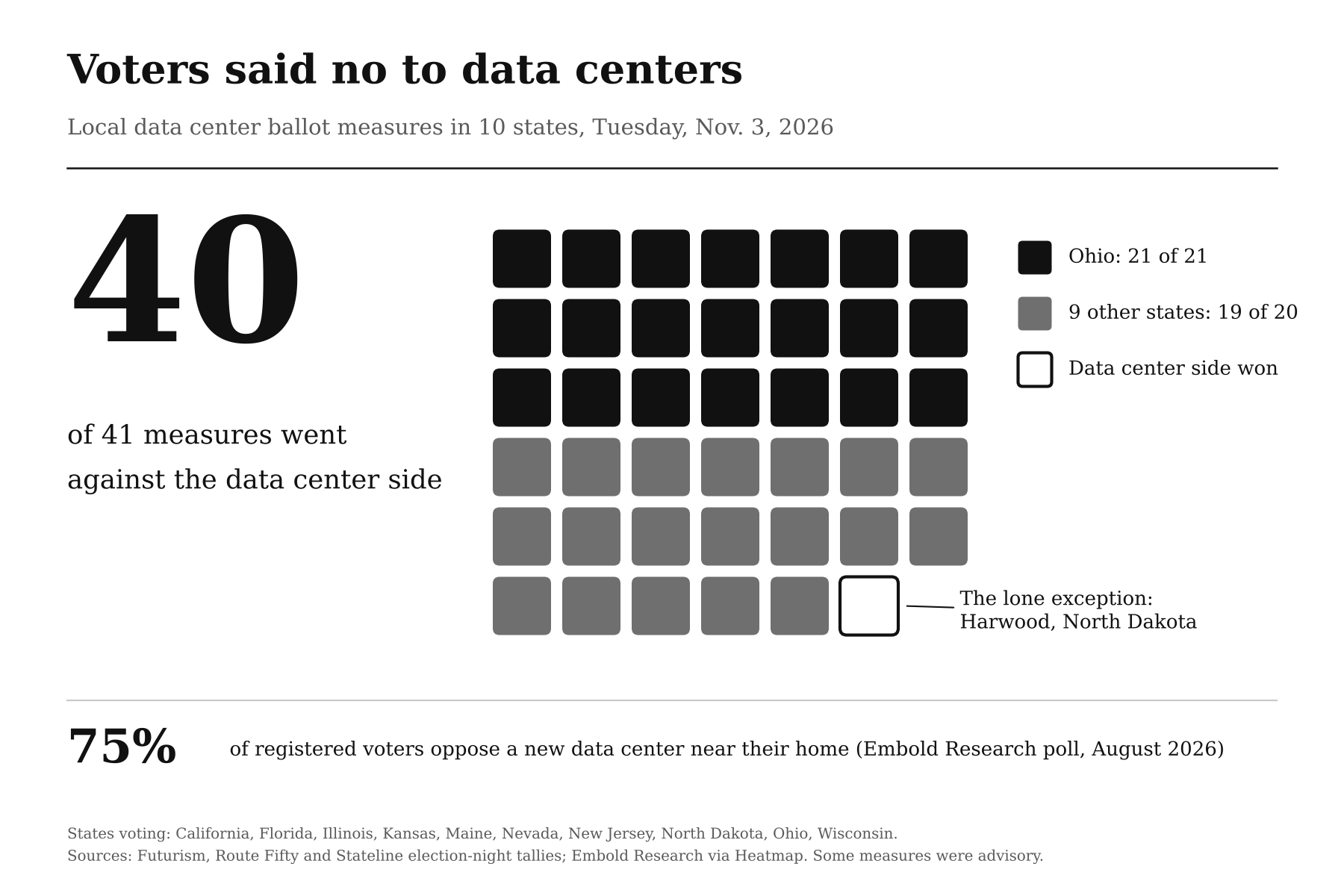
On Tuesday, Nov. 3, voters in 10 states weighed in on 41 data center ballot measures.
And they sided against the data center industry on every single one except a lone measure in Harwood, North Dakota.
Ohio alone had 21 of those measures. The data center side lost all 21.
But this didn’t come out of nowhere…
An August poll of 2,045 registered voters from Embold Research found that 75% of Americans oppose a new data center near their home.
And more than six in 10 said they strongly oppose one.
You can probably understand why. These buildings pull enormous amounts of electricity, which can show up on everyone’s utility bill.
Some of them drink water for cooling. And they bring new transmission lines and substations into towns that were quiet a year ago.
So folks want AI on their phones. They just don’t want the power plant for it in their backyard.
But that’s a problem, because the demand for computing power is still climbing. And China is racing us to build it.
The day after the election, Elon Musk posted on X that data centers in space were “looking pretty appealing right now.”
He wasn’t joking. And he already has the paperwork filed.
A Million Satellites Doing the Work of a Data Center
On Jan. 30, SpaceX asked the Federal Communications Commission for permission to launch up to 1 million satellites.
But these wouldn’t beam down internet like Starlink. They’d be computers, an “Orbital Data Center system” flying between 500 and 2,000 kilometers up.
The math in the filing is aggressive…
SpaceX says every ton of these satellites could generate about 100 kilowatts of computing power.
So, if you launch a million tons a year, you add roughly 100 gigawatts of AI computing capacity annually.
And the company has put a date on it. SpaceX’s IPO prospectus says its first orbital AI computing satellites could deploy as early as 2028.
Here’s why the idea holds up.
The Best Free Investment You’ll Ever Make
Join Wealth Daily today for FREE. We’ll keep you on top of all the hottest investment ideas before they
hit Wall Street. Become a member today, and get our latest free report: “The $10 Trillion AI Infrastructure Boom.”
It contains full details on why money managers are overpaid and provides you with
tools for growing your wealth.On your own terms. No fees, no commission.
Power is the first reason. In the right orbit, a solar panel sees the sun almost all day. No cloudy afternoons and no utility commission approving a rate hike.
Land is the second. A satellite doesn’t need a 500-acre parcel or a rezoning vote.
And then there’s the obvious one. Nobody in orbit is going to show up at a town hall meeting to complain about the hum.
Space does bring its own engineering problems…
Chips run hot, and there’s no air up there to carry the heat away. Plus, radiation chews up electronics.
And moving huge amounts of data between orbit and the ground takes serious communications hardware.
But for investors, each of those problems is a purchase order waiting to be written.
Somebody has to build the radiators, the hardened chips, the solar arrays, and the laser links. And somebody gets paid for every one of them.
None of it works, though, unless launch gets cheap. And on Saturday, Nov. 14, it got a lot closer.
SpaceX Caught a Spaceship
Last Friday evening, SpaceX launched Starship on its 15th test flight. The ship circled Earth 14 times, dropped off 26 Starlink satellites, and stayed up for about 22 hours.
Then it flew home to South Texas and stopped in midair, caught between the two giant arms on its launch tower. SpaceX calls them “chopsticks.”
SpaceX had caught the Super Heavy booster that way before. But this was the first time anyone had caught the upper stage, the part that actually goes to orbit and comes back through the atmosphere.
The booster had a problem on its way down and called off its own catch attempt. But the ship is the harder half to save, and SpaceX saved it.
And that’s a big deal because of how the economics work…
Picture an airline that scrapped every jet after one trip. A ticket from New York to Chicago would cost as much as the plane.
But that’s how rocketry worked for most of its history.
So, a fully reusable Starship changes the cost of getting a pound of hardware into orbit.
And when you’re talking about lifting a million tons of computers a year, the cost per pound decides whether the business works.
The Smaller Companies Building the Pieces
Elon Musk can build the rockets. He can’t build every part that goes on top of them.
A data center in orbit needs solar arrays that unfold once they get there. It needs chips that can survive radiation, cooling systems that work in a vacuum, antennas, and robots that can fix things without an astronaut on site.
That’s a lot of hardware. And smaller companies are already lining up to supply it.
Companies like Redwire (NYSE: RDW), which builds the roll-out solar arrays that power spacecraft, along with the structures that deploy once they reach orbit.
It’s already published research on how to handle power and heat for orbital data centers.
And on Sept. 30, Redwire signed an agreement with Sophia Space, a startup building modular “TILE” computers that combine solar panels, processors, and passive cooling in one flat package.
The two plan to work on demonstration missions first and full-scale orbital data center designs after that. Sophia expects its first TILE system to be flying in the second half of 2027.
Redwire also landed a spot on a Space Force contract vehicle worth more than $980 million in September. And it ended the second quarter with a record $542.1 million in contracted backlog.
And if you want to go even smaller, there’s Starfighters Space (NYSE American: FJET).
The company runs the world’s only commercial fleet of flight-ready Mach 2+ jets, a group of F-104 Starfighters.
And its plan is to carry small rockets high into the sky under the wing of one of those jets, then let the rocket fly the rest of the way to space. It’s like a running start for a rocket.
That approach makes it cheaper and faster to get small satellites and test hardware into position without booking space on a giant launch vehicle.
Starfighters has already worked with GE Aerospace on its STARLAUNCH program, including a critical design review earlier this year.
And next month, it plans to fly STARLAUNCH 1 under an F-104 between NASA’s Kennedy Space Center and Cecil Spaceport in Jacksonville.
These are early-stage companies. But that’s exactly why the upside is so large if orbital computing becomes the business SpaceX says it will be.
China Already Has Computers in Orbit
There’s one more reason this matters, and it has nothing to do with zoning boards.
China launched the first 12 satellites of its “Three-Body Computing Constellation” in May 2025.
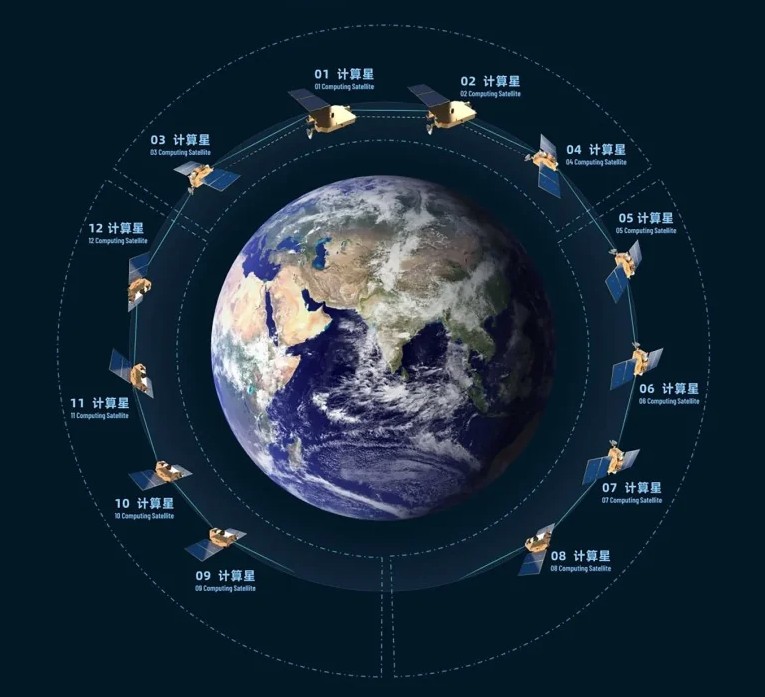
Each one carries an AI model with 8 billion parameters. And the plan calls for 2,800 of them.
In February, China announced it had finished nine months of in-orbit testing and had 10 AI models running in space.
You see, the AI race runs on hardware and electricity as much as software. And China has already moved part of that race off the planet.
America needs a lot more computing power to stay ahead. But voters just told us they won’t host much more of it on the ground.
Putting a big chunk of it in orbit solves both problems at once.
We’ll still build plenty of data centers here on Earth. But the next wave of growth has a place to go now, and cheap, reusable rockets just made the trip affordable.
Sell the Shovels
Now, let’s talk about one more potential payoff for investors, one of the oldest plays in the market…
During the California Gold Rush, plenty of miners went home broke. But the folks selling picks, shovels, and denim built fortunes. Levi Strauss never panned for an ounce of gold, yet every American knows his name.
And the gold rush in space is going to work the same way…
Elon Musk will get the headlines. But the companies supplying the solar arrays, the hardened chips, the cooling systems, and the ground networks will get the steady checks.
 My colleague Jason Simpkins has spent 15 years covering the Pentagon and the defense contractors it pays. And he calls this network “the Galactic Supply Chain.”
He’s also already identified three smaller contractors sitting right in the middle of the money already flowing from the Space Force and the Missile Defense Agency.
He walks through all three in a free video briefing, including what each company builds, who its biggest customers are, and the contracts he’s watching for 2027 and 2028.
You can watch Jason’s free Galactic Supply Chain briefing right here.
The next great American building boom might not happen on American soil at all. It might happen a few hundred miles above it.

The Best Free Investment You'll Ever Make
We never spam! View our Privacy Policy
After getting your report, you’ll begin receiving the Wealth Daily e-Letter, delivered to your inbox daily.
Angel Publishing Investor Club Discord - Chat Now
Jason Williams Premium
Introductory

Advanced


