When $8 Trillion Gets Tired of Waiting

There’s an old Wall Street saying that bull markets climb a wall of worry.
And right now that wall is made out of cash and taller than it’s ever been.
According to the Investment Company Institute, Americans had $7.89 trillion sitting in money-market funds at the end of September.
That’s an extraordinary amount of money parked in what is essentially the financial world’s waiting room.
And the bullish argument all that cash is making should be pretty obvious…
If stocks keep rising, a lot of that money will eventually come off the sidelines.
Investors who have been content collecting interest will start worrying less about preserving capital and more about missing out on gains.
So they’ll buy stocks.
And those purchases will push prices higher.
And higher prices will attract more buyers.
And suddenly that giant pile of cautious cash becomes rocket fuel for the bull market.
There’s just one problem…
A lot of people will tell you that argument is complete nonsense.
Every Buyer Has a Seller
The objection goes like this…
If I take $10,000 out of a money-market fund and buy $10,000 worth of stock from you, you now have my $10,000.
So, according to the objectors, no money actually “entered” the stock market; it just changed hands.
Every buyer needs a seller, and therefore, the trillions of dollars supposedly sitting “on the sidelines” can’t really flow into stocks.
And technically, that first part is true. But the conclusion just doesn’t follow…
Because the important question isn’t whether the cash continues to exist.
Of course it does.
The important question is what the next person does with it…
Let’s say I pull $10,000 out of a money-market fund and buy shares of Microsoft.
The person who sold them to me now has $10,000. But there’s absolutely no reason that seller has to put the money back into a money-market fund.
Maybe he thinks Microsoft has gotten expensive and uses the proceeds to buy a beaten-down industrial stock.
The industrial stock seller might turn around and buy an energy company. And that seller might use the proceeds to buy a small-cap stock.
Suddenly the same initial decision to move $10,000 out of cash has helped create a chain of transactions throughout the equity market.
The dollars are still there. But the desire to hold cash has fallen.
And that’s what matters…
Markets adjust to changes in desired asset allocation through price.
If millions of investors decide they want fewer money-market shares and more equities, somebody has to convince existing stockholders to give up their shares.
And the easiest way to do that is to offer them a higher price.
That’s how sidelined cash becomes bullish without violating the basic fact that every buyer has a seller.
And the best part for investors like us is that we don’t have to rely on theory…
We’ve seen this movie before.
The Best Free Investment You’ll Ever Make
Join Wealth Daily today for FREE. We’ll keep you on top of all the hottest investment ideas before they
hit Wall Street. Become a member today, and get our latest free report: “The $10 Trillion AI Infrastructure Boom.”
It contains full details on why money managers are overpaid and provides you with
tools for growing your wealth.On your own terms. No fees, no commission.
After the Dot-Com Crash
The first great example I’ll share comes after the dot-com bubble burst…
From 2000 through 2002, stocks suffered one of their worst stretches in decades.
The Nasdaq collapsed. The S&P 500 endured three consecutive losing years. And investors sought safety.
Federal Reserve data show total money-market fund assets rising from about $1.85 trillion at the end of 2000 to roughly $2.29 trillion in 2001 and then remaining above $2.2 trillion in 2002.
But then investors began changing their minds…
By the end of 2003, money-market assets had fallen to roughly $2.04 trillion. By the end of 2004, they were down to about $1.9 trillion (right around pre-crash levels).
And stocks?
The S&P 500 took off…
It gained 28% in 2003, followed by another double-digit year in 2004.
That wasn’t a coincidence.
The appetite for safety was fading at exactly the same time investors were rediscovering their appetite for risk.
And the huge cash pile accumulated during the bear market became a reservoir of demand once confidence returned.
Then It Happened Again in 2009
Then, a few years later, the so-called Great Recession gave us an even clearer example…
By February 2009, money-market fund assets had reached just under $3.9 trillion, an all-time record up to that point.
And that makes sense when you think about the psychology at the time…
Lehman Brothers had failed. Behr Stearns had followed suit. Nationwide banks were collapsing. Home prices were plunging. Unemployment was climbing.
And investors didn’t merely dislike stocks; they were downright terrified of them.
So they piled into cash. And, viewed through the conventional lens, that record money-market balance looked bearish…
Investors clearly didn’t trust the market.
But that was precisely what made the setup so bullish.
There weren’t many investors left who still needed to become scared…
They were already scared. They had already sold. They had already moved to safety.
The next major change in psychology was far more likely to be in the opposite direction.
And that’s exactly what happened…
The S&P 500 bottomed on March 9, 2009. And money-market balances began falling as stocks began climbing.
In fact, Federal Reserve data show money-market assets dropping from about $3.83 trillion at the end of 2008 to $3.32 trillion at the end of 2009, and then falling again to $3.03 trillion in 2010.
Meanwhile, the S&P 500 gained 26% in 2009 and another 15% in 2010.
And that was only the beginning, as the market kept climbing for years (up 2% in 2011, 16% in 2012, and 32% in 2013).
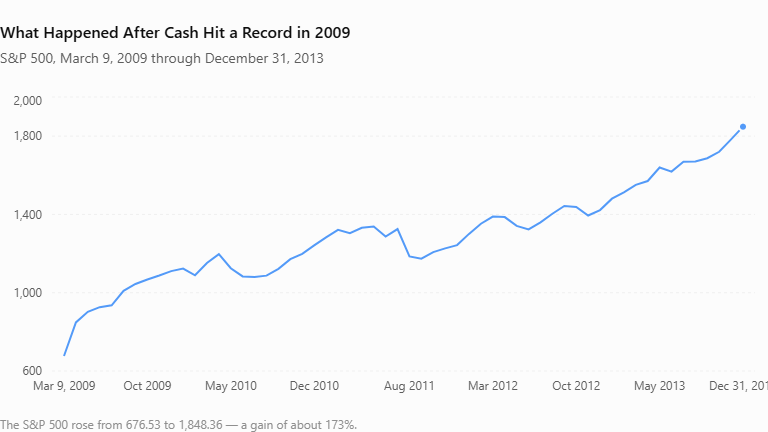
Again, the point isn’t that every dollar leaving a money-market fund permanently lodged itself inside the stock market. That’s not how markets work.
The point is that investors collectively decided they wanted less cash and more risk.
And prices had to rise to accommodate that shift.
The COVID Panic Did It Again
Then came 2020…
COVID shut down huge portions of the global economy virtually overnight. Stocks crashed and investors stampeded toward safety.
By the end of 2020, Federal Reserve data showed money-market fund assets around $4.77 trillion, another enormous increase in defensive positioning.
And something particularly interesting happened this time…
Stocks started recovering while cash balances were still extremely elevated.
The market bottomed in March, and by the summer, stocks were already well into an enormous rally.
Yet investors were still sitting on mountains of cash.
That just shows that we don’t even need to wait for money-market balances to collapse before the bullish effect appears.
Markets move on expectations, and even a relatively small number of marginal buyers can begin bidding stock prices higher.
Those gains improve sentiment. Improved sentiment attracts more buyers…
And eventually, the people sitting in cash start asking themselves whether safety is costing them too much.
And that’s when the fear of losing money gets replaced by the fear of missing out.
Cash Starts Looking Different When Stocks Won’t Stop Rising
Imagine you’ve got $500,000 sitting in a money-market fund…
You’re collecting a decent return and stocks look expensive to you, so you’re feeling pretty comfortable.
But then the market rises 5%…
“No big deal,” you say as you shrug it off.
But then it rises 10%…
And maybe you tell yourself it’s due for a correction.
But then it rises another 10%…
And some of the stocks you thought about buying six months ago are 30% higher.
Your friends are talking about their gains. Financial headlines are talking about record highs…
And suddenly that money-market yield doesn’t feel quite as attractive and you don’t feel so comfortable.
Nothing about the cash itself changed. Your opportunity cost is what changed…
So you move a little into stocks, and the person who sells those stocks to you doesn’t necessarily run back into a money-market fund.
He might rotate into another stock he thinks has more upside. And the next seller might do the same thing.
And that’s how a relatively small reduction in the public’s desired cash holdings can create much larger effects throughout the stock market.
And that brings us back to the nearly $8 trillion sitting in money-market funds today.
Today’s Wall Is Bigger Than Ever
As of September 30, money-market funds held approximately $7.89 trillion…
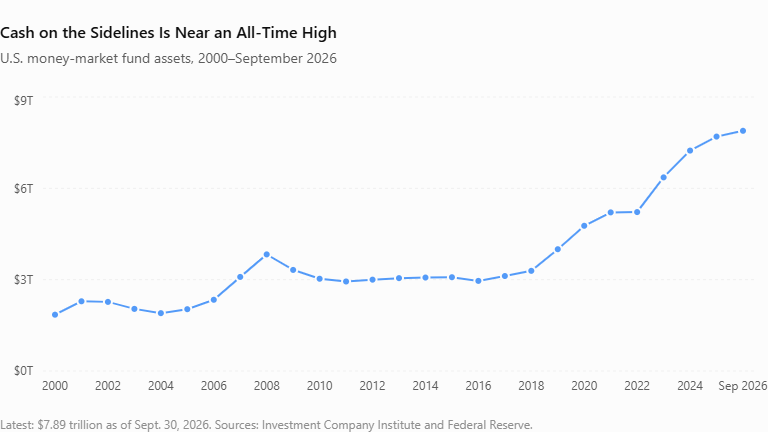
For comparison, the supposedly enormous record immediately before the 2009 bull market was about $3.9 trillion.
Yes, the economy and stock market are much larger today, so comparing those raw numbers isn’t perfect.
But the psychological setup should feel familiar…
Investors have spent years being given reasons to remain cautious.
Inflation. Interest rates. Recession fears. Wars. Political uncertainty. Government debt. Tariffs. AI bubble warnings. Market concentration. Valuations. Take your pick.
Yet stocks have kept climbing, and that matters…
Because every month that stocks refuse to collapse is another month that investors holding trillions of dollars in cash have to watch other people make money.
Eventually, some of them are going to decide they’ve waited long enough.
And the entire $7.89 trillion doesn’t need to “pour into the stock market,” to have an impact…
Even a modest shift away from cash and toward equities can create massive incremental demand.
And history suggests that’s exactly the kind of environment that has accompanied some of history’s most powerful bull markets.
The Wall of Worry Becomes Fuel
That’s why I think the bears are looking at today’s record money-market balances backward.
They see nearly $8 trillion sitting safely outside equities and interpret it as evidence that investors don’t trust the stock market.
Maybe so. But that’s also what makes it bullish…
The investors holding that cash have already acted on their fear and taken risk off the table.
They’ve already positioned themselves cautiously. And that means they can’t put selling pressure on the market unless they buy back in first.
And meanwhile, every additional rise in the market increases the temptation to do exactly that.
We saw it happen after the dot-com crash. We saw it even more clearly after the financial crisis. And we saw it again following the COVID crash.
Record cash balances didn’t prevent bull markets. They preceded them.
So forget the idea that $8 trillion has to somehow “enter” the stock market.
That’s not the argument. The argument is much simpler and far more elegant…
There are nearly $8 trillion worth of reasons investors have already chosen caution.
If confidence keeps improving and even a fraction of those investors decide they’d rather own stocks, sellers are going to demand higher prices before giving them up.
And then those sellers are likely to go looking for the next opportunity themselves.
That’s not cash disappearing. That’s money circulating through a rising market.
And historically, that’s been one hell of a tailwind.
To your wealth,

Jason Williams
 @TheReal_JayDubs
 Angel Research on Youtube
After graduating Cum Laude in finance and economics, Jason designed and analyzed complex projects for the U.S. Army. He made the jump to the private sector as an investment banking analyst at Morgan Stanley, where he eventually led his own team responsible for billions of dollars in daily trading. Jason left Wall Street to found his own investment office and now shares the strategies he used and the network he built with you. Jason is the founder of Main Street Ventures, a pre-IPO investment newsletter; the founder of Future Giants, a nano cap investing service; and authors The Wealth Advisory income stock newsletter. He is also the managing editor of Wealth Daily. To learn more about Jason, click here.
Want to hear more from Jason? Sign up to receive emails directly from him ranging from market commentaries to opportunities that he has his eye on.
The Best Free Investment You'll Ever Make
We never spam! View our Privacy Policy
After getting your report, you’ll begin receiving the Wealth Daily e-Letter, delivered to your inbox daily.
Angel Publishing Investor Club Discord - Chat Now
Jason Williams Premium
Introductory

Advanced


