The Erie Canal: The Critics Saw a Ditch... America Built an Economic Artery

Initial Investment:
Approximately $7 million (roughly $190 million in 2026 dollars).
Estimated Return on Investment:
Immeasurable. Conservatively, tens of trillions of dollars in economic value and productivity gains.
We continue our Wealth Daily series of looking at America’s greatest 11 investments that people hated.
For this fourth installment in the series, we go way back to 1817 when New York Governor DeWitt Clinton proposed one of the most ambitious infrastructure projects in American history.
The plan sounded almost absurd.
Dig a canal 363 miles long through forests, swamps, rocky terrain, and sparsely populated countryside. Connect the Hudson River to Lake Erie and create a water route between the Atlantic Ocean and the Great Lakes.
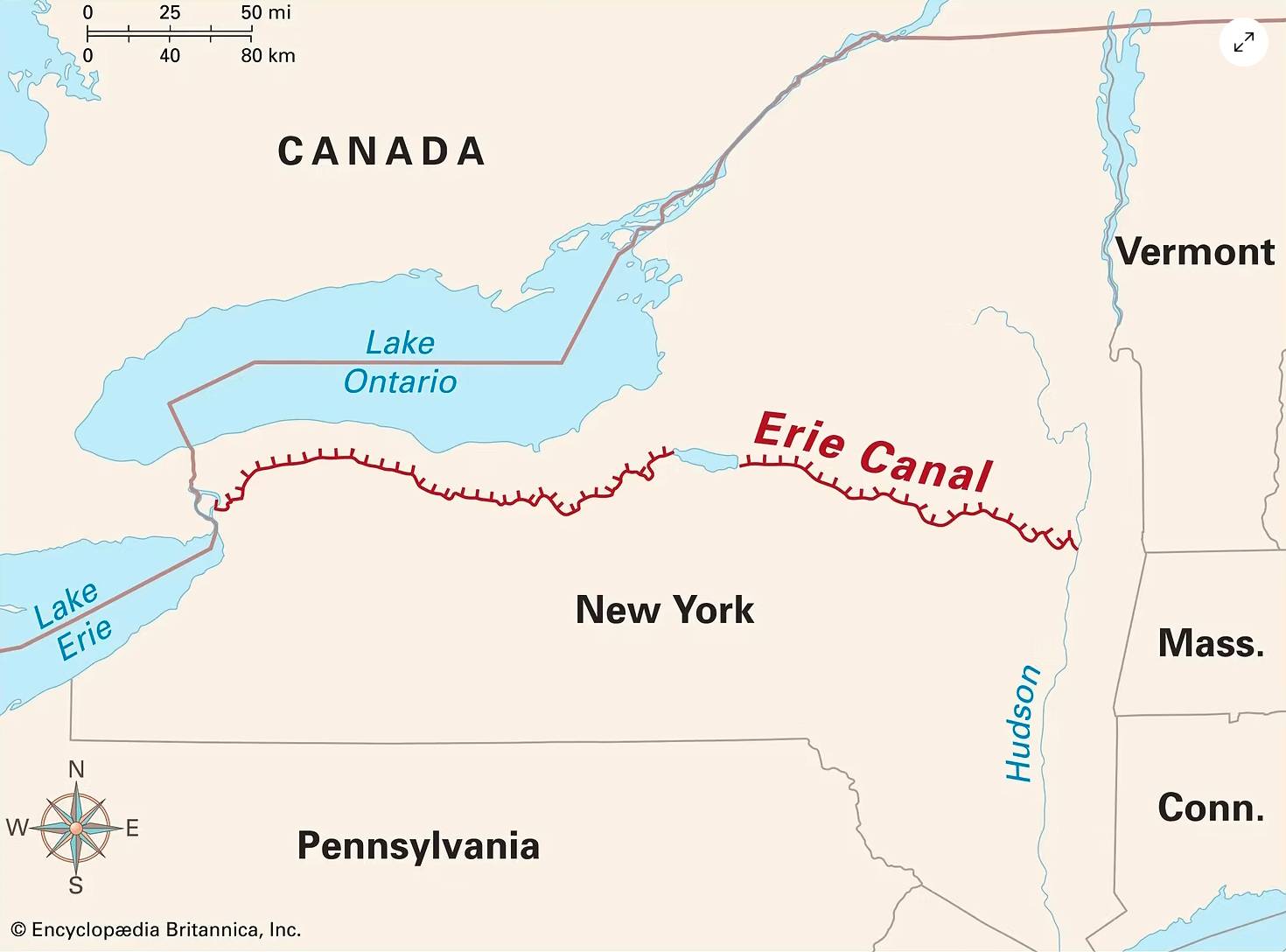
Today, the idea seems obvious.
At the time, it seemed insane.
The proposed canal would cost millions of dollars — an extraordinary sum for a young nation still finding its footing. Few people believed such an engineering feat could even be accomplished. Others doubted that enough commerce existed to justify the expense.
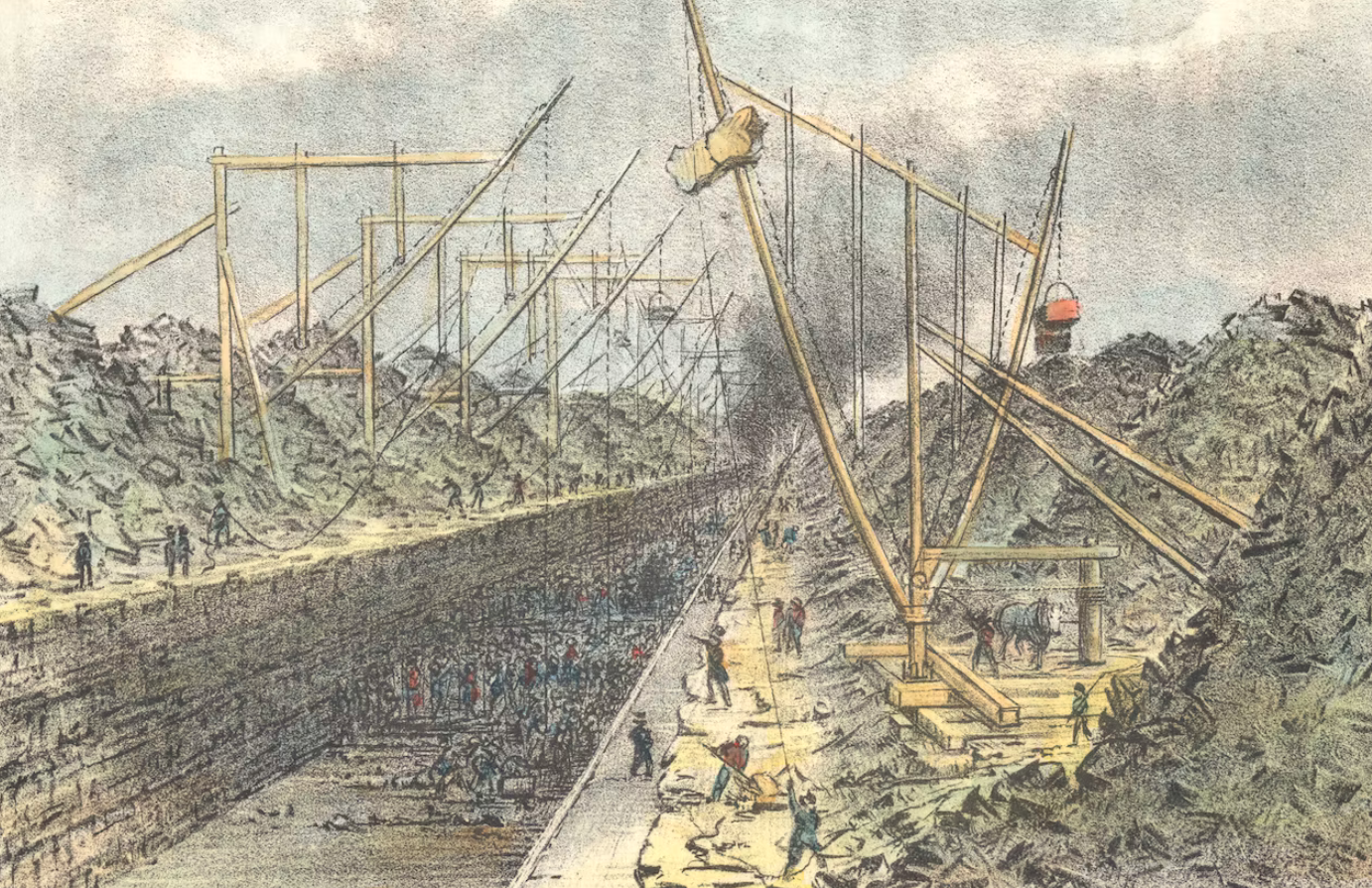
The ridicule came quickly.
Opponents mocked the proposal as “Clinton’s Ditch.”
Newspapers derided it as a gigantic trench that would bankrupt New York and lead nowhere. Political enemies accused Governor Clinton of chasing an impossible dream that would become one of the greatest public works disasters in American history.
To many Americans, the Erie Canal looked like a giant hole in the ground.
History would prove otherwise.
Construction officially began on July 4, 1817, in Rome, New York. The workforce faced grueling conditions. Swarms of mosquitoes, unpredictable weather, and the constant threat of accidents plagued the project. Nevertheless, progress was steady, and after eight years of relentless work, the Erie Canal was ready to open.
On October 26, 1825, Clinton boarded the packet boat Seneca Chief in Buffalo, beginning a historic voyage to New York City. Along the way, crowds gathered on the canal’s banks to cheer and watched as Governor Clinton poured a keg of Lake Erie water into the Hudson River, a symbolic “wedding of the waters” of the Great Lakes and the Atlantic Ocean.
The economic impact was almost immediate.
The Best Free Investment You’ll Ever Make
Join Wealth Daily today for FREE. We’ll keep you on top of all the hottest investment ideas before they
hit Wall Street. Become a member today, and get our latest free report: “The $10 Trillion AI Infrastructure Boom.”
It contains full details on why money managers are overpaid and provides you with
tools for growing your wealth.On your own terms. No fees, no commission.
The cost of shipping freight between the Midwest and New York City collapsed by more than 90%. Travel times fell dramatically. Farmers suddenly had access to distant markets. Merchants could move goods faster and more cheaply than ever before. Entire industries sprang up along the canal’s route.
The canal transformed New York City into the commercial capital of the United States.
Cities such as Buffalo, Rochester, Syracuse, and Albany boomed. Population surged across upstate New York. Commerce expanded westward. New markets emerged. Investment poured into transportation, agriculture, banking, and manufacturing.
The canal didn’t merely move goods.
It altered the economic geography of the country.
A project that critics had ridiculed as an expensive ditch became one of the most important infrastructure investments in American history.
Trying to calculate the return on investment is almost impossible.
The Erie Canal helped unlock the American Midwest, accelerated westward expansion, and established New York’s dominance in finance and trade. Trillions of dollars in economic activity can ultimately be traced back to a waterway that many people initially considered a foolish extravagance.
You see, the canal’s true value wasn’t the ditch itself.
Its value came from what the ditch made possible.
That’s an important distinction.
Governor Clinton wasn’t digging a trench for the sake of digging a trench. He was building a platform that would lower transportation costs, expand markets, and unleash economic activity that had previously been impossible.
Nobody in 1817 could fully appreciate how profoundly a canal would reshape commerce.
The same is true of artificial intelligence today.
The critics look at AI infrastructure and see giant buildings, massive electrical demand, and billions of dollars of capital expenditures. They see utility upgrades, transmission lines, cooling systems, and industrial construction.
I see an economic artery.
The Erie Canal dramatically reduced the cost of moving physical goods.
Artificial intelligence is reducing the cost of producing, analyzing, and applying intelligence itself.
That may prove to be one of the biggest economic events of this century.
When transportation becomes cheaper, trade expands. When communication becomes easier, networks grow. When computation becomes more affordable, innovation accelerates.
And when intelligence becomes dramatically cheaper and more abundant, entirely new industries can emerge.
That’s precisely what the AI data center build-out is creating.
A new economic artery. A new platform. A new foundation upon which entrepreneurs, scientists, engineers, and businesses will build products and services that we can’t fully imagine today.
You see, critics often focus on the infrastructure itself because that’s the part they can see.
The second-order effects remain hidden.
The opponents of the Erie Canal saw a costly construction project.
They didn’t foresee New York becoming the financial capital of America. They didn’t foresee millions of settlers moving west. They didn’t foresee the manufacturing boom that followed.
Likewise, many critics of AI infrastructure are focusing on today’s costs while overlooking tomorrow’s possibilities.
Nobody can fully predict how artificial intelligence will reshape medicine, scientific discovery, defense, manufacturing, logistics, and education.
That’s exactly the point.
The future value of transformational infrastructure almost always exceeds our ability to imagine it.
The canal looked like a ditch.
But it became an economic superhighway.
The critics saw dirt and water.
But DeWitt Clinton saw commerce and prosperity.
And today, the critics see data centers and power consumption.
I see the canals of intelligence being built before our eyes.
History has a habit of rewarding those who can recognize a new economic artery before the rest of the world realizes where it leads.
Get to the good, green grass first…
The Prophet of Profit,

Brian Hicks
 Check us out on YouTube!
Brian is a founding member and President of Angel Publishing. He writes about general investment strategies for Wealth Daily and Energy and Capital. Brian is the managing editor and investment director of R.I.C.H Report (Retired Independent Carefree Healthy), New World Assets and Extreme Opportunities. For more on Brian, take a look at his editor’s page.
The Best Free Investment You'll Ever Make
We never spam! View our Privacy Policy
After getting your report, you’ll begin receiving the Wealth Daily e-Letter, delivered to your inbox daily.
Angel Publishing Investor Club Discord - Chat Now
Brian Hicks Premium
Introductory

Advanced


