AI's Power Problem Is Real — but Wall Street’s Math May Be Wrong

Artificial intelligence is going to consume an enormous amount of electricity. That much is hard to dispute…
Technology companies are ordering power-hungry chips, building massive data center campuses and signing long-term energy contracts.
Utilities that spent years preparing for relatively flat electricity demand are suddenly being asked to connect facilities that can consume as much power as a small city.
But whenever investors begin treating a forecast as inevitable, it’s worth asking whether we’ve seen this story before.
And in this case, I’m convinced we have…
During the internet boom of the late 1990s, analysts warned that computers, servers, and telecommunications equipment were about to overwhelm the electric grid.
One widely circulated estimate claimed internet-related equipment already consumed roughly 8% of U.S. electricity and could eventually require half the nation’s power.
But that didn’t happen…
The internet still transformed the global economy. E-commerce reshaped retail. Streaming replaced television. Cloud computing changed corporate technology.
And smartphones put connected computers in billions of pockets.
Yet electricity consumption didn’t rise in direct proportion to internet usage.
Processors became more efficient. Servers became more powerful.
Virtualization allowed companies to consolidate workloads.
Cloud providers improved utilization. Cooling systems got better.
And software required less computing power to accomplish the same tasks.
Internet activity exploded, but the energy required for each unit of digital activity fell.
And that history offers an important lesson for today’s AI boom…
Directionally Right, Numerically Wrong
The forecasts surrounding AI power consumption aren’t imaginary.
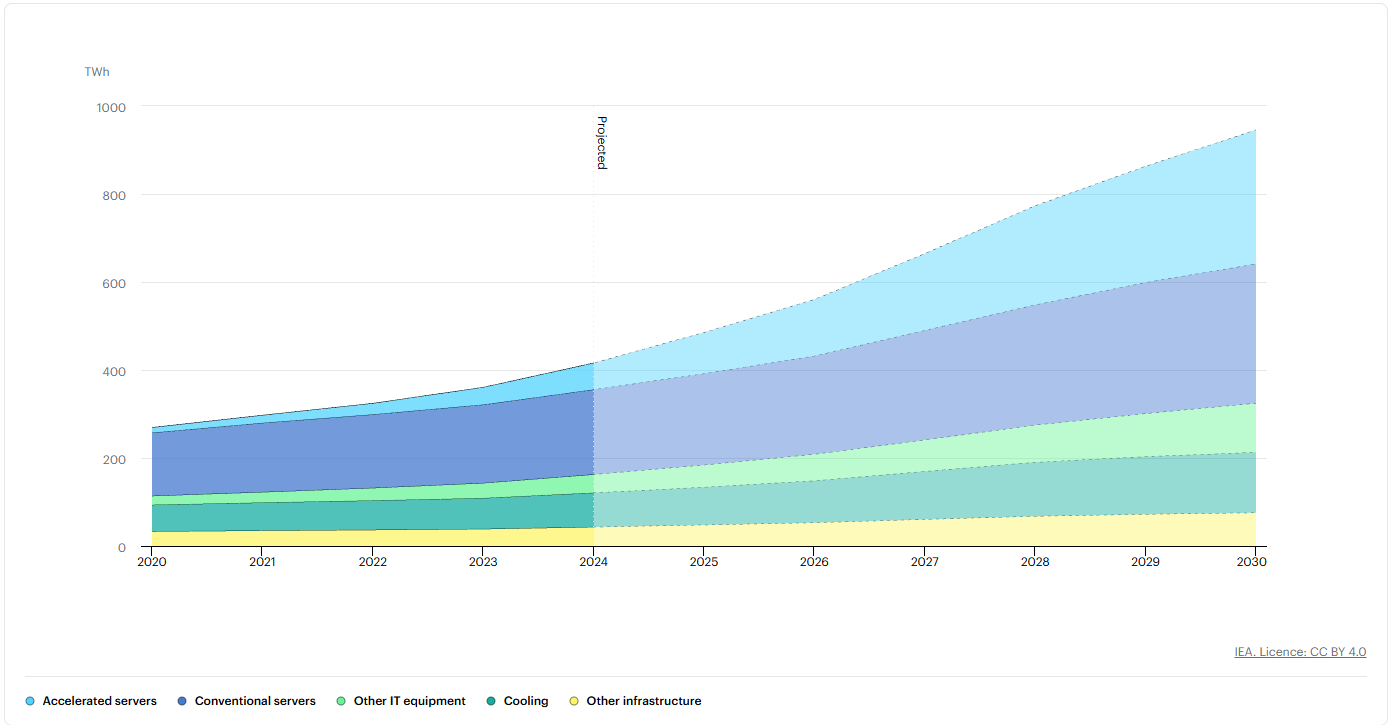
U.S. data centers consumed an estimated 176 terawatt-hours of electricity in 2023, up from 58 terawatt-hours in 2014.
Berkeley Lab estimates they could consume between 325 and 580 terawatt-hours by 2028.
That would create real pressure on power generation, transmission networks, transformers, substations, and local utility systems.
But investors should be careful about extending today’s steepest growth rates indefinitely.
Many projections begin with the electricity required to train or operate current AI models.
Analysts then multiply that figure by an enormous estimate of future users, queries, and workloads.
And that assumes the energy required for each useful AI task remains relatively constant.
But it almost certainly won’t…
Each new generation of AI hardware is designed to deliver more computing power per watt.
Developers are also using smaller models, specialized models, quantization, caching, model distillation, and mixture-of-experts architectures to reduce the computing needed for each task.
So training the largest frontier models may continue requiring gigantic clusters of accelerators.
But most commercial AI activity will eventually come from inference, when trained models answer questions, analyze data, and automate business processes.
And that creates enormous pressure to reduce costs…
Simply put, companies won’t spend $10 worth of computing power to create $1 worth of value.
And as AI moves from experimentation into everyday business use, energy efficiency will become one of the industry’s most important competitive advantages.
So the market is probably right about the direction of electricity demand…
But it may be very wrong about the final number.
The Best Free Investment You’ll Ever Make
Join Wealth Daily today for FREE. We’ll keep you on top of all the hottest investment ideas before they
hit Wall Street. Become a member today, and get our latest free report: “The $10 Trillion AI Infrastructure Boom.”
It contains full details on why money managers are overpaid and provides you with
tools for growing your wealth.On your own terms. No fees, no commission.
The Power Boom Still Matters
Now, that doesn’t undermine the energy investment case…
Even the lower end of current forecasts would represent one of the largest increases in U.S. electricity demand in decades.
The challenge also isn’t simply how much power the country produces. It’s whether enough power can be delivered to the right location at the right time…
AI data centers tend to cluster around fiber networks, available land, tax incentives, and existing technology hubs.
And that can create severe local shortages even when national electricity supplies appear adequate.
The United States may theoretically have enough generating capacity to support AI growth…
But Northern Virginia, Texas, Ohio, or Arizona may still lack the transmission infrastructure needed to connect another major campus.
And that means investors don’t need to believe the most sensational forecasts…
They only need to recognize that substantial capital must be invested in power generation, efficiency, and data center infrastructure.
And if you’re one of the investors who recognizes that, here are three ways to play each part of the trend (plus a bonus fourth play at the end).
The Power Producer: Constellation Energy
Constellation Energy Corp. (NASDAQ: CEG) is one of the clearest ways to invest in rising data center power demand.
The company operates the largest nuclear fleet in the United States, giving it access to something technology companies increasingly value…
Dependable, carbon-free electricity that’s available around the clock.
Wind and solar will contribute to the AI energy build-out, but data centers can’t simply stop operating when the sun goes down or the wind stops blowing.
They need continuous power, and nuclear generation is well suited to supplying it.
Constellation’s agreement with Microsoft to restart the former Three Mile Island Unit 1 demonstrates how valuable that capacity has become.
The plant, renamed the Crane Clean Energy Center, is expected to return approximately 835 megawatts of generation to the grid under a long-term power arrangement.
And Constellation doesn’t need every proposed data center to be completed in order to profit…
It only needs electricity demand to remain strong enough to keep scarce nuclear generation valuable and support favorable contracts.
That makes it a way to invest in the direction of the trend without depending on the most aggressive projections.
The Efficiency Play: Nvidia
Nvidia Corp. (NASDAQ: NVDA) is usually viewed as one of the companies creating AI’s power problem. But it may also be one of the companies best positioned to solve it…
You see, if a new generation of chips can perform substantially more AI work within the same power envelope, operators can generate more revenue without waiting years for another transmission line or power plant to be built.
Nvidia has therefore made performance per watt a major part of its product strategy.
And that efficiency doesn’t necessarily reduce demand for its products. It can actually expand the entire AI market.
You see, cheaper inference makes it practical to add AI to more software, devices, and business processes.
A workload that’s uneconomic at one cost per token may become highly profitable when that cost falls.
The same thing happened during the internet era…
More efficient computing didn’t reduce digital activity. It made digital services cheaper and encouraged far more usage.
So Nvidia benefits whether AI consumes more electricity overall or becomes substantially more efficient per task.
The Utilization Play: Digital Realty
Digital Realty Trust Inc. (NYSE: DLR) offers another way to invest in the trend…
The company owns and operates data centers in many of the world’s most important technology markets.
And those existing facilities are increasingly valuable because new data centers require land, fiber connections, cooling systems, equipment, permits, and, most importantly, access to electricity.
So Digital Realty doesn’t need to build an entirely new portfolio to grow.
It can lease available space, increase occupancy, activate previously signed contracts, and support higher-density workloads inside facilities it already owns.
That creates room for revenue growth through higher utilization…
More efficient AI hardware may actually strengthen that opportunity.
If customers can perform more computing within the same electrical capacity, they may expand the number of AI services they offer rather than reduce their physical footprint.
Faster internet connections didn’t cause people to use less internet. They encouraged streaming, cloud applications, and entirely new digital businesses.
And more efficient AI infrastructure could create the same effect inside Digital Realty’s facilities.
Invest in the Direction
Transformational technologies rarely develop in a straight line…
The internet consumed more electricity as it expanded, but efficiency gains kept demand from reaching the extreme levels some analysts predicted.
AI is likely to follow a similar path…
Electricity demand will rise. Utilities and grid operators will face genuine strain. Data centers will require more generation, transmission, and cooling capacity.
But at the same time, chips will improve. Models will become smaller. Software will become more efficient. And data centers will increase utilization.
The investment case doesn’t require choosing between rising AI power demand and improving AI efficiency.
Both can be true…
Constellation can benefit from the need for reliable generation. Nvidia can benefit from producing more intelligence per watt.
And Digital Realty can benefit from putting more computing activity into scarce, power-connected facilities.
The market may be wrong about the exact numbers. But it’s still right about the direction.
And one of the most interesting opportunities may be a company Wall Street still dismisses as a boring industrial stock…
But beneath that old-economy label, it’s developing technology that could help AI companies tackle their current power problem head on.
And that could make it an essential part of the solution to one of AI’s biggest constraints and allow investors to get exposure to the boom without chasing the market’s most obvious names.
So we’ve put together a special report explaining what this company is building, why Wall Street may be overlooking it, and how investors can position themselves before the rest of the market catches on.
Click here to get your free copy today.
To your wealth,

Jason Williams
 @TheReal_JayDubs
 Angel Research on Youtube
After graduating Cum Laude in finance and economics, Jason designed and analyzed complex projects for the U.S. Army. He made the jump to the private sector as an investment banking analyst at Morgan Stanley, where he eventually led his own team responsible for billions of dollars in daily trading. Jason left Wall Street to found his own investment office and now shares the strategies he used and the network he built with you. Jason is the founder of Main Street Ventures, a pre-IPO investment newsletter; the founder of Future Giants, a nano cap investing service; and authors The Wealth Advisory income stock newsletter. He is also the managing editor of Wealth Daily. To learn more about Jason, click here.
Want to hear more from Jason? Sign up to receive emails directly from him ranging from market commentaries to opportunities that he has his eye on.
The Best Free Investment You'll Ever Make
We never spam! View our Privacy Policy
After getting your report, you’ll begin receiving the Wealth Daily e-Letter, delivered to your inbox daily.
Angel Publishing Investor Club Discord - Chat Now
Jason Williams Premium
Introductory

Advanced


