When Corporate America Built Its First Data Centers

Last week, we traveled back to 1946.
To a room at the University of Pennsylvania filled with something the world had never really seen before.
Thirty tons of electronics.
Nearly 18,000 vacuum tubes. Miles of wiring. A machine so enormous that instead of sitting on a desk…
The desk practically had to sit inside the machine.
ENIAC showed the world something extraordinary.
Electronic computers could perform calculations at speeds previously considered impossible.
But ENIAC also revealed something else. Something that would ultimately become just as important.
Computers — big computers — needed infrastructure.
They needed enormous amounts of electricity.
As a result, they generated enormous amounts of heat.
Therefore, they needed cooling.
They needed around the clock technicians and security. They also needed a lot of space.
And as computers became more powerful, the buildings surrounding them would become increasingly sophisticated.
That is where our story continues.
Because during the next two decades — the 1950s and ’60s, the computer escaped the laboratory…
And invaded corporate America.
Welcome to the Computer Room
Imagine walking into the headquarters of a major American corporation sometime around 1965.
Maybe it’s a bank.
You walk through the offices and eventually reach a room unlike anything else in the building.
The door may be locked. Access is restricted. Inside, the temperature is carefully controlled.
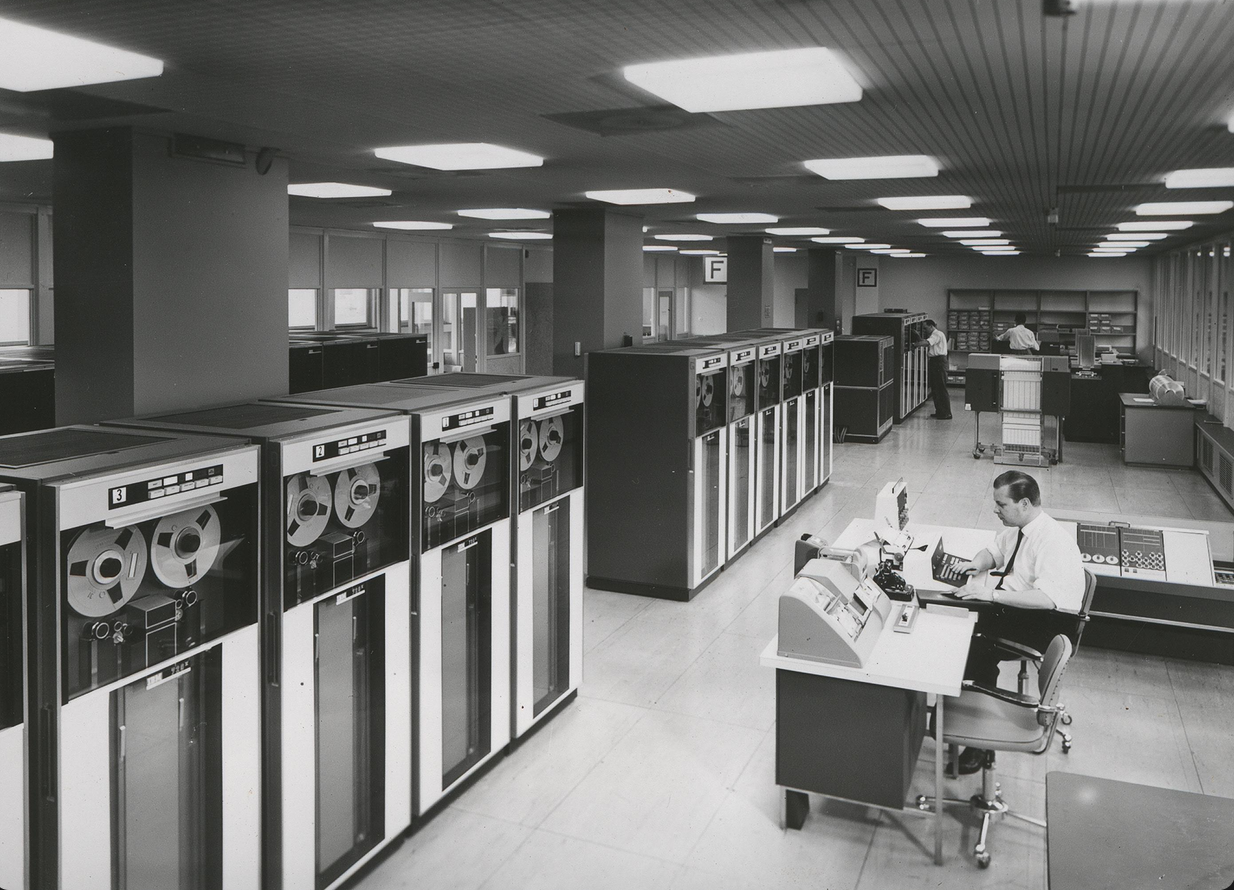
There are enormous cabinets arranged across the floor.
Tape drives spin. Printers chatter. Lights blink across control panels.
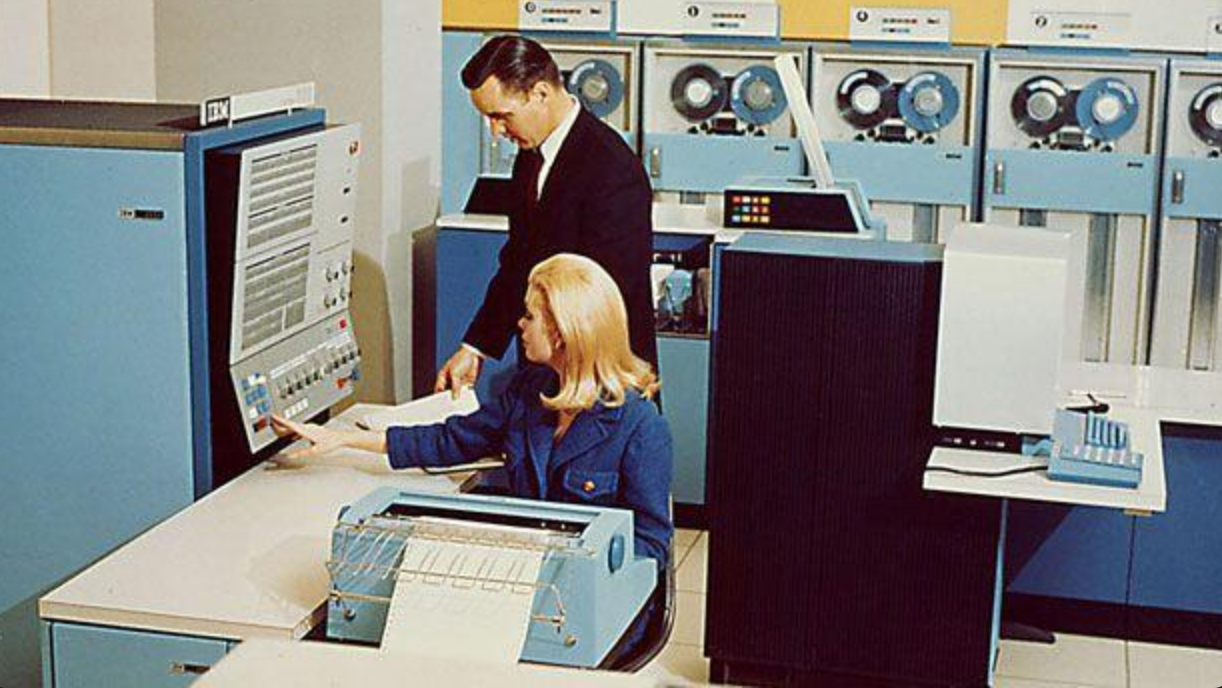
Technicians move between machines.
The floor itself may even be elevated so electrical cables and communications wiring can run underneath it.
This wasn’t called an AI data center or a hyperscale facility.
It was usually called something much simpler.
The computer room.
But look closely.
Because nearly everything we associate with the modern data center was beginning to appear.
Dedicated computing equipment. Specialized electrical infrastructure. Cooling. Cabling. Security. Storage. Networking. Backup systems. Trained personnel.
The architecture surrounding computation was becoming almost as important as the computers themselves.
And one company was about to push this transformation into overdrive.
The Best Free Investment You’ll Ever Make
Join Wealth Daily today for FREE. We’ll keep you on top of all the hottest investment ideas before they
hit Wall Street. Become a member today, and get our latest free report: “The $10 Trillion AI Infrastructure Boom.”
It contains full details on why money managers are overpaid and provides you with
tools for growing your wealth.On your own terms. No fees, no commission.
April 7, 1964
On April 7, 1964, IBM made one of the most important announcements in the history of computing.
The company unveiled the System/360.
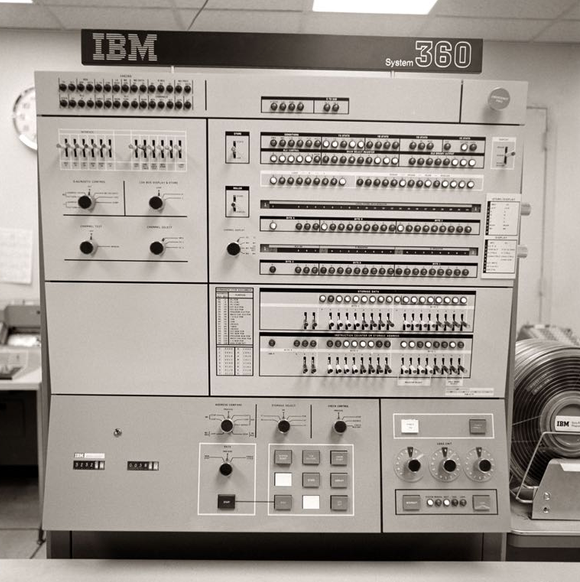
Today, that name probably means very little to most investors.
But the System/360 helped change the way corporations thought about computers.
Before it, businesses frequently purchased machines built for particular purposes. Moving software and data between different models could be difficult or impossible.
IBM had a radically different idea.
Build an entire family of compatible computers.
A customer could start relatively small.
Then, as the business grew, they could move to larger and more powerful machines without abandoning the entire computing ecosystem it had already built.
Think about how important that was.
IBM wasn’t merely selling corporations a computer anymore.
It was effectively telling them, “Build your business around computing.”
And corporate America did.
Banks began using mainframes to process enormous volumes of transactions. Insurance companies used them to manage policies and calculate risk. Manufacturers used them for inventory and production planning. Airlines used computers to manage reservations. Governments used them to process enormous quantities of information. Universities used them for research.
Computers were no longer experimental machines hidden inside military laboratories.
They were becoming essential business infrastructure.
The Computer Became the Building’s Most Important Tenant
Here’s where the story becomes especially relevant to what is happening today.
A mainframe couldn’t simply be delivered to an office and plugged into the wall.
These machines could require significant electrical capacity.
They produced heat. They required carefully managed environments. Equipment had to be protected from dust and contaminants. Cables had to connect processors, storage systems, terminals, and peripheral equipment.
Reliability became increasingly important because companies were beginning to depend upon these machines to conduct business.
The computer room, therefore, became something unusual.
A room designed around the needs of the machine rather than the needs of the humans working inside it.
Think about that.
Because we’re doing exactly the same thing today.
Only on a gigantic scale.
Today we talk about locating AI data centers near power generation.
We talk about liquid cooling and backup generators.
We talk about substations. Transformers. Transmission lines. Water. Security. Fiber connections. The terminology sounds futuristic. The engineering is dramatically more advanced.
But the fundamental problem is surprisingly old…
How do you build an environment capable of keeping extremely valuable computers running continuously?
Corporate America began confronting that question more than half a century ago.
Then Something Even More Important Happened
The machines became indispensable.
That changed everything.
Imagine you’re running a bank in 1968.
At first, the computer is an efficiency tool. It processes information faster. It reduces paperwork. It performs calculations.
But, gradually, more of the bank’s operations move onto the computer:
Customer records
Transactions
Accounting
Payroll
Loans
Suddenly the machine isn’t merely helping the business.
The business is becoming dependent upon the machine.
Now imagine the computer stops working.
That’s no longer an inconvenience. That’s a business problem.
And this is one of the most important transitions in the entire history of the data center.
Computing went from being useful…
To being mission critical.
Once that happened, corporations were willing to spend enormous amounts of money to ensure that their machines remained operational.
The computer room began evolving into something much larger: the corporate “data center.”
We’ve Seen This Movie Before
Now jump forward roughly 60 years.
Listen to the debate surrounding artificial intelligence today.
Companies are spending too much money. The computers are too expensive. The buildings require too much electricity. Cooling them is becoming increasingly difficult. Utilities can’t build power generation fast enough. Transformers are in short supply. Transmission infrastructure needs upgrading.
Companies are spending billions before anyone knows exactly how much revenue AI will ultimately generate.
Sound familiar?
The numbers are vastly larger. The technology is vastly more powerful. But the underlying economic pattern isn’t new.
Whenever computation becomes more important to the economy…
The infrastructure supporting computation becomes more important too.
That happened with the mainframe.
It happened with the internet.
It happened with cloud computing.
And now it’s happening with artificial intelligence.
But there’s another lesson hiding inside the mainframe era.
Computing Creates Its Own Demand
Imagine telling the CEO of a major American corporation in 1960 that his company would soon spend millions of dollars installing computers.
He might have asked a perfectly reasonable question…
What exactly are we going to do with all that computing power?
The answer turned out to be…
Almost everything.
Accounting
Payroll
Inventory
Banking
Reservations
Engineering
Manufacturing
Logistics
Communications
Databases
Customer records
To really hammer this home, this is a picture of engineers drawing blueprints before AutoCad:

Every time computing became cheaper or more powerful, businesses discovered another reason to use it.
That pattern continued for decades.
And eventually, something remarkable happened.
The giant mainframe escaped the computer room.
Computers became small enough to sit on desks.
Then they became laptops. Then smartphones. Then billions of connected devices.
Yet instead of reducing the need for centralized computing infrastructure…
It created even more demand for it.
That’s the paradox at the heart of the data center story.
Computers became smaller. But the infrastructure behind them became larger. Much larger.
From One Room to $31 Trillion
That’s why I want you to remember those old photographs of IBM mainframe rooms.
The enormous cabinets. The spinning tape reels. The raised floors.
The technicians standing beside machines that today look almost prehistoric.
Don’t laugh at them.
Study them.
Because you’re looking at the early architecture of an industry that is now becoming one of the largest infrastructure stories in human history.
ENIAC required a room. The mainframe required the corporate computer center. The internet would require buildings filled with servers. The cloud would require enormous hyperscale campuses.
And artificial intelligence is beginning to require something larger still.
Entire industrial ecosystems built around computation.
And enormous amounts of land.
That’s how we eventually arrive at the almost unbelievable projection I showed you last week: $31 trillion in global data center spending through 2035.
Look at that number without understanding the history and it sounds insane.
Look at the history…
And suddenly it begins to make sense.
We aren’t witnessing the birth of the data center.
We’re witnessing its latest evolution.
And that distinction is enormously important for investors.
Because AI didn’t suddenly create humanity’s need for computing infrastructure three years ago.
We’ve been building that infrastructure for generations.
Every successive computing revolution simply pushed it to another level.
ENIAC gave us the first glimpse.
IBM brought computing into corporate America.
And then, during the 1980s and 1990s, something happened that would make even the System/360 revolution look small.
Computers began talking to each other.
And eventually, the entire world connected.
That is where we’ll go next.
“Chapter 3: When the Internet Turned Data Centers Into an Industry.”
Get to the good, green grass first…
The Prophet of Profit,
And that’s when the modern data center really began taking shape.
And that meant businesses had to start constructing infrastructure around them.
And I think it’s even more important.

Brian Hicks
 Check us out on YouTube!
Brian is a founding member and President of Angel Publishing. He writes about general investment strategies for Wealth Daily and Energy and Capital. Brian is the managing editor and investment director of R.I.C.H Report (Retired Independent Carefree Healthy), New World Assets and Extreme Opportunities. For more on Brian, take a look at his editor’s page.
The Best Free Investment You'll Ever Make
We never spam! View our Privacy Policy
After getting your report, you’ll begin receiving the Wealth Daily e-Letter, delivered to your inbox daily.
Angel Publishing Investor Club Discord - Chat Now
Brian Hicks Premium
Introductory

Advanced


