$40 Trillion Was Never the Story — What Comes Next Is

There are numbers so large they stop feeling real.
Today’s number is $40 trillion.
That’s the amount of debt the United States is on the verge of accumulating — months earlier than government forecasters expected. It is a staggering milestone, but it’s also the wrong thing to focus on.
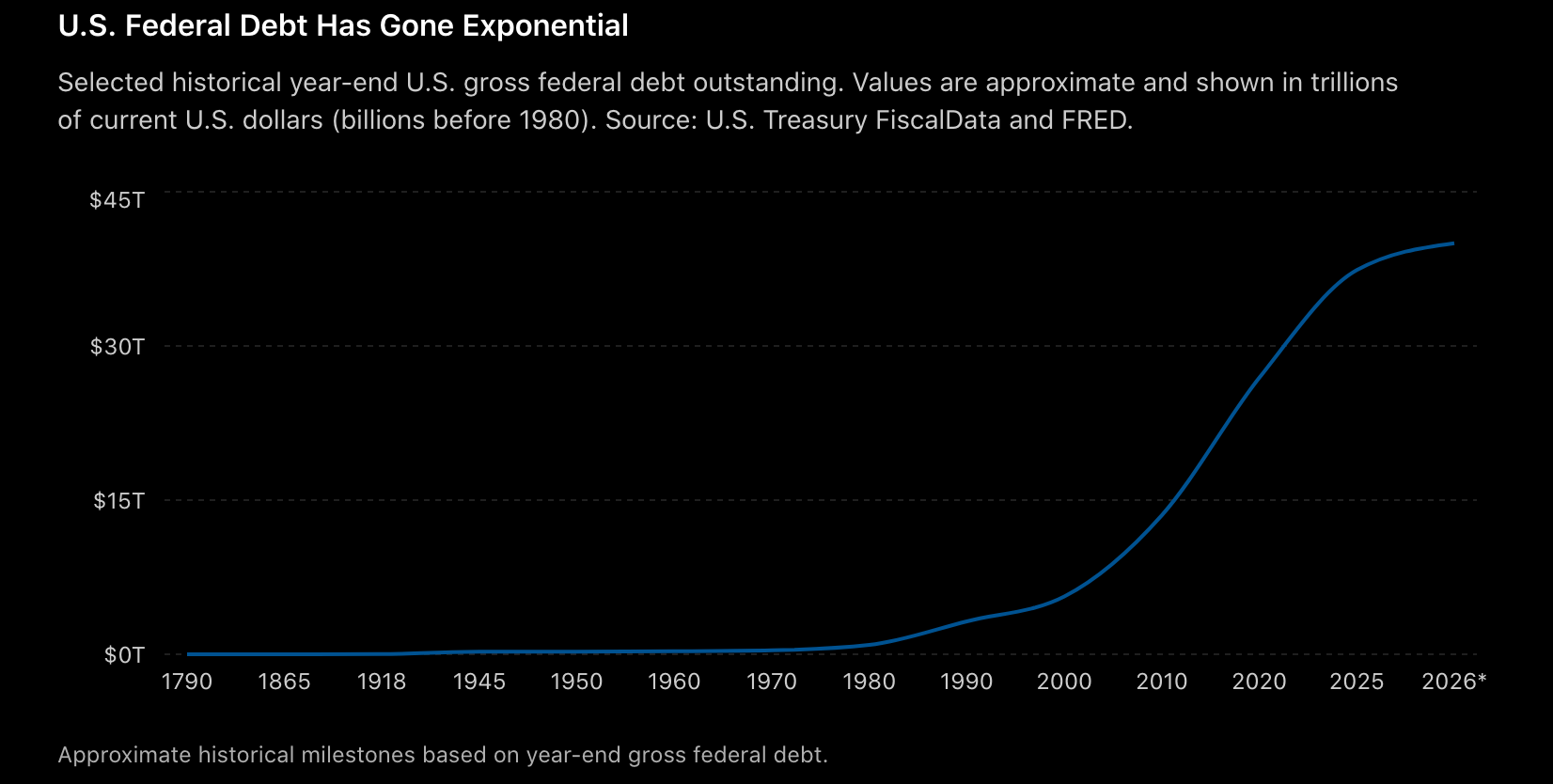
The real story isn’t that America is crossing another debt threshold.
The real story is what governments always do once debt reaches levels that can never realistically be repaid.
History has seen this movie before.
Governments rarely choose painful spending cuts. They almost never default outright. And sustained economic miracles capable of outgrowing mountains of debt are extraordinarily rare.
Instead, they choose the path of least political resistance.
They create more money.
Not necessarily by running the printing presses in the old-fashioned sense, but through ever-expanding deficits, larger Treasury issuance, accommodative monetary policy, and financial systems designed to absorb an endless supply of government debt.
That process gradually erodes the purchasing power of the currency itself.
It’s happened throughout history.
And there’s little reason to believe this time will be fundamentally different.
Debt Doesn’t Destroy Wealth… Currency Debasement Does
One of the biggest misconceptions about national debt is that the debt itself is the crisis.
It isn’t.
The real issue is how governments manage debt that has become too large to pay back honestly.
When obligations grow faster than the productive economy, policymakers eventually begin reducing the real value of those obligations by reducing the purchasing power of the currency they’re denominated in.
That doesn’t make the debt disappear.
It simply changes who ultimately bears the cost.
History offers countless examples — from Ancient Rome to Revolutionary France to more recent episodes in Argentina, Zimbabwe, and Venezuela. Different governments. Different eras. Different political systems.
The ending always rhymes.
Currencies weaken.
Scarce assets hold their value.
Why Gold Keeps Winning
This is precisely why gold has remained a store of value for thousands of years.
And gold is rebounding strong after making record highs earlier this year:
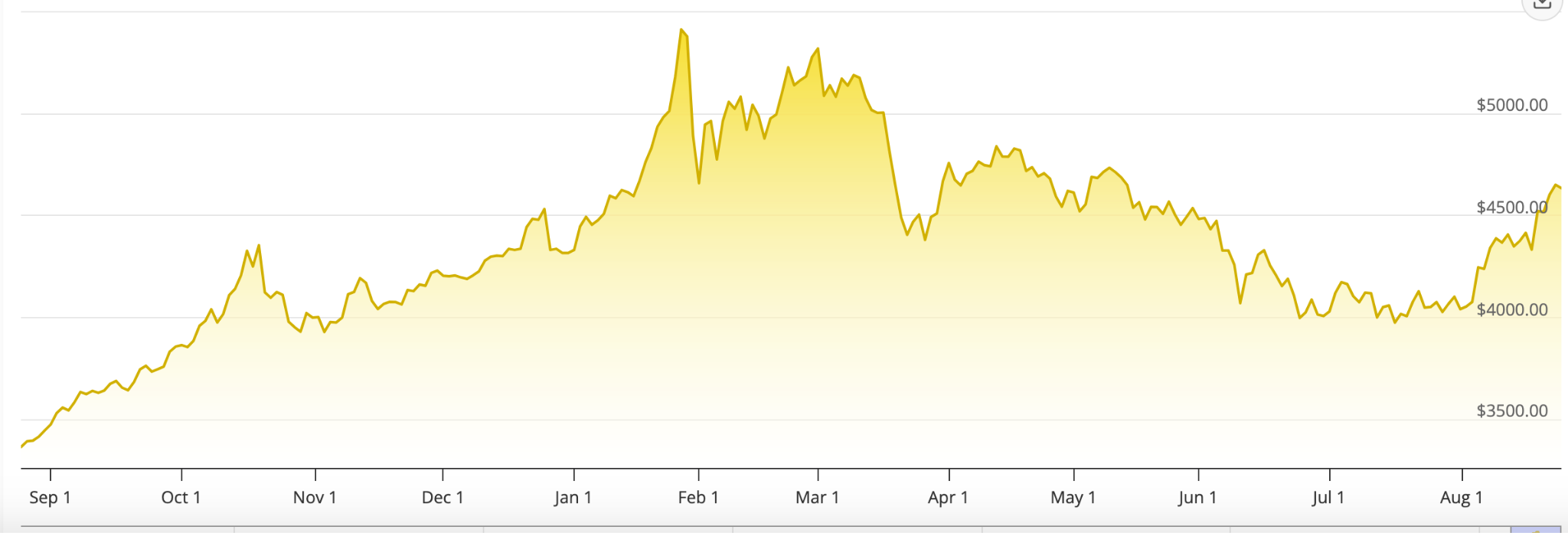
Gold itself doesn’t suddenly become more useful every decade.
Instead, paper currencies slowly lose purchasing power while gold maintains its scarcity.
That’s why periods of accelerating government debt have historically been constructive for precious metals.
Today, the United States is borrowing at a pace that would have seemed unimaginable only a generation ago.
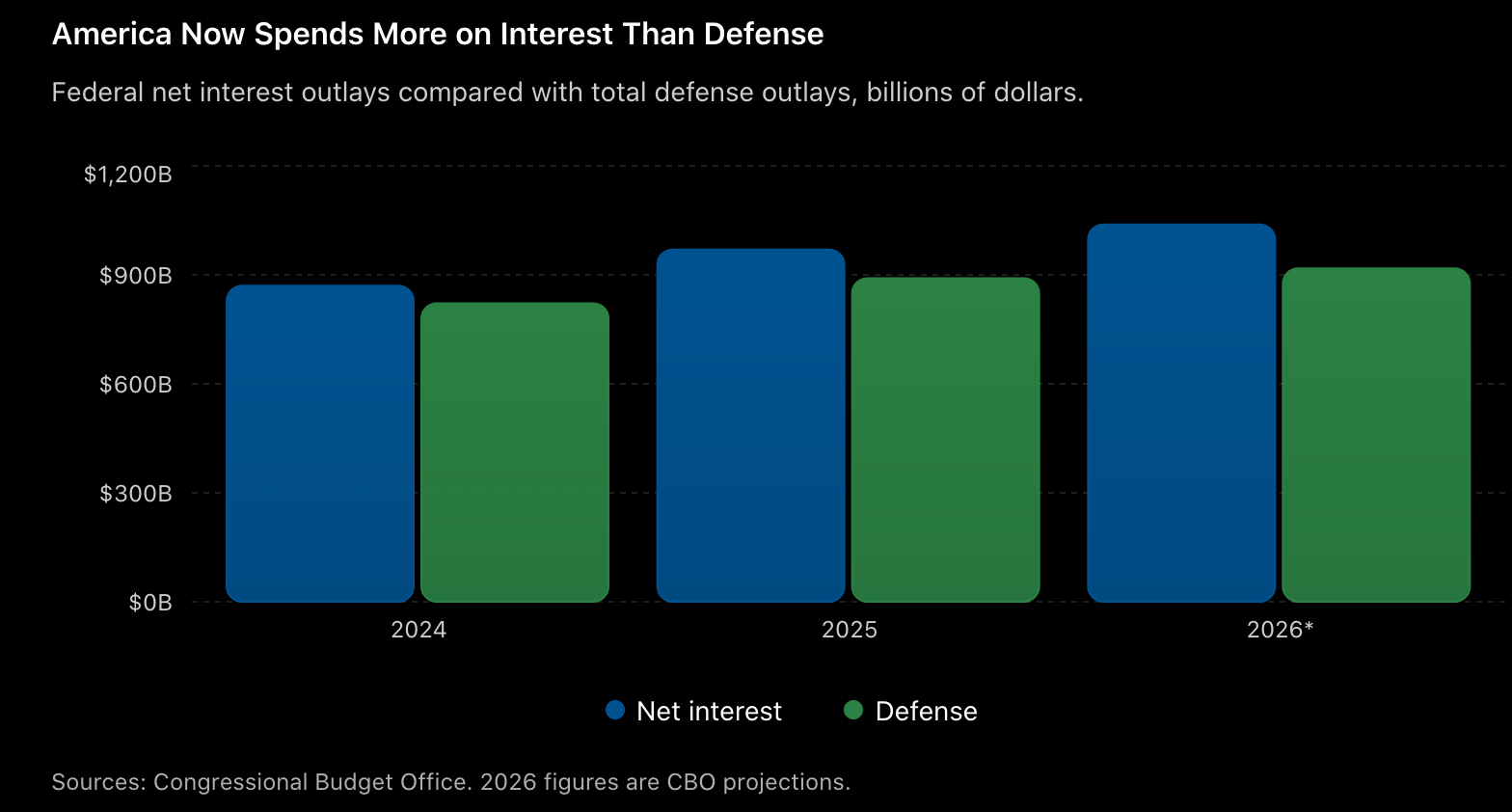
In fact, the U.S. spends more interest to service its debt than it does on military spending:
The first trillion dollars of federal debt took nearly two centuries to accumulate.
Today, Washington is adding another trillion dollars in just a matter of months.
That’s not linear growth. That’s compound growth.
And compound growth works just as powerfully for debt as it does for investment returns.
The Best Free Investment You’ll Ever Make
Join Gold World today for FREE. Get the latest insight on gold, silver, and precious metals delivered straight to your inbox. When you become a member today, you’ll get our latest free report: “The #1 Golden Token to Buy Now.” Don’t Delay!
After getting your report, you’ll begin receiving the Gold World e-Letter, delivered to your inbox daily.
But There’s Another Force Investors Shouldn’t Ignore
The debt story is only half of what’s happening.
At the same time governments are borrowing record amounts of money, they’re also funding the largest industrial expansion in decades.
- Artificial intelligence
- Massive data centers
- Electric grids
- Defense modernization
- Critical minerals
- Semiconductor manufacturing
- Nuclear energy
- Domestic manufacturing
All of it requires enormous quantities of real-world resources.
Copper. Silver. Uranium. Natural gas. Steel. Concrete. Electricity.
The physical economy is being rebuilt at precisely the same moment the monetary system is becoming increasingly strained.
That combination creates a powerful backdrop for scarce, productive assets.
Silver May Be the Biggest Beneficiary
Gold often receives most of the attention during monetary uncertainty.
Silver deserves just as much.
Unlike gold, silver serves two very different markets.
It functions as both a monetary metal and a critical industrial input.
Modern AI servers, semiconductor fabrication plants, advanced electronics, solar installations, robotics, defense systems, and electrification projects all consume significant amounts of silver.
At the same time, investors increasingly view it as a store of value during periods of monetary instability.
Few assets enjoy both of those demand drivers simultaneously.
The Rise of Tokenized Real Assets
Another trend developing alongside these macroeconomic changes is the emergence of tokenized real-world assets.
Rather than representing purely digital value, tokenization allows ownership interests in tangible assets — including precious metals and certified mineral resources — to be digitally transferred and traded.
For decades, gaining exposure to gold typically meant purchasing physical bullion, mining company shares, or ETFs.
Today, new financial structures are beginning to broaden those options.
While the industry remains in its early stages, tokenization has the potential to reshape how investors access real assets over the coming years.
It’s one more example of how financial markets continue evolving alongside technology.
Investors Should Focus on the Trend — Not the Headline
Crossing $40 trillion is dramatic.
It makes headlines. Politicians will debate it. Cable news will spend days arguing over who’s responsible.
Markets, however, tend to care far more about where the long-term trend is headed than about any single number.
And that trend appears increasingly clear. Government borrowing continues climbing. Interest costs continue rising. Infrastructure spending remains enormous. AI investment continues accelerating. Critical mineral demand continues expanding.
Those forces aren’t disappearing after the next election.
They’re structural.
And structural changes often create the biggest investment opportunities.
The Bigger Picture
The $40 trillion milestone isn’t the finish line.
It’s simply another reminder that the financial landscape is changing.
The next decade is likely to look very different from the last. Monetary policy is evolving. Industrial policy is evolving. Capital markets are evolving. Technology is reshaping finance itself.
Periods of major transition have historically rewarded investors who recognize the direction of travel before it becomes obvious.
The number itself — $40 trillion — is remarkable.
But what matters far more is understanding what comes after it.
Because that’s where the real opportunities are likely to emerge.
Get to the good, green grass first…
The Prophet of Profit,

Brian Hicks
 Check us out on YouTube!
Brian is a founding member and President of Angel Publishing. He writes about general investment strategies for Wealth Daily and Energy and Capital. Brian is the managing editor and investment director of R.I.C.H Report (Retired Independent Carefree Healthy), New World Assets and Extreme Opportunities. For more on Brian, take a look at his editor’s page.
The Best Free Investment You'll Ever Make
We never spam! View our Privacy Policy
After getting your report, you’ll begin receiving the Wealth Daily e-Letter, delivered to your inbox daily.
Angel Publishing Investor Club Discord - Chat Now
Brian Hicks Premium
Introductory

Advanced


