The Metal the Modern World Can’t Function Without

Copper prices just surged after the Democratic Republic of Congo banned exports of copper and cobalt concentrates.
The restriction is meant to force more processing to happen inside Congo, allowing the country to capture more value from its mineral wealth.
But it’s also the latest reminder that the era of unrestricted access to critical resources may be ending.
Resource nationalism is spreading across the mineral markets.
Governments are imposing export bans, production quotas, processing requirements, taxes, and strategic reserves…
Because they increasingly recognize that controlling the materials behind manufacturing, energy, technology, and infrastructure provides leverage.
And China has been using that leverage for years…
It dominates the processing of many critical minerals, restricts exports when it suits its interests, and controls major mining assets beyond its own borders.
Case in point: Chinese companies own or control many of Congo’s most important copper and cobalt operations.
So, while Congo is acting in its own economic interest, its export restrictions can further tighten supply chains that are already heavily oriented toward China.
And copper’s immediate reaction should get investors’ attention.
The Congo ban applies to concentrates rather than all copper exports. Yet prices still surged to all-time highs as traders confronted the possibility of tighter supply.
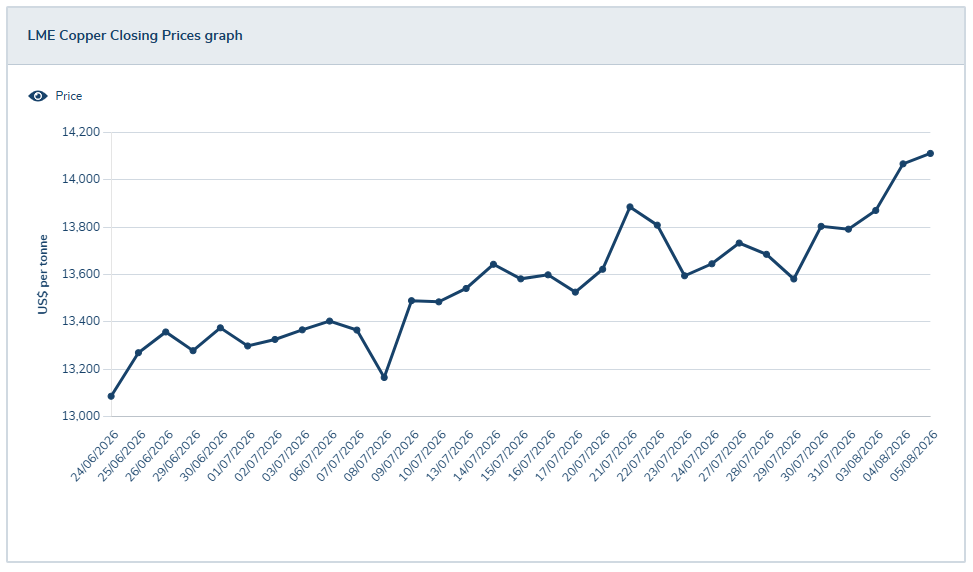
That’s what happens when the market realizes access to a critical material can no longer be taken for granted.
And copper isn’t the only metal facing this problem…
Tungsten may be an even more concentrated, and much less appreciated, example.
Like many people, you may be scratching your head because you don’t think you used any tungsten today…
But tungsten helped manufacture the phone in your hand, the car in your driveway, the appliances in your kitchen, and the building around you.
It’s used in cutting tools, drill bits, industrial machinery, semiconductors, medical imaging equipment, welding electrodes, heating elements, and wear-resistant components.
Even when tungsten isn’t present in the finished product, tungsten-equipped machinery probably helped make it.
And that makes tungsten one of the most important materials most people have never heard of.
It also explains why the world’s dependence on China for tungsten is becoming an enormous commercial problem — and an increasingly attractive investment opportunity.
The Best Free Investment You’ll Ever Make
Join Gold World today for FREE. Get the latest insight on gold, silver, and precious metals delivered straight to your inbox. When you become a member today, you’ll get our latest free report: “The #1 Golden Token to Buy Now.” Don’t Delay!
After getting your report, you’ll begin receiving the Gold World e-Letter, delivered to your inbox daily.
The Metal Behind Modern Life
Manufacturers use tungsten carbide in tools that cut, grind, shape, and drill other hard materials…
Automakers rely on it to machine vehicle components.
Construction companies use tungsten-tipped drills, saws, and road-milling equipment.
Energy producers use it in drilling systems, and mining companies depend on it to break through rock.
Take tungsten away and the world wouldn’t stop manufacturing things. But it would manufacture them more slowly, less accurately, and at much greater cost.
Because a relatively small amount of tungsten can protect millions of dollars in machinery, reduce downtime, extend tool life, and improve factory productivity.
And that’s why its importance is much larger than the size of the market might suggest.
Because tungsten also connects the traditional industrial economy to the digital one…
It’s used in semiconductor manufacturing, integrated circuits, electrical contacts, electrodes, and high-temperature equipment.
Its ability to conduct electricity, resist heat, and remain stable at microscopic scales makes it invaluable in chip production.
Every AI model, cloud service, smartphone, and connected vehicle ultimately depends on physical chips.
And those chips depend on mines, processors, equipment manufacturers, fabrication plants, and specialty-material suppliers.
The digital economy may look weightless from the outside, but, as our regular readers know, underneath it sits a mountain of metal.
But it doesn’t stop there. Tungsten also plays an important role in health care…
Its density and ability to tolerate intense heat make it useful in X-ray equipment, radiation shielding, and medical-imaging components.
And its combination of hardness, density, heat resistance, and electrical properties is tough to replace, which is exactly what turns a metal from “useful” into “critical.”
The World’s 80% Problem
The supply picture is where this becomes especially compelling for investors…
China produces close to 80% of the world’s newly mined tungsten. The rest of the planet collectively produces only about one-fifth of primary global supply.
But its influence doesn’t stop at the mine…
China also controls a large portion of the processing capacity needed to convert ore into the powders, carbides, chemicals, alloys, and components manufacturers can actually use.
And that’s the gap investors need to understand…
The global economy consumes tens of thousands of tons of tungsten annually, but the entire non-Chinese mining industry supplies only a fraction of that demand.
Everyone outside China must compete for limited independent production, draw from inventories, recover used material, or remain reliant on Chinese suppliers.
But China also consumes a large share of the tungsten it produces…
Its factories need the same cutting tools, semiconductors, electronics, and industrial equipment Western companies need.
So Western buyers aren’t just competing with each other…
They’re competing with China’s enormous manufacturing sector for material China already controls.
And the recent events in Congo demonstrate exactly why this matters…
China controls critical mineral production at home, dominates processing in multiple markets, holds major interests in foreign deposits, and has demonstrated a willingness to restrict exports.
Meanwhile, resource-rich countries are increasingly limiting raw exports, mandating domestic processing, and reserving more of their production for national development.
For Western manufacturers, that means the old assumption that critical minerals will always be available on the open market is becoming dangerous.
The copper surge following Congo’s announcement showed what can happen when access to one major commodity is suddenly questioned.
With tungsten, the concentration is already far more extreme.
Big Western Companies Are Fighting Back
Breaking China’s grip will require more mining, more processing, more recycling, and better use of the tungsten already circulating through the economy.
And several major Western companies are already working on different parts of the problem…
Almonty Industries is advancing the Sangdong tungsten mine in South Korea, one of the most important new sources of non-Chinese supply.
Sandvik, one of the world’s largest industrial tooling companies, recovers tungsten from used cemented-carbide tools.
It collects worn cutting inserts, drill components, and other industrial materials, then recycles the valuable metals into new products.
U.S.-based, Kennametal pursues a similar strategy through its carbide-recycling operations.
These companies represent three important parts of the Western response, developing new mines, strengthening non-Chinese supply chains, and recovering more tungsten from products already in use.
But recycling can’t solve the entire problem. Because you can only recycle tungsten that’s already been mined, used, collected, and processed.
The Opportunity Hidden in Plain Sight
Most people will never knowingly buy tungsten. But they will buy the things tungsten makes possible…
They’ll live in buildings constructed with tungsten-tipped tools, drive vehicles manufactured with tungsten-equipped machinery, use electronics built around advanced semiconductors, and receive medical scans from machines that depend on tungsten’s unusual properties.
That’s why the commercial tungsten opportunity is much larger than most investors realize.
Demand comes from manufacturing, construction, energy, technology, health care, transportation, and infrastructure.
Yet almost 80% of newly mined supply comes from one country.
The rest of the world is trying to support a modern industrial economy with only 20% of the primary supply under “independent” control.
That’s not a small imbalance. It’s a structural supply gap that Western governments, manufacturers, and investors can’t afford to ignore.
Large mining, tooling, and recycling companies will play an important role in rebuilding the Western supply chain.
But the biggest potential gains may come from much smaller companies whose assets are strategically positioned to supply the Western market.
We’ve identified one such little-known Western tungsten stock that could be particularly well placed to benefit.
It’s small enough that meaningful progress could bring major attention, and its project sits in a strategic location likely to become very important as buyers look outside China.
That combination could make it one of the most explosive ways to play the West’s effort to break China’s grip on tungsten.
If you’re interested in learning more, you can get the full report right here.
To your wealth,

Jason Williams
 @TheReal_JayDubs
 Angel Research on Youtube
After graduating Cum Laude in finance and economics, Jason designed and analyzed complex projects for the U.S. Army. He made the jump to the private sector as an investment banking analyst at Morgan Stanley, where he eventually led his own team responsible for billions of dollars in daily trading. Jason left Wall Street to found his own investment office and now shares the strategies he used and the network he built with you. Jason is the founder of Main Street Ventures, a pre-IPO investment newsletter; the founder of Future Giants, a nano cap investing service; and authors The Wealth Advisory income stock newsletter. He is also the managing editor of Wealth Daily. To learn more about Jason, click here.
Want to hear more from Jason? Sign up to receive emails directly from him ranging from market commentaries to opportunities that he has his eye on.
The Best Free Investment You'll Ever Make
We never spam! View our Privacy Policy
After getting your report, you’ll begin receiving the Wealth Daily e-Letter, delivered to your inbox daily.
Angel Publishing Investor Club Discord - Chat Now
Jason Williams Premium
Introductory

Advanced


