The Trade That Didn’t Need a War… But Got One Anyway

When we recommended Direxion Daily Energy Bull and Bear 2X Shares (ERX) back in early December 2025 as part of the AI Power Torque Stack, we weren’t trying to outguess geopolitics.
We weren’t sitting around drawing maps of the Middle East or trying to predict where the next flash point would be. That’s not how real money is made over time. Instead, we focused on something far more reliable — something far more durable — and that’s the simple, unavoidable truth that the world was about to need vastly more energy than it currently produces.
It was part of the MoneyQuake’s Conjoined Twin thesis that argued that Twin #2 (the natural resources required for the infrastructure build out for the vast AI data center network) was going to require a copious amount of commodities, particularly energy.
And as I’ve been telling you for years, when you are confident in the move in the markets, you go in big.
We did that last year with gold and silver, especially when we invested in Direxion Daily Junior Gold Miners Index Bull 2X Shares (JNUG).
Although gold and silver are still in a cyclical bull market, right now the play is energy.
AI isn’t just another tech trend. It’s not social media. It’s not e-commerce. It’s an infrastructure revolution — one that requires enormous, continuous, non-negotiable amounts of electricity.
Data centers don’t sleep. Training models don’t pause. And the backbone of all of it — at least for the foreseeable future — still runs on hydrocarbons. Oil. Natural gas. LNG. The very assets most investors had been ignoring or underweighting for years.
So we positioned in ERX not because we expected chaos… but because we understood demand was going to collide with constrained supply.
Now fast-forward.
ERX is up 73% year to date.
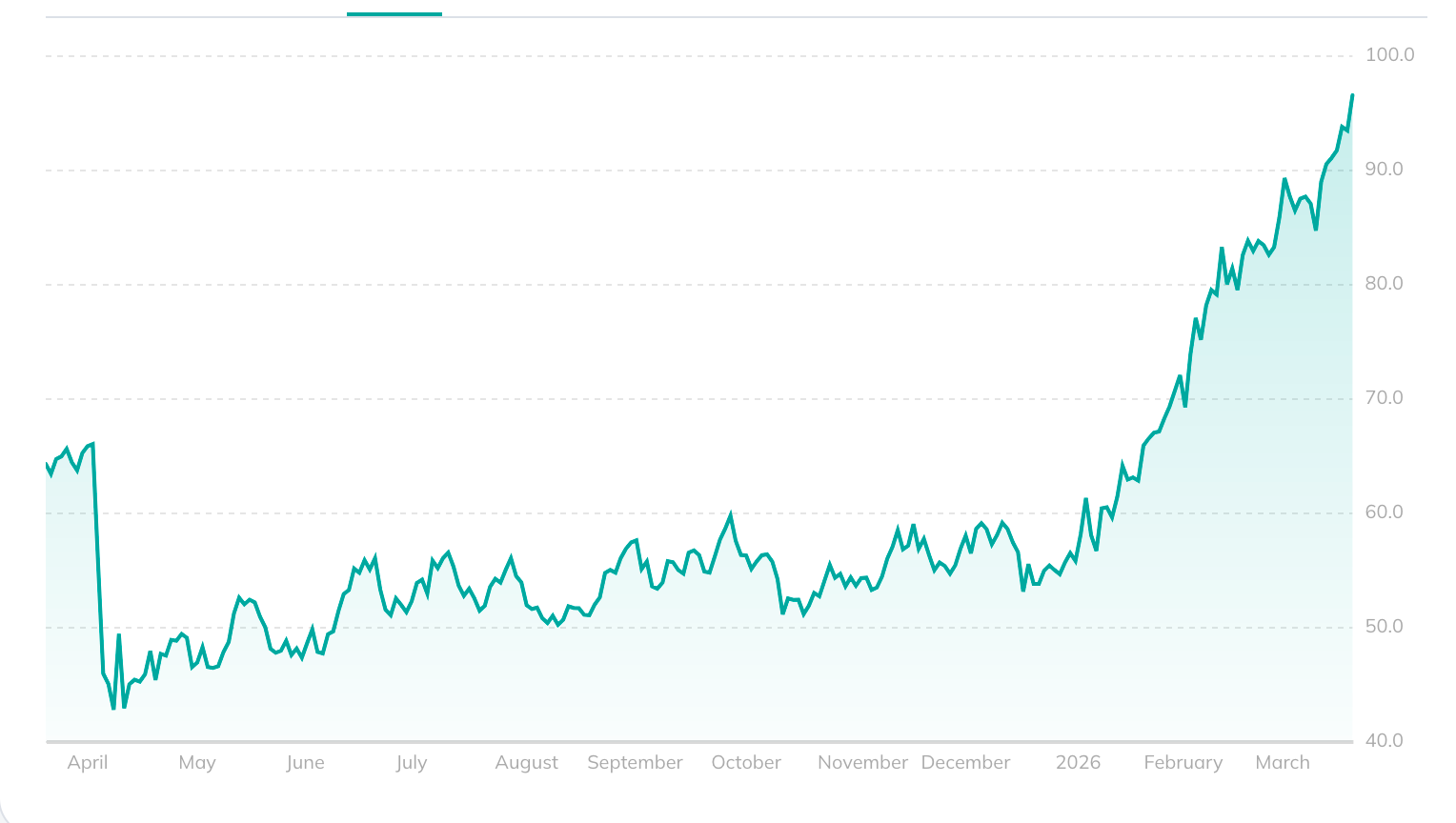
And suddenly, everyone wants to know why.
When Reality Forces the Market to Reprice Everything
The answer is simple… but uncomfortable.
The world reminded investors that energy isn’t optional.
When Iran escalated tensions and targeted critical infrastructure tied to Qatar’s LNG exports — one of the most important energy supply nodes on the planet — the market didn’t just react… it repriced risk instantly. Billions of dollars in production capacity were suddenly seen not as guaranteed supply, but as vulnerable assets. Fragile. Exposed. Disruptible.
And in that moment, the entire energy equation changed.
The Best Free Investment You’ll Ever Make
Join Gold World today for FREE. Get the latest insight on gold, silver, and precious metals delivered straight to your inbox. When you become a member today, you’ll get our latest free report: “The Dawn of NatGold.” Don’t Delay!
After getting your report, you’ll begin receiving the Gold World e-Letter, delivered to your inbox daily.
Prices moved higher not because demand increased overnight — that was already happening — but because the market was forced to acknowledge that supply could disappear overnight. That’s a very different kind of realization. That’s not growth. That’s fear. That’s scarcity. That’s urgency.
And when those three forces collide?
You don’t get gradual moves.
You get violent repricing.
Resource Wars: The Oldest Story in the World
Strip away the headlines, the politics, the commentary — all of it — and what you’re left with is something incredibly simple.
This is a resource war.
Not in the dramatic, Hollywood sense. Not necessarily with tanks rolling across borders every time. But in the very real, very consequential sense that nations are competing — and sometimes clashing — over the things that make modern civilization possible.
Energy sits at the top of that list.
Always has.
Empires have been built on access to energy… and they’ve collapsed when that access was threatened. The difference today is scale. The world is more interconnected, more dependent, and more fragile than at any point in history. A disruption in one region doesn’t stay contained — it ripples outward, instantly impacting pricing, supply chains, and investment flows across the globe.
That’s exactly what we’re seeing now.
And ERX, sitting squarely in the energy producer complex, is one of the purest ways to capture that reality.
The Truth About Investing That Most People Never Learn
Here’s the part that separates successful investors from everyone else — and it’s not what most people think.
It’s not about predicting the exact event.
It’s not about knowing the date, the headline, or the trigger.
It’s not about being “right” in the traditional sense.
It’s about being positioned in assets that benefit when the inevitable happens.
That’s it.
That’s the entire game.
Because events — whether geopolitical, economic, or systemic — are almost always unpredictable in their timing and specifics. But the underlying pressures that lead to them? Those build slowly. Quietly. Inevitably.
And if you can identify those pressures early… You don’t need to predict the spark.
You just need to be holding the fuel.
ERX: Where Two Megatrends Collide
What makes ERX so powerful in this moment — and why this move isn’t just a one-off spike — is that it sits at the intersection of two massive, accelerating forces.
On one side, you have the AI-driven energy supercycle — a once-in-a-generation expansion in electricity demand driven by data centers, cloud computing, machine learning, and digital infrastructure. This alone would have been enough to drive a sustained bull market in energy.
But layered on top of that…
You now have geopolitical instability, supply disruptions, and the re-emergence of energy as a strategic asset.
This is where things get explosive.
Because now you’re not just dealing with rising demand — you’re dealing with threatened supply at the same time. And when those two forces move in opposite directions simultaneously, the result is not balance.
It’s acceleration.
We’ve Seen This Before — Just in a Different Sector
If this setup feels familiar, it should.
Last year, the exact same dynamic played out in gold through JNUG.
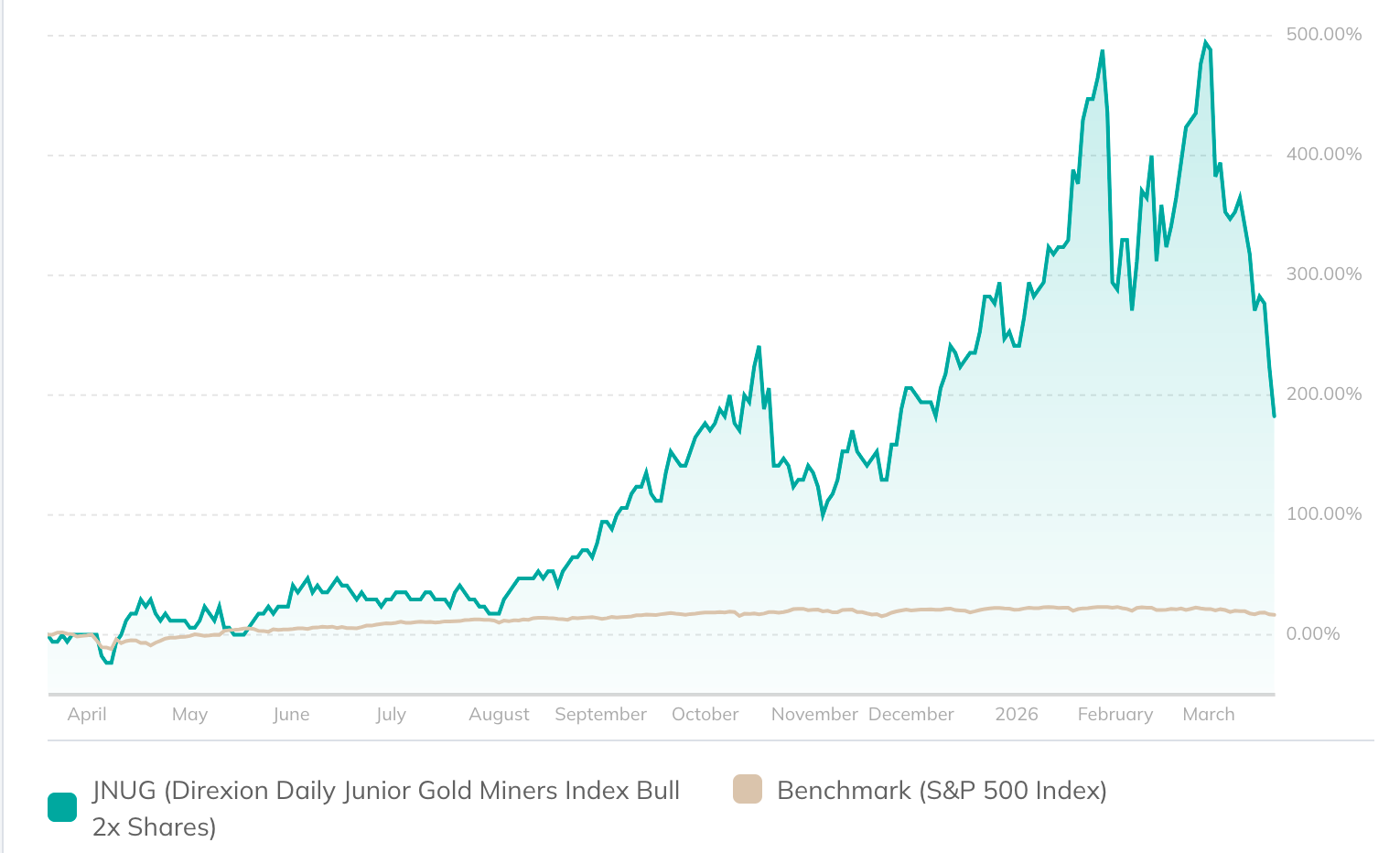
Gold had already been in a strong bull market, driven by monetary instability, central bank buying, and growing distrust in fiat systems. That was the foundation. That was the slow build.
But when geopolitical stress intensified…
When fear entered the system… When investors started looking for safety…
That’s when gold didn’t just rise — it surged.
And leveraged vehicles like JNUG didn’t drift higher.
They went parabolic.
That’s what happens when a structural trend meets a catalyst.
This Year, the Catalyst Chose Energy
Now the same script is playing out again — just with a different asset class.
This time, it’s not monetary fear driving the move.
It’s physical scarcity.
It’s the realization that energy supply — particularly LNG — is not as secure, stable, or guaranteed as investors once believed.
And that realization is forcing capital to move.
Quickly. Aggressively. And in size.
The Illusion of “Unexpected”
Turn on any financial news outlet right now and you’ll hear the same language repeated over and over again.
“Unexpected escalation.”
“Surprise attack.”
“Unforeseen disruption.”
But let me ask you something…
Was it really unexpected?
Or was it simply a matter of time?
Because when you step back and look at the broader landscape — rising geopolitical tensions, concentrated energy infrastructure, increasing global demand, and a decade of underinvestment in supply — what we’re seeing now doesn’t look like a surprise.
It looks like pressure finally releasing.
Right Asset. Right Time. That’s the Entire Game
This is the lesson that ties everything together.
We didn’t buy ERX because of war.
We bought ERX because the world was heading toward an energy imbalance.
The war didn’t create the opportunity.
It revealed it.
And that’s why timing in markets isn’t about precision… It’s about positioning. You don’t need to be perfect.
You just need to be early enough.
Where This Goes From Here
Now the question becomes — what happens next?
And the honest answer is this: Moves like this rarely end cleanly.
They don’t peak politely.
They don’t give you a clear signal and say, “OK, that’s it.”
Instead, they tend to overshoot, pull back, consolidate… and then move again.
Especially when they are driven by forces like fear, scarcity, and forced repositioning — all of which are very much in play right now.
And even if this specific geopolitical flashpoint cools…
The underlying conditions remain. Energy demand is still rising. Supply is still constrained.
And the world is still increasingly fragmented.
The Bigger Picture Most Investors Still Miss
What we’re living through right now is not a one-time event.
It’s not a trade. It’s not a phase. It’s a shift.
A shift toward a world where resources — especially energy — are no longer taken for granted, where supply chains are weaponized, and where access matters just as much as ownership.
That doesn’t reverse overnight.
That defines the next decade.
Final Thought
If there’s one takeaway from all of this — one idea to hold onto — it’s this…
You don’t need to predict the future to profit from it.
You need to understand what the world cannot function without… identify where the pressure is building… and position yourself in the assets that benefit when that pressure is released.
Because moments like this — when everything suddenly “clicks” — don’t create wealth.
They reveal who was already positioned to capture it.
And the investors who win?
They’re not the ones chasing the move.
They’re the ones who were already there when the world finally caught up.
Get to the good, green grass first…
The Prophet of Profit,

Brian Hicks
 Check us out on YouTube!
Brian is a founding member and President of Angel Publishing. He writes about general investment strategies for Wealth Daily and Energy and Capital. Brian is the managing editor and investment director of R.I.C.H Report (Retired Independent Carefree Healthy), New World Assets and Extreme Opportunities. For more on Brian, take a look at his editor’s page.
The Best Free Investment You'll Ever Make
We never spam! View our Privacy Policy
After getting your report, you’ll begin receiving the Wealth Daily e-Letter, delivered to your inbox daily.
Angel Publishing Investor Club Discord - Chat Now
Brian Hicks Premium
Introductory

Advanced


