The Sell-off Everyone’s Screaming About — and the Part They’re Missing

Late last week. Early this week. Then again overnight on Wednesday…
Gold and silver took it on the chin, and if you only follow the headlines — or worse, the price ticker — you’d think the precious metals bull market just died a dramatic death.
That’s the surface-level take. It’s also the wrong one. And it’s also the one the media (who missed the whole rally to begin with) is parroting.

But this wasn’t a collapse in fundamentals. It wasn’t a sudden loss of faith in gold as money or silver as a strategic metal.
Instead, what we just witnessed was a violent paper-market event — largely centered in U.S. futures and derivatives — doing what paper markets do best: flushing out weak hands, triggering margin calls, and punishing momentum chasers who piled in late.
Meanwhile, in the real world — the physical market — the story looks nothing like the price chart flashing red on your screen.
And this is the part the talking heads won’t tell you, because it doesn’t fit into a neat soundbite…
The disconnect between paper metals and physical metals has rarely been wider.
And historically, when that gap stretches like this, it doesn’t resolve by fundamentals collapsing. It resolves by prices snapping violently higher.
Central Banks Aren’t Panicking — They’re Accumulating
If gold was suddenly “broken,” central banks didn’t get the memo.
They are buying gold at one of the fastest paces in modern history.
Not trading it. Not hedging it.
Buying it. Taking delivery. Putting it in vaults. Removing it from circulation.
That matters because central banks don’t speculate.
They don’t chase RSI indicators.
They buy for one reason: trust.
Or more accurately, distrust — of fiat currencies, geopolitical stability, and the long-term purchasing power of paper money.
Silver doesn’t get the same headlines, but it’s quietly becoming strategic again too.
Between industrial demand, energy transition uses, defense applications, and monetary hedging, sovereign and quasi-sovereign buyers are paying attention.
And unlike gold, silver doesn’t have deep above-ground inventories sitting idle.
When the biggest, most patient players in the world are accumulating while retail is being shaken out, that’s not a warning sign. That’s a setup.
The Best Free Investment You’ll Ever Make
Join Wealth Daily today for FREE. We”ll keep you on top of all the hottest investment ideas before they hit Wall Street. Become a member today, and get our latest free report: “A Maverick’s Guide to Gold: 3 Gold Stocks Set to Disrupt the Market”
It contains full details on something incredibly important that’s unfolding and affecting how gold is classified as an investment..
After getting your report, you’ll begin receiving the Wealth Daily e-Letter, delivered to your inbox daily.
Paper Crash, Physical Shortage
Here’s the line you should tattoo on your investing brain: This crash happened in paper, not in metal.
In the physical market, bullion is tight. And in some cases, it’s outright scarce.
Large dealers are reporting low inventories, long delivery times, and intermittent out-of-stock notices on popular products.
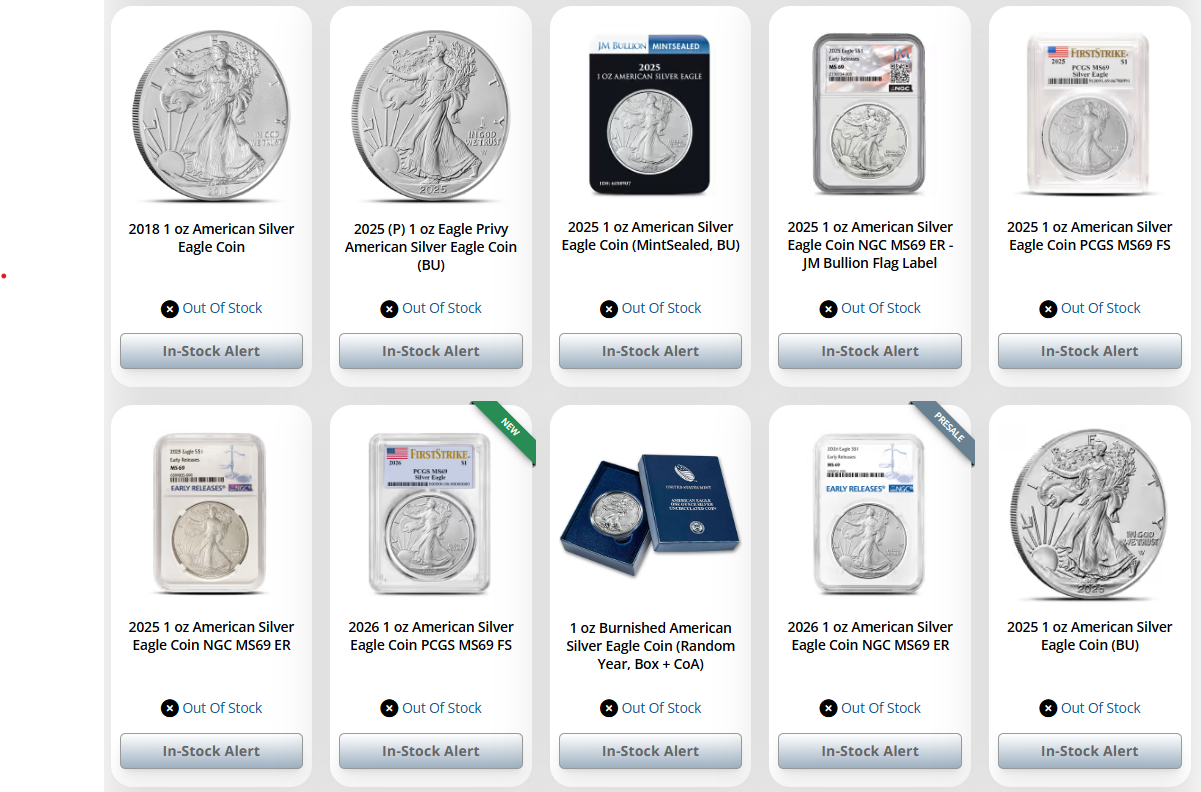
Premiums haven’t collapsed the way futures prices suggest they should have if demand was truly falling off a cliff.
That’s the tell.
If this were a real demand destruction event, physical supply would be backing up. Vaults would be full. Dealers would be discounting aggressively. None of that is happening.
Instead, futures prices got hit by forced selling, algorithmic cascades, and leveraged traders getting margin-called into oblivion.
Physical holders? They’re not selling. They’re waiting — or buying more.
That divergence doesn’t last forever.
The Silver Floor That Could Break the Paper Market
Now let’s talk about the most explosive wildcard in this entire setup: silver.
There is active discussion in government and policy circles about establishing a price floor for silver due to its strategic importance…
Energy systems. Electronics. Defense. Medical. You name it — modern infrastructure doesn’t work without silver.
If even a soft floor is implemented — explicitly or implicitly — it changes everything.
Why? Because silver is one of the most heavily shorted commodities in the paper markets.
A price floor limits downside risk for longs while absolutely torching short sellers who depend on volatility and forced liquidations to keep the game going.
That’s how you trigger a short squeeze. Not a meme-stock squeeze. A structural one.
And when silver squeezes, it doesn’t move politely. It gaps. It rips…
It forces repricing across the entire sector — especially the miners, whose margins go from “good” to “obscene” in a hurry.
This Is Exactly How Precious Metals Bull Markets Behave
If you’ve been through one of these cycles before, none of this feels strange.
Gold moves first. Silver follows — usually later and faster. Miners come last, but when they move, they move like a freight train with no brakes.
And none of it happens in a straight line.
Corrections are part of the process…
Sharp, scary, confidence-shaking pullbacks are how the market transfers metal from impatient hands to strong ones.
Momentum traders get punished. Long-term holders get rewarded.
And the people who win these cycles aren’t the ones who time every wiggle.
They’re the ones who understand the structure and stay positioned while everyone else second-guesses themselves.
The Companies About to Turn Volatility Into Cash Flow
Here’s where it really gets fun…
While traders argue about charts, miners are quietly preparing to report earnings based on elevated gold and silver prices that are still massively higher than their long-term cost structures.
Margins are fat. Cash flow is real. Balance sheets are improving. And valuations still don’t reflect it.
Below is the only list you need right now — three gold miners and three silver miners that are positioned to benefit as reality reasserts itself over paper games:
- Barrick Gold is minting money at current gold prices, with all-in sustaining costs far below where gold has been trading. Every $100 move in gold drops straight to the bottom line, and upcoming earnings are likely to remind the market just how powerful that leverage is.
- Newmont has spent the last cycle cleaning up its portfolio and focusing on high-quality ounces. With gold still historically elevated, Newmont’s margins are expanding even after recent volatility, and cash flow remains strong enough to support dividends and balance sheet strength.
- Agnico Eagle Mines continues to be one of the best operators in the space. Low geopolitical risk, disciplined capital allocation, and robust margins mean that even after a paper-market hit, the fundamentals are screaming higher.
- Pan American Silver is one of the cleanest ways to play a silver rebound. With production spread across stable jurisdictions and costs that look laughably low if silver re-prices, Pan American is set up for explosive earnings leverage.
- Silvercorp Metals has been quietly printing cash thanks to high-grade operations and conservative management. If silver prices stabilize anywhere near current levels — or spike on a squeeze — the company’s margins expand dramatically.
- Hecla Mining offers pure exposure to a silver upside scenario with significant operational leverage. Hecla doesn’t need silver to go to the moon to perform — but if it does, the torque is undeniable.
That’s the list. No fluff. No hype.
Just companies whose economics improve radically as the paper fog clears.
Why Earnings Season Could Be the Wake-Up Call
Here’s what most investors forget during corrections: Earnings don’t care about your feelings.
Miners are about to report results based on realized prices that were far higher than where fear-driven selling just pushed futures contracts.
That creates cognitive dissonance for the market — and opportunity for those paying attention.
Strong earnings force analysts to update models…
Updated models force price targets higher…
Higher targets force portfolio managers to chase exposure they thought they had time to buy later.
And that’s how reversals happen.
What to Do Right Now (and What Not to Do)
If you’re not invested in precious metals, this kind of volatility isn’t a reason to run.
It’s an invitation.
These are the moments when positions get built — not when prices feel safe and everyone agrees.
If you are invested, the worst possible move is panic-selling into a paper-driven flush while physical demand, central bank accumulation, and miner economics all point in the opposite direction.
This is how bull markets test conviction.
Gold went first. Silver is coiling. Miners are loading the spring.
The path won’t be smooth — but the destination hasn’t changed.
And my call to action is both simple and unapologetic: Get invested if you aren’t, stay invested if you are, and use these dips to add — not retreat.
The shakeout is the setup.
To your wealth,

Jason Williams
 @TheReal_JayDubs
 Angel Research on Youtube
After graduating Cum Laude in finance and economics, Jason designed and analyzed complex projects for the U.S. Army. He made the jump to the private sector as an investment banking analyst at Morgan Stanley, where he eventually led his own team responsible for billions of dollars in daily trading. Jason left Wall Street to found his own investment office and now shares the strategies he used and the network he built with you. Jason is the founder of Main Street Ventures, a pre-IPO investment newsletter; the founder of Future Giants, a nano cap investing service; and authors The Wealth Advisory income stock newsletter. He is also the managing editor of Wealth Daily. To learn more about Jason, click here.
Want to hear more from Jason? Sign up to receive emails directly from him ranging from market commentaries to opportunities that he has his eye on.
The Best Free Investment You'll Ever Make
We never spam! View our Privacy Policy
After getting your report, you’ll begin receiving the Wealth Daily e-Letter, delivered to your inbox daily.
Angel Publishing Investor Club Discord - Chat Now
Jason Williams Premium
Introductory

Advanced


