Gold Is Only as Valuable as Your Ability to Access It

The Day a Nation Lost Access to Its Own Gold
Let me start with a story that sounds like something out of a geopolitical thriller…
But it’s real.
In the vaults beneath London — thousands of miles from Caracas — sits billions of dollars’ worth of Venezuelan gold.
Gold that belongs to Venezuela. Gold they cannot access.
For years, roughly 31 metric tons of Venezuelan gold have been effectively frozen at the Bank of England — locked up due to political disputes, sanctions, and questions over who the legitimate government is.
Think about that for a second.
A sovereign nation… With billions in hard assets… Unable to touch it.
Not because the gold disappeared. Not because it was stolen.
But because it was stored somewhere else.
The physical bullion is legitimately owned by Venezuela. I’m talking about bars with serial numbers, stacked and accounted for. Wealth that belongs — at least on paper — to a sovereign nation. And yet, for years now, Venezuela has been unable to access it. Not because the gold vanished. Not because it was stolen in the traditional sense. But because control over access became entangled in politics, sanctions, and legal disputes over who had the authority to claim it.
Think about the implications of that.
That is the difference between owning gold and controlling gold.
Possession Is Nine-Tenths of the Law
History is filled with these moments — quiet, often overlooked, but incredibly revealing.
During times of crisis, war, or financial stress, gold has a strange way of becoming inaccessible at exactly the moment it’s needed most.
In World War II, entire national reserves were moved across oceans under extreme secrecy, sometimes never fully returning to their original owners.
Governments have seized private gold, restricted ownership, or imposed sudden rules that transformed personal wealth into something conditional.
The Best Free Investment You’ll Ever Make
Join Gold World today for FREE. Get the latest insight on gold, silver, and precious metals delivered straight to your inbox. When you become a member today, you’ll get our latest free report: “The Dawn of NatGold.” Don’t Delay!
After getting your report, you’ll begin receiving the Gold World e-Letter, delivered to your inbox daily.
Even in modern times, access can be delayed, disputed, or outright denied — not with force, but with paperwork, policy, and “temporary” restrictions.
No alarms. No headlines.
Just a simple reality…
You don’t get your gold when you need it.
Poland’s Canary in the Coal Mine
Now let’s bring this into the present — because what’s happening today in Poland is one of the clearest signals yet that the world is starting to understand this risk all over again.
For decades, much of Poland’s gold reserves were stored abroad — in London, in New York — a legacy of wartime necessity and postwar financial arrangements. At the time, it made sense. Those locations were considered stable, secure, and deeply integrated into the global financial system.
But over the past several years, Poland has been quietly reversing that decision, physically repatriating large portions of its gold back onto its own soil through carefully orchestrated, highly secure transfers.
Why go through all that effort?
Because something fundamental has shifted.
There is now an increasing recognition — not just in Poland, but across multiple nations — that gold stored abroad is not the same as gold held at home.
It may be accounted for. It may be insured. It may be “safe” in the conventional sense. But in a world where geopolitical tensions are rising, alliances are fluid, and financial systems are being weaponized in ways we haven’t seen before, access itself has become the risk.
And the debate inside Poland right now reflects that tension perfectly. There are growing calls to bring even more of their gold home — to remove it from foreign vaults entirely — because the idea of relying on another country’s system, even a friendly one, is no longer as comfortable as it once was.
The Polish central bank leadership has pushed back, arguing that diversified storage locations provide security. But the very existence of this debate tells you everything you need to know…
Trust is no longer absolute.
“Do You Trust Your Wife?”
— Andy Dufresne, The Shawshank Redemption
And this isn’t just Poland.
Germany has already brought back hundreds of tons of gold from foreign vaults. Hungary has increased its domestic holdings. Nations across Europe and beyond are quietly reassessing where their gold is stored and, more importantly, who ultimately controls access to it. This isn’t being done for optics. It’s not a symbolic gesture.
It’s preparation.
Because in a true global disruption — whether financial, political, or military — the rules change. Access can be restricted. Transfers can be delayed. Legal ownership can become entangled in jurisdictional disputes. And suddenly, the gold you thought you had… becomes gold you have to ask permission to use.
And this is another reason why tokenized gold — the kind NatGold will be doing — is so important. I’ll address that important topic in the next Wealth Daily.
But until then…
This is where the conversation shifts from global to personal — because the exact same principle applies to you, to me, and to every individual investor who owns gold in any form.
Most people think they own gold.
But what they actually own is exposure to gold.
They own ETFs. They own digital representations. They own claims on gold stored somewhere else — often in vaults they’ve never seen, in jurisdictions they don’t fully understand, under agreements they’ve never read closely enough. And in normal times, this works. It’s convenient. It’s efficient. It feels safe.
Until the moment it doesn’t.
Because the second you introduce a third party — a bank, a vault, a financial institution, a government — you introduce a point of failure. Not a guaranteed failure. But a potential one. And that potential is exactly what gold was originally designed to eliminate.
Gold, for thousands of years, has been the one asset that exists outside the system. It doesn’t rely on a counterparty. It doesn’t depend on a promise. It doesn’t require validation from a third party to maintain its value. It simply exists — tangible, finite, and universally recognized.
But the moment you store it somewhere else…
You bring the system back into the equation.
And this is the part that almost no one talks about — especially not in mainstream financial circles.
There Is a Spectrum of Gold Ownership
At one end, you have paper gold — ETFs, derivatives, digital accounts — where you have price exposure but no direct claim to physical metal. Move up a level, and you have allocated gold stored in professional vaults — better, but still dependent on access and institutional integrity. Move up again, and you have safe deposit boxes — closer, but still ultimately controlled by a bank.
And then, at the very top of that hierarchy…
You have gold in your personal possession.
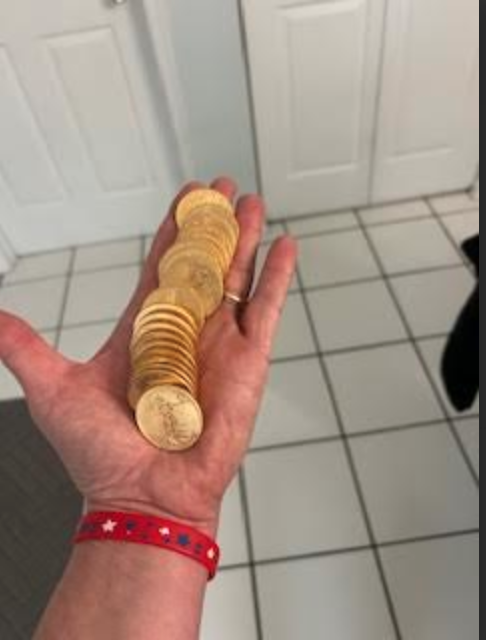
Gold that you can reach. Touch. Smell.
Gold that you can access instantly.
Gold that does not require permission to hold in your hands.
Because here’s the truth that cuts through everything…
The farther your gold is from you, the less control you have over it.
And in a stable world, that may not matter much.
But we are not in a stable world anymore.
We are in a world where conflicts are escalating, where financial systems are increasingly used as tools of policy and pressure, where assets can be frozen, restricted, or redefined with the stroke of a pen. We are in what I’ve been calling the MoneyQuake era — a period of structural change where the old assumptions about access, liquidity, and control are being tested in real time.
In that kind of environment, gold becomes more than just an investment.
It becomes insurance.
And insurance only works if you can actually use it when you need it.
So let me leave you with this — not as a theory, not as a prediction, but as a practical reality you can act on immediately.
Because at the end of the day, this isn’t about fear.
It’s about preparedness. It’s about understanding that ownership without access is incomplete.
And it’s about taking one simple step to close that gap.
Your Golden Insurance Policy
Here’s what you can do to ensure you have access to the gold you own at a moment’s notice.
First, make sure you own a high-quality safe that is properly secured — and by secured, I mean bolted into the floor and positioned in a location that is both discreet and difficult to access without your knowledge. This isn’t about paranoia; it’s about responsibility. If you’re going to take physical possession of real wealth, you need to treat it with the same seriousness as any other high-value asset.
Second, keep a portion of your gold in your immediate control — not all of it, necessarily, but enough that you can access meaningful value instantly if the need ever arises. This creates a balance between security and accessibility, allowing you to benefit from both without overexposing yourself to either risk.
Third, maintain discretion. The fewer people who know what you hold and where you hold it, the better. Gold has always carried a unique kind of visibility — and with that visibility comes attention you may not want.
And finally, think in terms of layers. You can still use vault storage, still hold diversified forms of gold — but always anchor your strategy with a core position that is physically yours, under your control, within arm’s reach.
Because when everything else is uncertain…
When systems are strained…
When access becomes the question instead of price…
You don’t want to be the person asking where your gold is.
You want to be the person who already knows.
And more importantly…
The person who can reach out, open a safe…
And hold it in your hand.
Get to the good, green grass first…
The Prophet of Profit,

Brian Hicks
 Check us out on YouTube!
Brian is a founding member and President of Angel Publishing. He writes about general investment strategies for Wealth Daily and Energy and Capital. Brian is the managing editor and investment director of R.I.C.H Report (Retired Independent Carefree Healthy), New World Assets and Extreme Opportunities. For more on Brian, take a look at his editor’s page.
The Best Free Investment You'll Ever Make
We never spam! View our Privacy Policy
After getting your report, you’ll begin receiving the Wealth Daily e-Letter, delivered to your inbox daily.
Angel Publishing Investor Club Discord - Chat Now
Brian Hicks Premium
Introductory

Advanced


