2025: The Year of the Dirt Diggers

2025 will go down in history as the year everybody thought they were chasing AI…
But the quiet, almost embarrassing truth is that the real money — the “I never have to work again” money — was made digging in the dirt.
It was the year of the miners.
While the world obsessed over GPUs, data centers, and trillion-dollar tech valuations, the oldest wealth engine on Earth — gold — had its greatest breakout of the modern era. Silver went manic. Copper and uranium tightened. And the companies tied directly to these metals didn’t just outperform…
They annihilated the market.
2025 was the year when five legacy gold giants crushed the S&P 500 by roughly 16-to-1 — and the junior miners delivered the kind of returns that alter family trees.
When the Metal Woke Up
Gold didn’t simply “go up” in 2025.
It escaped orbit.
Spot gold ripped to all-time highs above $4,500/oz, while silver vaulted into the $80 range and logged triple-digit yearly gains.
Central banks hoarded gold like their currencies were on fire.
The BRICS countries accelerated their de-dollarization push.
Investors rediscovered what real money feels like when everything else feels political.
And beneath this tidal wave, five companies sat perfectly positioned.
The Five Families of Gold
2025’s mining renaissance begins with five names that form the backbone of global gold production:
Newmont (NEM)
Barrick Gold (B)
Agnico Eagle (AEM)
Wheaton Precious Metals (WPM)
AngloGold Ashanti (AU)
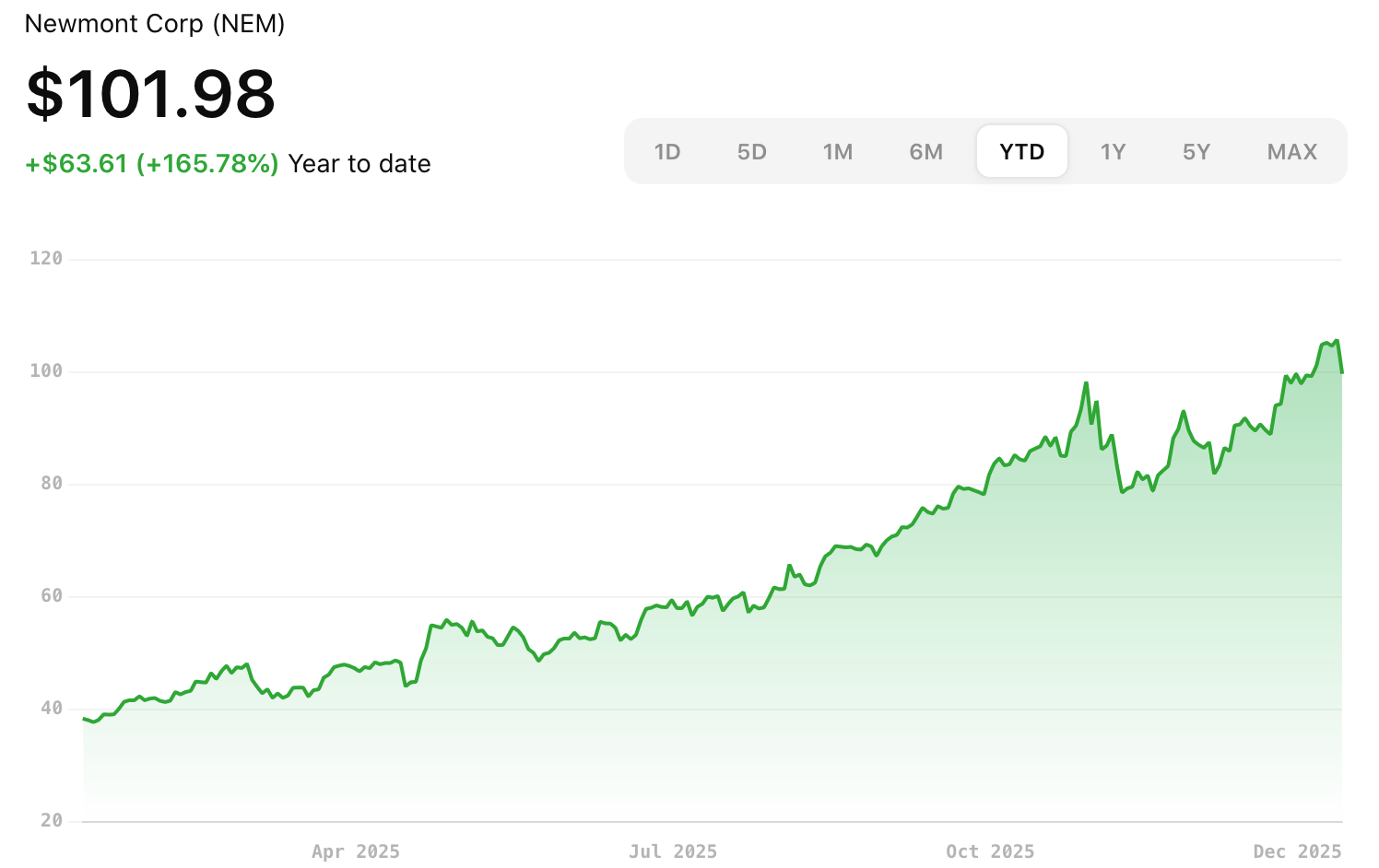
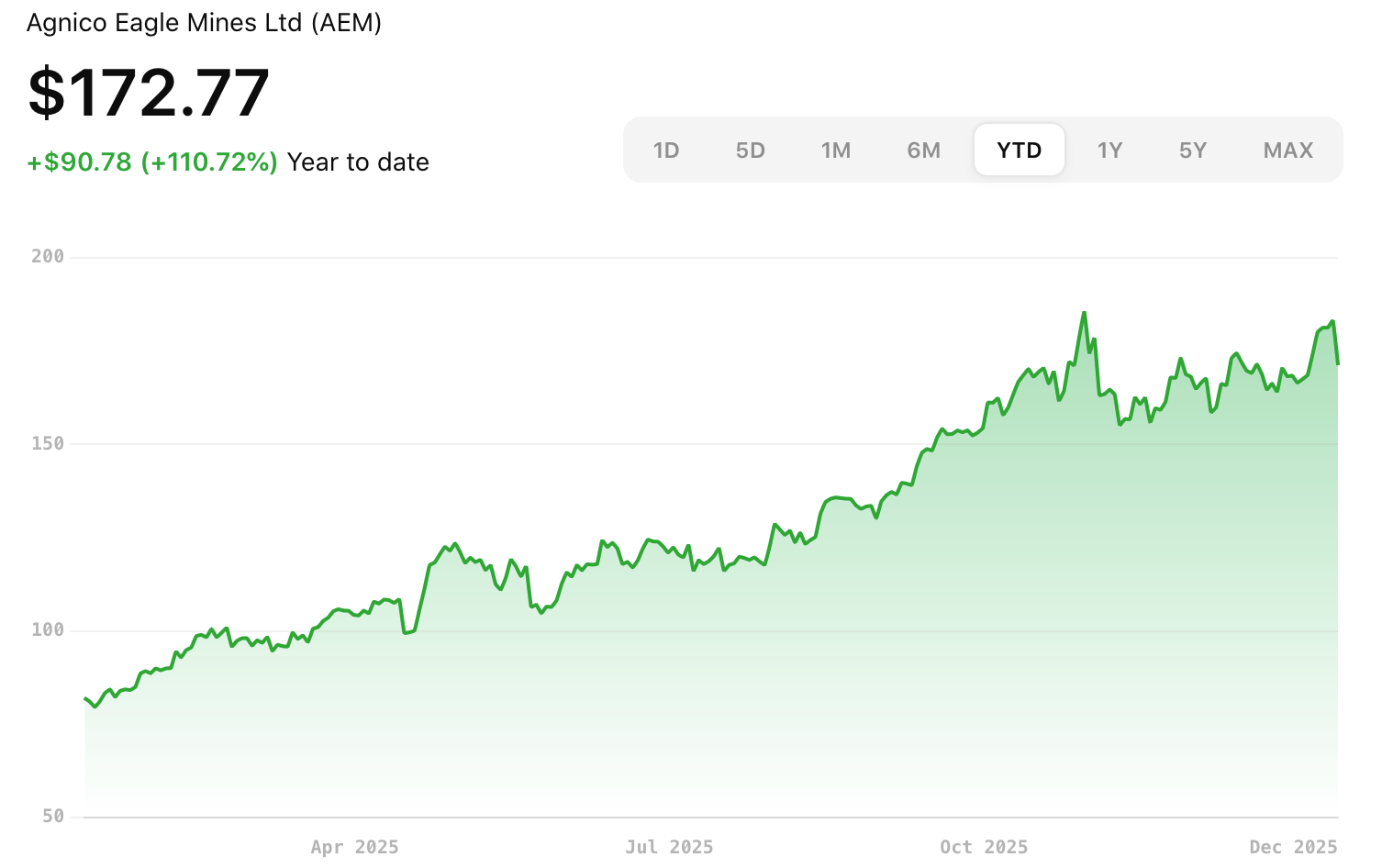
Together, they outperformed the S&P 500 by a staggering, and in the case of AngloGold, it outperformed the S&P 500 16-to-1 ratio.
Below, each chart tells the story better than words.
Newmont (NEM)
World’s largest gold miner. Years of consolidation finally paid off. Cash flow exploded as gold broke above $3,000, then $4,000, turning Newmont into a dividend-printing machine.
Barrick Gold (B)
A global web of Tier 1 deposits that once looked “messy” suddenly became invaluable in a fractured geopolitical world. Barrick didn’t just ride the gold wave — it became a strategic asset.
Agnico Eagle (AEM)
The quiet assassin. Agnico’s premier Canadian and Nordic assets gave investors pure leverage to gold without jurisdictional drama. Institutions flooded in.
Wheaton Precious Metals (WPM)
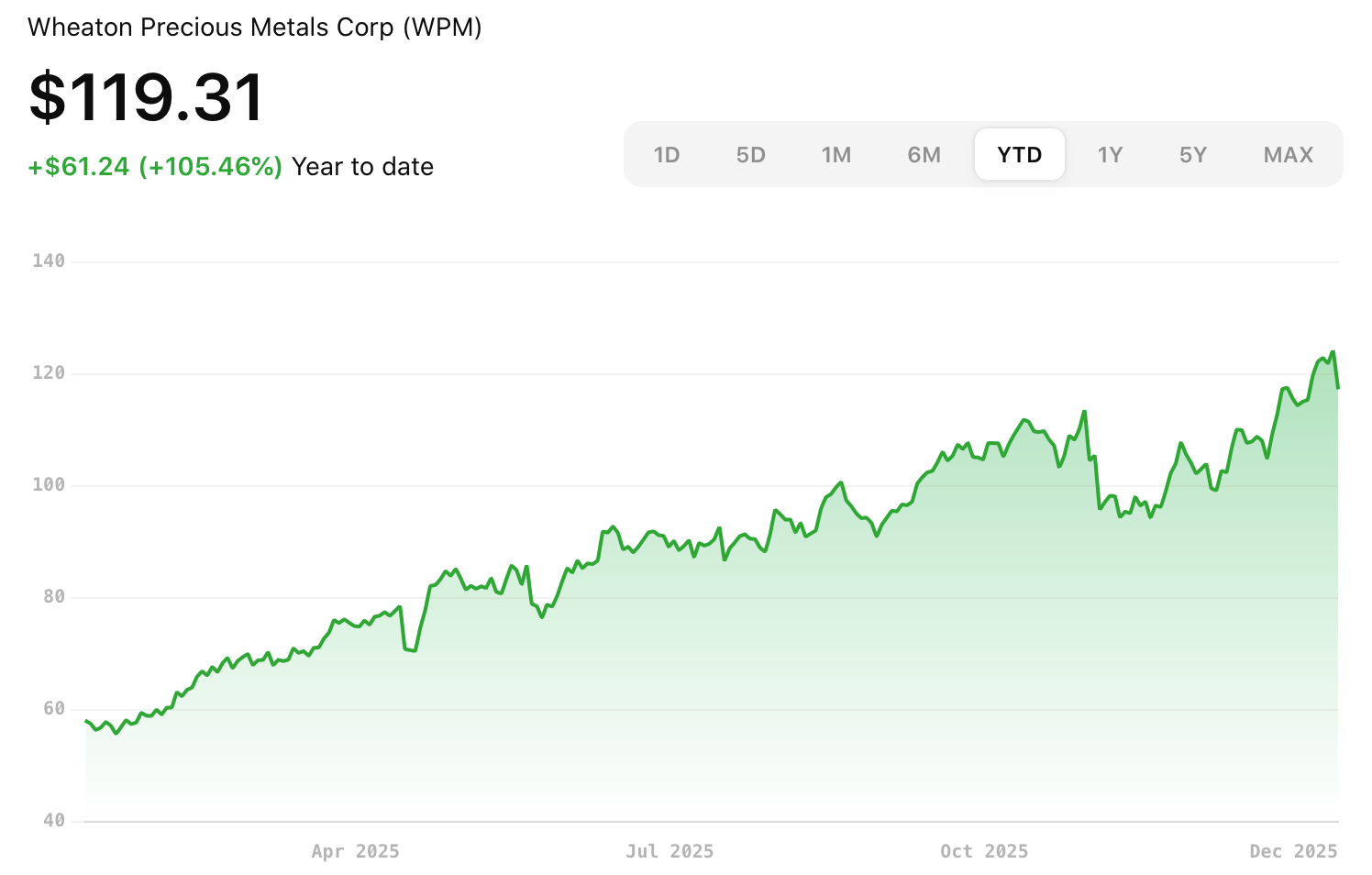
Not a miner — a streamer.
In 2025, that distinction was worth billions.
Wheaton buys metal at a fixed discount… so every spike in spot prices widened its margins to cartoonish levels.
The Best Free Investment You’ll Ever Make
Join Wealth Daily today for FREE. We”ll keep you on top of all the hottest investment ideas before they hit Wall Street. Become a member today, and get our latest free report: “A Maverick’s Guide to Gold: 3 Gold Stocks Set to Disrupt the Market”
It contains full details on something incredibly important that’s unfolding and affecting how gold is classified as an investment..
After getting your report, you’ll begin receiving the Wealth Daily e-Letter, delivered to your inbox daily.
AngloGold Ashanti (AU)
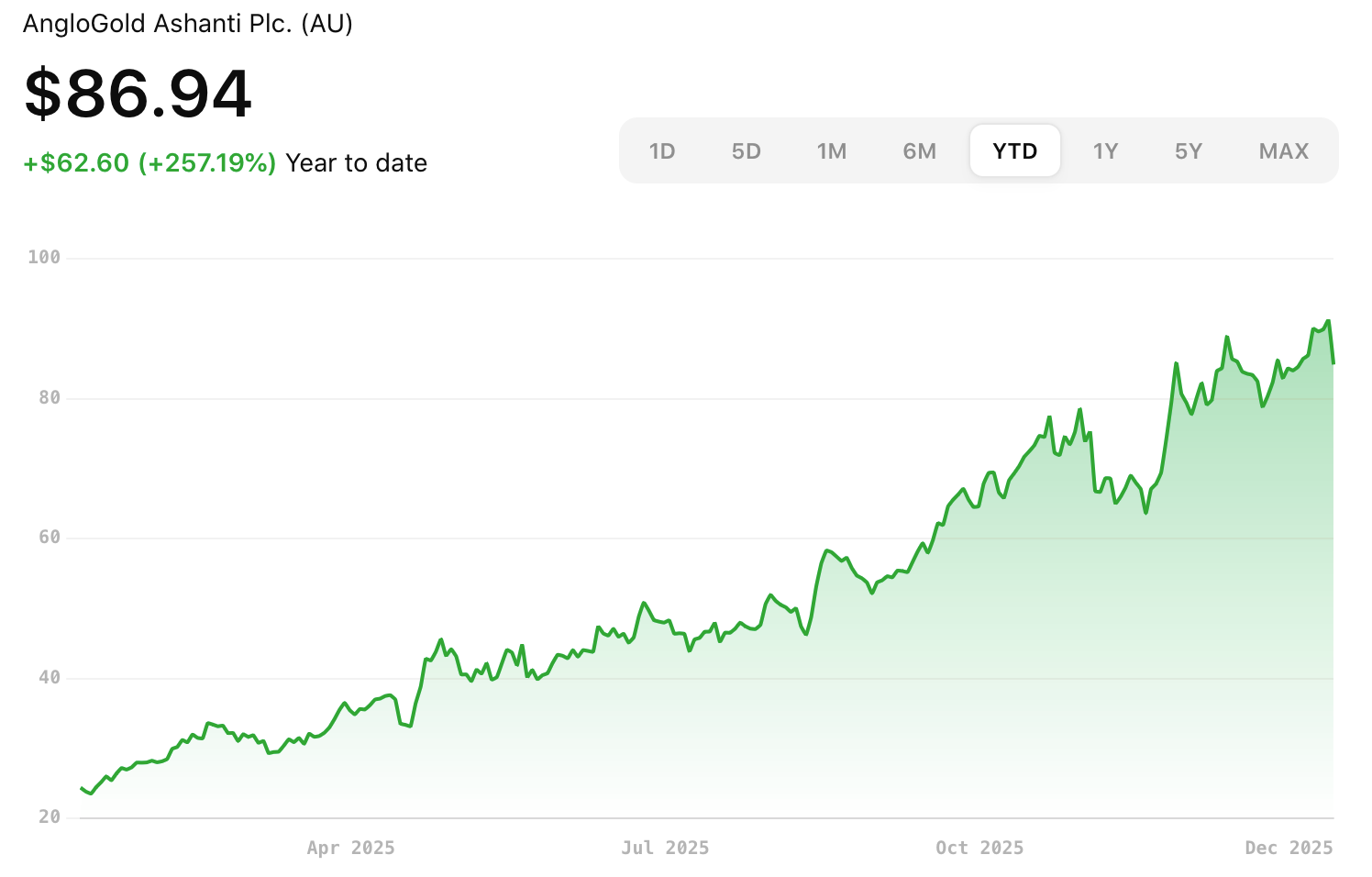
After years of restructuring, AU emerged lean, sharp, and positioned for a supercycle. When gold repriced globally, AU became one of the fastest climbers.
Why These Five Led the Charge
Each of the Big Five carried a different storyline — but all benefited from the same explosive mix:
Record-high metal prices
Years of underinvestment in new mines
Global resource nationalism
AI-driven energy demand pushing silver and copper into deficit
Central banks dumping dollars and hoarding gold
The majors had exactly what the world wanted: verified reserves, real production, and leverage to price.
But even with these extraordinary gains…
They were not the biggest wealth generators of 2025.
Not even close.
When the Juniors Started Throwing Off Generational Wealth
This is where fortunes exploded.
The junior miners — tiny explorers and near-term developers across Canada, Nevada, Mexico, Brazil, West Africa, and Australia — delivered the kinds of returns that most investors spend decades dreaming about.
All year long, the same story repeated:
A junior in the Yukon updated its resource estimate — and the market realized it was sitting on 3–5 million ounces priced suddenly at $4,400 gold instead of $1,300. The stock went up 10X.
A beaten-down Nevada developer finally secured its key permit — instantly becoming a takeover target. The stock went up 7X.
A silver developer in Mexico announced a series of monster drill holes — at the same time silver pierced $70. The stock went up 15X.
An obscure West African explorer hit a discovery hole that rewrote its entire geological model. The stock went up 20X.
These weren’t meme stocks.
They were geological lotteries — except the numbers were real, validated by assays, engineers, and feasibility studies.
A $10,000 position opened quietly in late 2024 was suddenly worth $25,000–$50,000 by Q4 2025.
Take a look at Apollo Silver (APGO):
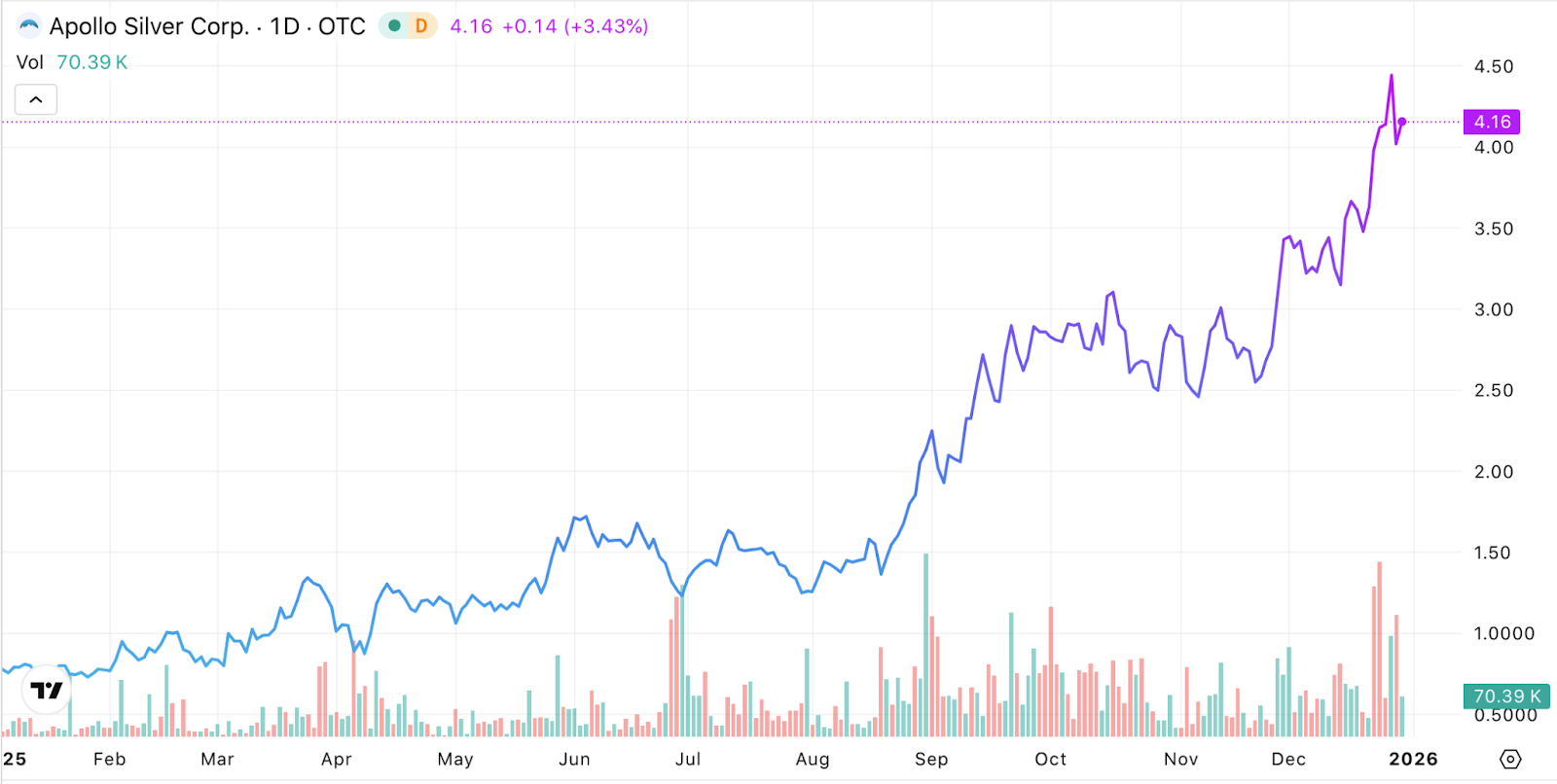
Apollo Silver is a junior we’ve been recommending for years. And if you bought it when we recommended it, you’re sitting on a small fortune.
This isn’t a marketing line. It’s the truth.
This is the math of leverage.
Why Juniors Outperform Majors in Every Gold Bull Market
Here’s the “explain it like I’m 5” version:
When gold rises, a major producer becomes more profitable.
When gold rises, a junior miner becomes more valuable — sometimes exponentially so.
That’s because juniors offer:
Unpriced ounces in the ground
Unpriced discovery potential
Unpriced future production
Huge takeover appeal to majors
If you’re a major like Newmont or Barrick, you must replace declining reserves.
But discovery takes 10–15 years.
Permitting can take a decade.
So what do you do?
You go shopping.
2025 saw:
Strategic investments
Buyout rumors
Royalty deals
Streaming agreements
And multiple takeover wars for high-grade assets
Every deal re-rated the entire junior sector higher.
2025 Was Not an Accident — It Was a Pressure Valve Blowing Open
Some analysts call 2025 a “one-off spike.”
They are catastrophically wrong.
The conditions that produced this mining boom are intensifying:
Global gold demand from central banks is still accelerating.
BRICS nations are openly shifting to gold-backed settlement systems.
AI and electrification are consuming metals faster than miners can produce them.
U.S. policy is now aggressively pro-mining after decades of stagnation.
Silver is in the worst structural deficit in over 30 years.
Copper supply has officially entered a multi-year shortage.
New gold discoveries are at a 50-year low.
If you blend these forces together…
2025 wasn’t a climax.
It was the ignition.
Conclusion: The First Great Stair-Step of a New Era
When historians look back, 2025 won’t be remembered as a peak.
It will be remembered as a beginning — the moment when:
The Big Five miners crushed the S&P by 16-to-1.
The market rediscovered real assets.
Gold became the world’s unofficial reserve currency again.
Silver reclaimed its role as the energy metal of the future.
Junior miners delivered generational wealth.
The AI boom got the headlines.
The miners got the money.
And this first stair-step — this breakout — is only the start of a multi-year revaluation of physical resources, monetary metals, and the companies that pull them from the earth.
2025 wasn’t a fluke.
It was the first chapter of a bull market that will define this decade.
Get to the good, green grass first…
The Prophet of Profit,

Brian Hicks
 Check us out on YouTube!
Brian is a founding member and President of Angel Publishing. He writes about general investment strategies for Wealth Daily and Energy and Capital. Brian is the managing editor and investment director of R.I.C.H Report (Retired Independent Carefree Healthy), New World Assets and Extreme Opportunities. For more on Brian, take a look at his editor’s page.
The Best Free Investment You'll Ever Make
We never spam! View our Privacy Policy
After getting your report, you’ll begin receiving the Wealth Daily e-Letter, delivered to your inbox daily.
Angel Publishing Investor Club Discord - Chat Now
Brian Hicks Premium
Introductory

Advanced


